


BRUSSELS, Belgium: EU leaders on Thursday tasked the European Commission to move ahead with options for funding Ukraine for two more years, leaving the door open for a mammoth loan using frozen Russian assets.
In broadly-worded conclusions adopted after marathon talks in Brussels, EU leaders stopped short of greenlighting plans for the 140-billion-euro ($162-billion) “reparations loan” — pushing that crunch decision to December.
But diplomats said the text was a step toward a potential agreement — though it was watered down in the face of strong objections from Belgium, where the bulk of the Russian central bank funds frozen after the 2022 invasion are held.
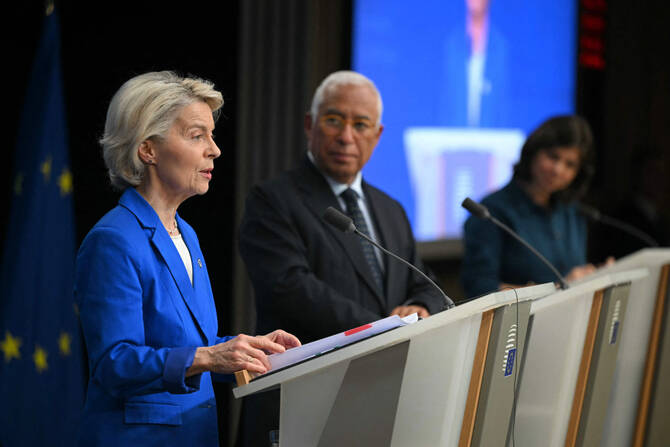
European Council President Antonio Costa said the bloc had “committed to ensure that Ukraine’s financial needs will be covered for the next two years.”
“Russia should take good note of this: Ukraine will have the financial resources it needs to defend itself,” he told a news conference.
The EU froze some 200 billion euros of Russian central bank assets after Moscow’s tanks rolled into Ukraine, and the European Commission has proposed using the funds to provide a huge loan to Kyiv — without seizing them outright.
Speaking beside Costa, Commission chief Ursula von der Leyen said there was still tough work ahead on the complex proposal.
“We agreed on the ‘What’ — that is, the reparations loan — and we have to work on the ‘How,’ how we make it possible,” she said.
Ukraine’s President Volodymyr Zelensky, who was in Brussels to shore up European support, welcomed the summit outcome as a signal of “political support” for the notion of using Russian assets to keep Kyiv in the fight.
‘Judicial questions’
The vast majority of the Russian funds is held in international deposit organization Euroclear, based in Belgium — the most vocal skeptic of a plan it fears could open it up to costly legal challenges from Russia.
The Brussels talks were focused largely on addressing those concerns.
Belgian Prime Minister Bart De Wever repeated demands for guarantees from all EU countries that they share the risk if Russia sues, and said other countries must also tap Moscow’s assets on their territory — threatening otherwise to block the plan.
“I’m only poor little Belgium, the only thing I can do is point out where the problems are and to gently ask solutions for the essential problem,” De Wever told reporters after the talks.
Belgium has not been alone however in raising concerns.
French President Emmanuel Macron acknowledged the plan “raises judicial questions, and questions over risk sharing” — while also saying it remained the best option for shoring up Ukraine these next two years.
The summit conclusions — adopted by all member states with the exception of Hungary, seen as Russia’s closest ally in the 27-nation bloc — did not mention the loan directly, instead inviting the commission “to present, as soon as possible, options for financial support.”
Still, a European diplomat described it as “a great success.”
Another diplomat said the compromise wording “does not close but does not rush” the sensitive matter of using Russian assets for Ukraine.
US oil sanctions
The EU talks were taking place a day after the bloc agreed a 19th package of sanctions on Russia and US President Donald Trump hit Moscow with sanctions on two oil majors, Rosneft and Lukoil.
Zelensky hailed the US sanctions as sending a “strong and much-needed message” to Russia — whose leader Vladimir Putin hit back insisting they would not significantly damage the country’s economy.
“Good, I’m glad he feels that way,” Trump told reporters at the White House when asked about Putin’s response. “I’ll let you know about it in six months from now. Let’s see how it all works out.”
The US measures represent a major stepping up of its actions against Russia and reflect Trump’s frustration at being unable to persuade Putin to end the conflict despite what he calls his personal chemistry with the Kremlin chief.
Zelensky said he hoped Trump’s shift on sanctions would also herald a change of mind on giving Ukraine long-range Tomahawk missiles — after Kyiv came away from a meeting in Washington empty-handed last week.
The EU sanctions package meanwhile saw the bloc bring forward a ban on the import of liquefied natural gas from Russia by a year to the start of 2027, and blacklist more than 100 extra tankers from Moscow’s so-called “shadow fleet” of aging oil vessels.


