

Met Police sack British officer over ‘racism’ revealed in BBC Panorama probe

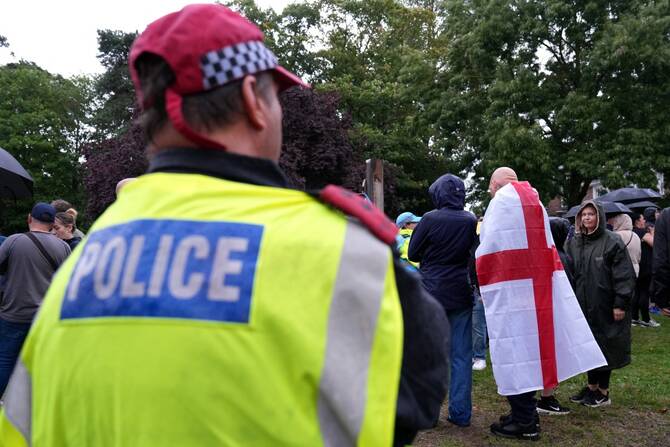
A Police Officer stands outside Epping District Council, as protestors take part in a demonstration calling for the closure of the Bell Hotel in Epping, northeast of London, after police charged an asylum-seeker with sexual offences, July 24, 2025. (AFP)
Short Url
Updated 23 October 2025
Follow

Met Police sack British officer over ‘racism’ revealed in BBC Panorama probe

  • Philip Neilson dismissed with immediate effect on Thursday after Met hearing upholds three allegations, including making ‘highly racist and discriminatory remarks’ about different ethnic groups
  • Neilson is the first of 10 current or former officers to face a hearing as part of the Metropolitan Police’s accelerated misconduct proceedings regarding footage recorded during the investigation

LONDON: A Metropolitan Police officer at Charing Cross police station in London has been sacked for gross misconduct after being secretly recorded in a BBC Panorama undercover investigation making racist comments and endorsing inappropriate force.

Philip Neilson was dismissed with immediate effect on Thursday after a Met hearing upheld three allegations against him, including making “highly racist and discriminatory remarks” about different ethnic groups.

Neilson was recorded by BBC undercover reporter Rory Bibb describing an “invasion” of “scum” from the Middle East, and making offensive remarks about individuals from Algeria and Somalia.

He is the first of 10 current or former officers to face a hearing as part of the Met Police’s accelerated misconduct proceedings regarding footage recorded during the Panorama investigation, according to the BBC.

The first allegation against Neilson involved glorifying the use of inappropriate force against a restrained detainee and promoting unlawful violence against migrants.

The second involved Neilson referring to Somalians as “scum” and claiming there was an invasion of the UK by migrants, comments the undercover reporter described as “floridly racist.”

Neilson was also recorded saying a detainee who had overstayed his visa stay in the UK should have a “bullet through his head.”

Commander Jason Prins, chair of the panel held in southwest London on Thursday, found all the allegations proven.

“It was or must have been obvious to him that the comments made were abhorrent,” Prins said. “The conduct of the officer is a disgrace.”

Neilson, who had worked for the Met Police for four years, denied being racist and said that the BBC undercover reporter had “breached his human rights.”

The officer acknowledged that the remarks were inappropriate, but argued that they only constituted misconduct, with some being made while he was intoxicated after consuming a large amount of alcohol.

A second police officer featured in BBC Panorama, Martin Borg, was also dismissed on Thursday after the Met’s panel upheld five out of eight allegations of gross misconduct against him.

The scandal is the second to affect Charing Cross police station in central London following the exposure of shocking messages exchanged by officers in 2022. Officers at the station were found by the Independent Office for Police Conduct to have joked about rape and domestic abuse, and also made racist comments in messages exchanged from 2016-2018, The Independent reported.


UN slams world’s ‘apathy’ in launching aid appeal for 2026

Updated 08 December 2025
Follow

UN slams world’s ‘apathy’ in launching aid appeal for 2026

  • ‘Prioritized’ plan to raise at least $23 billion to help 87 million people in the world’s most dangerous places such as Gaza and Ukraine

UNITED NATIONS, United States:  The United Nations on Monday hit out at global “apathy” over widespread suffering as it launched its 2026 appeal for humanitarian assistance, which is limited in scope as aid operations confront major funding cuts.

“This is a time of brutality, impunity and indifference,” UN humanitarian chief Tom Fletcher told reporters, condemning “the ferocity and the intensity of the killing, the complete disregard for international law, horrific levels of sexual violence” he had seen on the ground in 2025.

“This is a time when the rules are in retreat, when the scaffolding of coexistence is under sustained attack, when our survival antennae have been numbed by distraction and corroded by apathy,” he said.

He said it was also a time “when politicians boast of cutting aid,” as he unveiled a streamlined plan to raise at least $23 billion to help 87 million people in the world’s most dangerous places such as Gaza, Ukraine, Sudan, Haiti and Myanmar.

The United Nations would like to ultimately raise $33 billion to help 135 million people in 2026 — but is painfully aware that its overall goal may be difficult to reach, given US President Donald Trump’s slashing of foreign aid.

Fletcher said the “highly prioritized appeal” was “based on excruciating life-and-death choices,” adding that he hoped Washington would see the choices made, and the reforms undertaken to improve aid efficiency, and choose to “renew that commitment” to help.

The world body estimates that 240 million people in conflict zones, suffering from epidemics, or victims of natural disasters and climate change are in need of emergency aid.

‘Lowest in a decade’

In 2025, the UN’s appeal for more than $45 billion was only funded to the $12 billion mark — the lowest in a decade, the world body said.

That only allowed it to help 98 million people, 25 million fewer than the year before.

According to UN data, the United States remains the top humanitarian aid donor in the world, but that amount fell dramatically in 2025 to $2.7 billion, down from $11 billion in 2024.

Atop the list of priorities for 2026 are Gaza and the West Bank.

The UN is asking for $4.1 billion for the occupied Palestinian territories, in order to provide assistance to three million people.

Another country with urgent need is Sudan, where deadly conflict has displaced millions: the UN is hoping to collect $2.9 billion to help 20 million people.

In Tawila, where residents of Sudan’s western city of El-Fasher fled ethnically targeted violence, Fletcher said he met a young mother who saw her husband and child murdered.

She fled, with the malnourished baby of her slain neighbors along what he called “the most dangerous road in the world” to Tawila.

Men “attacked her, raped her, broke her leg, and yet something kept her going through the horror and the brutality,” he said.

“Does anyone, wherever you come from, whatever you believe, however you vote, not think that we should be there for her?”

The United Nations will ask member states top open their government coffers over the next 87 days — one day for each million people who need assistance.

And if the UN comes up short, Fletcher predicts it will widen the campaign, appealing to civil society, the corporate world and everyday people who he says are drowning in disinformation suggesting their tax dollars are all going abroad.

“We’re asking for only just over one percent of what the world is spending on arms and defense right now,” Fletcher said.

“I’m not asking people to choose between a hospital in Brooklyn and a hospital in Kandahar — I’m asking the world to spend less on defense and more on humanitarian support.”