

Pakistan begins refunding $12.4 million in Hajj 2025 savings to pilgrims

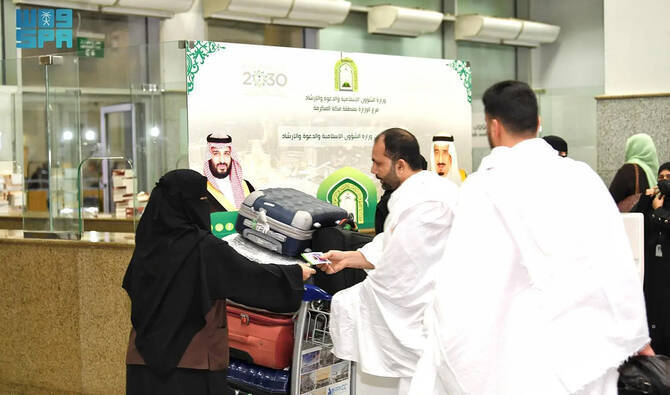
Pakistani Hajj pilgrims arrive at the King Abdulaziz International Airport in Jeddah, Saudi Arabia, on May 30, 2024. (SPA/File)
Short Url
Updated 23 October 2025
Follow

Pakistan begins refunding $12.4 million in Hajj 2025 savings to pilgrims

  • Hajj refunds will be transferred directly to pilgrims’ bank accounts via their respective bank branches, says religion ministry
  • Religious affairs ministry reminds pilgrims second installment of Hajj 2026 must be deposited at designated banks from Nov. 3-15

ISLAMABAD: Pakistan’s religious affairs ministry announced on Thursday that the government has started the process of refunding savings from Hajj 2025 back to pilgrims, saying that an amount of Rs3.5 billion [$12.4 million] will be refunded by Oct. 31. 

Pakistan’s government offers refunds to Hajj pilgrims from the amount it saves on the cost of the annual Islamic pilgrimage. In a press release, the religious affairs ministry said the refunds will be transferred directly to the pilgrims’ bank accounts via their respective bank branches. 

Saudi Arabia granted Pakistan a total quota of 179,210 pilgrims for Hajj last year. Typically, this national quota is evenly split between government-run and private schemes. 

“The process of refunding the savings from Hajj 2025 has also commenced,” the religious affairs ministry announced. “A total of PKR 3.5 billion ($12.4 million) will be refunded to pilgrims of Hajj 2025.”

The ministry said that the difference in refund amounts is primarily due to variations in accommodation costs in the different zones of Mina and Makkah. It gave a breakdown of the refund numbers:

Around 25% of the total pilgrims, which amount to 21,895, will not get any refund.  

A total of 14% of the pilgrims, 12,286, will receive Rs12,000 each [$42.60] while 13,939 pilgrims will receive Rs25,000 [$88.75] each and 10% of the total pilgrims, amounting to 8,496, will receive Rs48,000 [170.4] each. 

Around 23% of the total pilgrims, 20,302, will receive Rs75,000 [$266.25] each, 12% of the total pilgrims, 10,945, will receive Rs90,000 [$319.50] each and 408 pilgrims will reach receive Rs110,000 [$390.50] each. 

Pakistan has been allocated the same quota of 179,210 pilgrims for Hajj 2026. Of these, around 118,000 seats have been allocated to the government scheme and the rest to private tour operators. The religious affairs ministry noted that this year, an additional quota of 30,000 pilgrims has been issued for the government scheme.

It reminded prospective pilgrims that the second installment of Hajj 2026 must be deposited at the designated banks between Nov. 3-15, adding that each pilgrim will be notified through the official “Pak Hajj” mobile application.

The cost for the Long Hajj Package (40 days) has been set at Rs1,150,000 [$4,094], while the short Hajj package, with a duration of 25 days, will cost pilgrims Rs1,200,000 [$4,272].


Pakistani legislator says tax authority open to reviewing high smartphone import levies

Updated 5 sec ago
Follow

Pakistani legislator says tax authority open to reviewing high smartphone import levies

  • Current tax regime adds substantial cost to imported phones, making devices hard to afford
  • Calls for reform have grown in recent months alongside the wider debate on digital inclusion

ISLAMABAD: Pakistan may be open to lowering the high import taxes charged on smartphones, a move that could reduce device prices for millions of users, after a legislator campaigning for reform said on Tuesday the Federal Board of Revenue (FBR) would not oppose a reduction if the ministry of finance’s Tax Policy Office recommended one.

Imported phones in Pakistan are subject to heavy duties, sales tax and registration fees that can add hundreds of dollars to the final price, with high-end devices often costing significantly more than their retail value abroad. The government has long argued the levy is designed to regulate imports and curb grey-market phones, but critics say the policy restricts digital access, education and e-commerce for ordinary citizens.

Member of Parliament Kasim Gilani has been publicly challenging the tax regime for weeks.

“Chairman FBR has stated that if the Tax Policy Office of the Finance Ministry recommends a reduction in PTA tax, FBR will have no objection to rationalizing the tax percentage. A major development for smartphone users across Pakistan,” Gilani posted on X.

https://x.com/KasimGillani/status/1998356129735426552?s=20

The government, Pakistan Telecommunication Authority (PTA) and FBR have not yet issued a public confirmation of Gilani’s X post.

The so-called PTA tax, widely referred to by consumers using the name of the national telecom regulator, is in practice a series of federal charges collected on imported devices, particularly those brought into Pakistan from abroad or by returning expatriates. Registration fees for users who activate foreign-purchased phones locally can also significantly raise costs.

Calls for reform have grown in recent months alongside the wider debate on digital inclusion. Pakistan’s population is overwhelmingly young, with over 60 percent under the age of 30, and smartphones are now central to banking, online education and gig-economy work. Reducing the levy could expand access to Internet-enabled devices, but it could also reduce revenue unless phased or redesigned.

No formal reduction has been announced yet, and any change would require approval from the ministry of finance and relevant tax bodies. However, Gilani’s statement suggests a potential shift if policymakers conclude that lower duties could boost adoption, compliance and long-term digital growth.