

Pakistan unveils electricity subsidy for industry, farmers amid IMF-backed energy overhaul

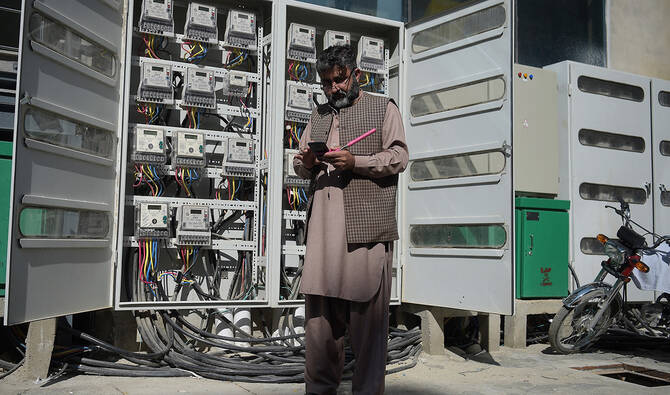
Muhammad Noshad, a Pakistani employee of the state-run Islamabad Electric Supply Company (IESCO), takes a meter reading with his smartphone at a commercial building in Islamabad on November 7, 2018. (AFP/ file)
Short Url
Updated 23 October 2025
Follow

Pakistan unveils electricity subsidy for industry, farmers amid IMF-backed energy overhaul

  • New ‘Roshan Maeeshat’ initiative to provide electricity at Rs22.98 ($0.08) per unit till 2028
  • PM says reduced tariffs aim to spur exports and job creation without burdening households

ISLAMABAD: Pakistan on Thursday unveiled a three-year electricity subsidy for its industrial and agricultural sectors, offering power at Rs22.98 ($0.08) per unit under a new “Roshan Maeeshat Bijli Package,” the prime minister’s office said. 

The plan aims to boost exports, create jobs, and revive economic growth, even as Islamabad pursues IMF-mandated energy reforms to reduce losses and phase out untargeted subsidies.

Under the package, industries and farmers will receive additional electricity at reduced rates from November 2025 to October 2028. Existing tariffs of Rs34 ($0.12) per unit for industry and Rs38 ($0.14) for agriculture will be lowered to Rs22.98 ($0.08) to make Pakistani products more competitive in regional markets.

“The electricity supplied under the Roshan Maeeshat Bijli Package will not place any burden on households or other sectors,” Sharif was quoted as saying in a statement released by his office, adding that economic revival and job creation required relief for productive industries and farmers.

He called the initiative “a timely measure to strengthen Pakistan’s economy and ensure growth in exports and employment,” saying industrial and agricultural growth was key to reducing the country’s debt dependency.

During last winter’s pilot phase of the package, industries and farmers consumed an additional 410 gigawatt-hours of power, helping boost production and exports while creating new employment opportunities, according to official data.

“By supporting our farmers and industries with affordable energy, we will accelerate growth and move toward self-reliance,” Sharif said, adding that with continued efforts from the government’s economic team and the business community, Pakistan would achieve “full economic sovereignty in the near future.”

Pakistan’s energy sector remains one of its biggest economic challenges, marked by high generation costs, heavy subsidies and a mounting “circular debt” that stood at about Rs2.396 trillion ($8.6 billion) by end-March 2025.

Under the 37-month, $7 billion IMF Extended Fund Facility approved in September 2024, Islamabad committed to restoring cost recovery in the power sector, cutting line losses, and phasing out untargeted energy subsidies. The Fund has repeatedly urged Pakistan to align tariffs with actual supply costs and limit fiscal support to targeted, time-bound relief programs.

To ease financial pressures on state-run power distributors, the government secured a Rs1.275 trillion ($4.6 billion) syndicated financing deal with local banks in June 2025 to offset part of the debt.

With industrial growth constrained by repeated tariff hikes and erratic power supply, business groups have long warned that high energy costs make Pakistani goods uncompetitive in global markets.


Pakistan says it seized 32 square kilometers inside Afghanistan as border clashes escalate

Updated 6 sec ago
Follow

Pakistan says it seized 32 square kilometers inside Afghanistan as border clashes escalate

  • Security official describes ‘limited tactical action’ in Gudwana after Afghan assaults
  • Islamabad accuses Kabul of sheltering militants as UN, China and Russia urge restraint

ISLAMABAD: Pakistan has seized a 32-square-kilometer area inside Afghanistan following overnight fighting, a security official said on Saturday, as cross-border clashes between the two countries escalated sharply.

A Pakistani security official, speaking on condition of anonymity, said troops carried out a “limited tactical action” in the Gudwana area opposite the Zhob sector along the frontier, capturing Afghan territory after responding to attacks on Pakistani positions.

“On the night of Feb. 26/27, posts opposite the Zhob sector launched anticipated physical attacks on multiple Pakistani positions,” the official said, referring to fighters linked to Afghanistan’s Taliban authorities, whom Islamabad identifies as Tehreek-e-Taliban Afghanistan (TTA).

“In response to aggressive unprovoked fire and physical attacks, Pakistan security forces launched a limited tactical action on the night of Feb. 27/28 in the general area of Gudwana with a view to capture TTA Tahir Post,” he continued, adding that 32 square kilometers of Afghan territory were seized.

The official said special combat teams crossed the border after preparatory bombardment, supported by intelligence, surveillance and reconnaissance assets providing “real-time battlefield awareness.”

He said 24 Afghan Taliban fighters were killed and 37 wounded, with no Pakistani casualties reported.

The claims could not be independently verified, and there was no immediate confirmation from Taliban authorities in Kabul of any territorial loss in the Gudwana area.

The latest clashes erupted after Pakistani airstrikes targeted what Islamabad described as militant hideouts inside Afghanistan over the weekend, triggering retaliatory fire along the frontier and sharply escalating long-running tensions. Islamabad accuses Kabul of sheltering Pakistani Taliban militants responsible for attacks inside Pakistan, an allegation that Afghanistan denies.

Pakistan’s Information Minister Attaullah Tarar said on Saturday evening that 352 Afghan Taliban fighters had been killed and more than 535 wounded since the latest phase of hostilities began.

Tarar said Pakistani strikes had destroyed 130 check posts, 171 tanks and armored vehicles and targeted 41 locations across Afghanistan by air. Those figures could not be independently verified.

The United Nations, as well as China and Russia, have called for restraint.

The United States said Pakistan has the right to defend itself against cross-border militancy.