

Pakistan unveils electricity subsidy for industry, farmers amid IMF-backed energy overhaul

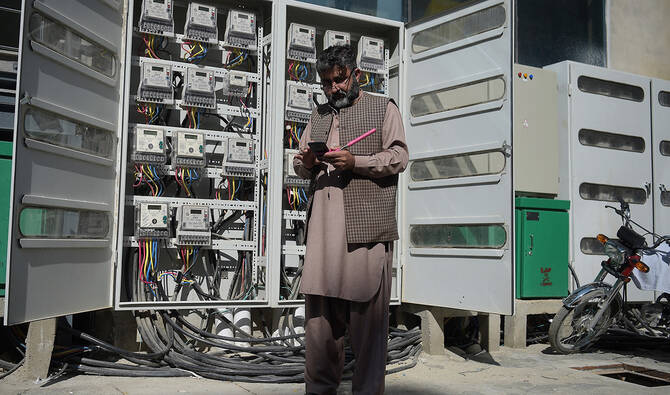
Muhammad Noshad, a Pakistani employee of the state-run Islamabad Electric Supply Company (IESCO), takes a meter reading with his smartphone at a commercial building in Islamabad on November 7, 2018. (AFP/ file)
Short Url
Updated 23 October 2025
Follow

Pakistan unveils electricity subsidy for industry, farmers amid IMF-backed energy overhaul

  • New ‘Roshan Maeeshat’ initiative to provide electricity at Rs22.98 ($0.08) per unit till 2028
  • PM says reduced tariffs aim to spur exports and job creation without burdening households

ISLAMABAD: Pakistan on Thursday unveiled a three-year electricity subsidy for its industrial and agricultural sectors, offering power at Rs22.98 ($0.08) per unit under a new “Roshan Maeeshat Bijli Package,” the prime minister’s office said. 

The plan aims to boost exports, create jobs, and revive economic growth, even as Islamabad pursues IMF-mandated energy reforms to reduce losses and phase out untargeted subsidies.

Under the package, industries and farmers will receive additional electricity at reduced rates from November 2025 to October 2028. Existing tariffs of Rs34 ($0.12) per unit for industry and Rs38 ($0.14) for agriculture will be lowered to Rs22.98 ($0.08) to make Pakistani products more competitive in regional markets.

“The electricity supplied under the Roshan Maeeshat Bijli Package will not place any burden on households or other sectors,” Sharif was quoted as saying in a statement released by his office, adding that economic revival and job creation required relief for productive industries and farmers.

He called the initiative “a timely measure to strengthen Pakistan’s economy and ensure growth in exports and employment,” saying industrial and agricultural growth was key to reducing the country’s debt dependency.

During last winter’s pilot phase of the package, industries and farmers consumed an additional 410 gigawatt-hours of power, helping boost production and exports while creating new employment opportunities, according to official data.

“By supporting our farmers and industries with affordable energy, we will accelerate growth and move toward self-reliance,” Sharif said, adding that with continued efforts from the government’s economic team and the business community, Pakistan would achieve “full economic sovereignty in the near future.”

Pakistan’s energy sector remains one of its biggest economic challenges, marked by high generation costs, heavy subsidies and a mounting “circular debt” that stood at about Rs2.396 trillion ($8.6 billion) by end-March 2025.

Under the 37-month, $7 billion IMF Extended Fund Facility approved in September 2024, Islamabad committed to restoring cost recovery in the power sector, cutting line losses, and phasing out untargeted energy subsidies. The Fund has repeatedly urged Pakistan to align tariffs with actual supply costs and limit fiscal support to targeted, time-bound relief programs.

To ease financial pressures on state-run power distributors, the government secured a Rs1.275 trillion ($4.6 billion) syndicated financing deal with local banks in June 2025 to offset part of the debt.

With industrial growth constrained by repeated tariff hikes and erratic power supply, business groups have long warned that high energy costs make Pakistani goods uncompetitive in global markets.


Pakistan, Qatar resolve to boost strategic, economic cooperation at Doha talks

Updated 25 sec ago
Follow

Pakistan, Qatar resolve to boost strategic, economic cooperation at Doha talks

  • Both countries urge dialogue on Afghanistan amid renewed border tensions between Islamabad and Kabul
  • Discussions focus on bilateral trade and investment, energy, defense, manpower and labor and culture

ISLAMABAD: Pakistan and Qatar on Tuesday agreed to deepen their strategic and economic cooperation during high-level talks between Prime Minister Shehbaz Sharif and his Qatari counterpart Sheikh Mohammed bin Abdulrahman bin Jassim Al Thani, Sharif’s office said.

Sharif visited Qatar along with a high-level delegation on the invitation of Qatari emir Sheikh Tamim bin Hamad Al Thani. The Pakistan premier also held meetings with Qatar’s trade and defense minister to discuss cooperation in various domains.

The visit came at a time when Pakistan is seeking closer economic engagement with Gulf partners amid its broader push to stabilize the economy and attract investment, while maintaining security and defense cooperation with key regional states.

During their meeting in Doha, PM Sharif and Qatar’s Sheikh Mohammed discussed bilateral relations and exchanged views on regional and international developments, according to the Pakistan prime minister’s office.

“They reaffirmed the strong brotherly relations between Pakistan and Qatar and expressed satisfaction at the growing momentum in political, economic and institutional ties,” Sharif’s office said.

“Discussions focused on enhancing cooperation in the fields of trade and investment, energy, defense, manpower and labor and culture, with both sides stressing the importance of their task force to accelerate cooperation in all these areas.”

Pakistan and Qatar maintain strong trade and investment ties. In 2022, the office of Qatar’s emir said the Qatar Investment Authority planned to invest $3 billion in Pakistan, targeting sectors including transport, aviation, education, health, media, technology and labor.

Nearly 300,000 Pakistanis live and work in Qatar, according to Pakistan’s foreign office, with many employed in health, education, engineering and public services, as well as construction and transport. The two countries engage through forums such as the Bilateral Political Consultations and the Joint Ministerial Commission.

Sharif said he had productive discussions with Qatar’s emir Sheikh Tamim bin Hamad Al Thani on how the two sides could transform their brotherly ties into mutually beneficial economic relationships. 

“We also took stock of the regional situation,” he said. “Pakistan and Qatar will continue to work together for peace and stability in the region and beyond.”

Prime Minister Shehbaz Sharif (second right) meets the Qatari Emir Qatar’s emir Sheikh Tamim bin Hamad Al Thani (left) in Doha, Qatar, on February 24, 2026. (PID)

DIALOGUE WITH AFGHANISTAN

Earlier, Sharif and Qatar’s Deputy PM Sheikh Saoud Al-Thani discussed the situation in Afghanistan and called for dialogue to support regional stability.

The meeting took place amid renewed tensions after Islamabad carried out airstrikes last week on what it described as Tehreek-e-Taliban Pakistan (TTP) targets inside Afghanistan. Kabul said the strikes killed civilians and vowed to respond to what it called a violation of its sovereignty.

“Regional developments were also discussed, in particular the situation in Iran and Afghanistan,” Sharif’s office said in a statement. “Both sides emphasized the importance of dialogue, de-escalation and collective efforts to promote peace and stability in the region.”

This was the second time in less than six months that Pakistan conducted airstrikes in Afghanistan. The last strikes triggered heavy, weeklong clashes between the neighbors along their border before Qatar and Turkiye mediated a ceasefire between them in Oct. last year.

Separately, Sharif held meetings with Qatar’s State Minister for Trade Dr. Ahmed bin Mohammed Al-Sayed and a delegation of the Qatar Businessmen Association (QBA), highlighting Pakistan’s investment-friendly reforms.

He invited QBA members to explore opportunities in infrastructure, logistics, energy, agriculture, technology and export-oriented manufacturing, his office said.