LONDON: The only British soldier ever charged in the 1972 Bloody Sunday massacre will learn his fate Friday in a Northern Ireland courtroom.
Judge Patrick Lynch is due to deliver his verdict in Belfast Crown Court on whether the former paratrooper identified only as Soldier F committed murder and attempted murder in the deadliest shooting of the three decades of sectarian violence known as “The Troubles.”
Prosecutors said the lance corporal, who has not been named to protect him from retaliation, killed two people and tried to kill five others when he and other troops fired at fleeing unarmed civilians on Jan. 20, 1972, in Londonderry, also known as Derry.
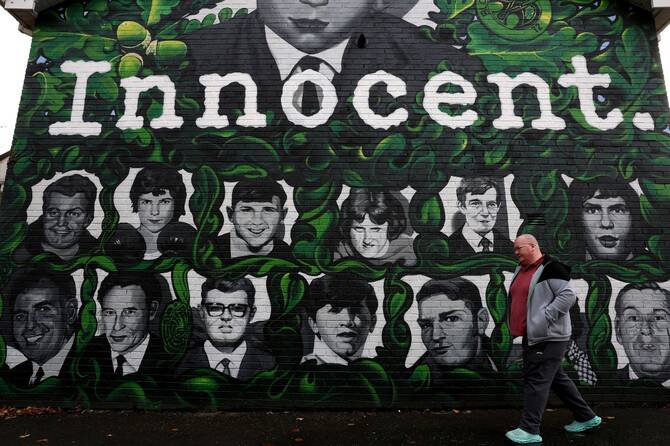
Thirteen people were killed and 15 were wounded in the event that has come to symbolize the conflict between mainly Catholic supporters of a united Ireland and predominantly Protestant forces that wanted to remain part of the United Kingdom.
While the violence largely ended with the 1998 Good Friday peace accord, tensions remain. Families of civilians killed continue to press for justice, while supporters of army veterans complain that their losses have been downplayed and that they have been unfairly targeted in investigations.
Soldier F, who was shrouded from view in court by a curtain, did not testify in his defense and his lawyer presented no evidence. The soldier told police during a 2016 interview that he had no “reliable recollection” of the events that day but was sure he had properly discharged his duties as a soldier.
Defense lawyer Mark Mulholland attacked the prosecution’s case as “fundamentally flawed and weak” for relying on soldiers he dubbed “fabricators and liars,” and the fading memories of survivors who scrambled to avoid live gunfire that some mistakenly thought were rounds of rubber bullets.
Surviving witnesses spoke of the confusion, chaos and terror as soldiers opened fire and bodies began falling after a large civil rights march through the city.
The prosecution relied on statements by two of Soldier F’s comrades — Soldier G, who is dead, and Soldier H, who refused to testify. The defense tried unsuccessfully to exclude the hearsay statements because they could not be cross-examined.
Prosecutor Louis Mably argued that the soldiers, without justification, had all opened fire, intending to kill, and thus shared responsibility for the casualties.
The killings were a source of shame for a British government that had initially claimed that members of a parachute regiment fired in self-defense after being attacked by gunmen and people hurling fuel bombs.
A formal inquiry cleared the troops of responsibility, but a subsequent and lengthier review in 2010 found soldiers shot unarmed civilians fleeing and then lied in a cover-up that lasted decades.
Then-Prime Minister David Cameron apologized and said the killings were “unjustified and unjustifiable.”
The 2010 findings cleared the way for the eventual prosecution of Soldier F, though delays and setbacks kept it from coming to trial until last month.
Soldier F has pleaded not guilty to two counts of murder for the deaths of James Wray, 22, and William McKinney, 27, and five counts of attempted murder for the shootings of Joseph Friel, Michael Quinn, Joe Mahon, Patrick O’Donnell, and for opening fire at unarmed civilians.


![]()

Judge to rule in 1972 Bloody Sunday murder case against former British soldier
Short Url
https://arab.news/y99rp
Judge to rule in 1972 Bloody Sunday murder case against former British soldier
- Prosecutors said the lance corporal, who has not been named to protect him from retaliation, killed two people and tried to kill five others when he and other troops fired at fleeing unarmed civilians on Jan. 20, 1972, in Londonderry, also known as Derry


Latest updates






© 2026 SAUDI RESEARCH & PUBLISHING COMPANY, All Rights Reserved And subject to Terms of Use Agreement.