WASHINGTON: The White House on Thursday announced that construction on a massive, new $200 million ballroom will begin in September and be ready before President Donald Trump ‘s term ends in early 2029.
It will be the latest change introduced to what’s known as “The People’s House” since the Republican president returned to office in January. It also will be the first structural change to the Executive Mansion itself since the addition of the Truman balcony in 1948.
Trump has substantially redecorated the Oval Office through the addition of golden flourishes and cherubs, presidential portraits and other items, and installed massive flagpoles on the north and south lawns to fly the American flag. Workers are currently finishing up a project to replace the lawn in the Rose Garden with stone.
Trump for months has been promising to build a ballroom, saying the White House doesn’t have space big enough for large events and scoffing at the notion of hosting heads of state and other guests in tents on the lawn as past administrations have done for state dinners attended by hundreds of guests.
The East Room, the largest room in the White House, can accommodate about 200 people.
Trump said he’s been planning the construction for some time.
“They’ve wanted a ballroom at the White House for more than 150 years but there’s never been a president that was good at ballrooms,” Trump told reporters Thursday. “I’m good at building things and we’re going to build quickly and on time. It’ll be beautiful, top, top of the line.”
He said the new ballroom would not interfere with the mansion itself.
“It’ll be near it but not touching it and pays total respect to the existing building, which I’m the biggest fan of,” he said of the White House. “It’s my favorite. It’s my favorite place. I love it.”
Trump said the ballroom will serve administrations to come.
“It’ll be a great legacy project,” he said. “I think it will be really beautiful.”
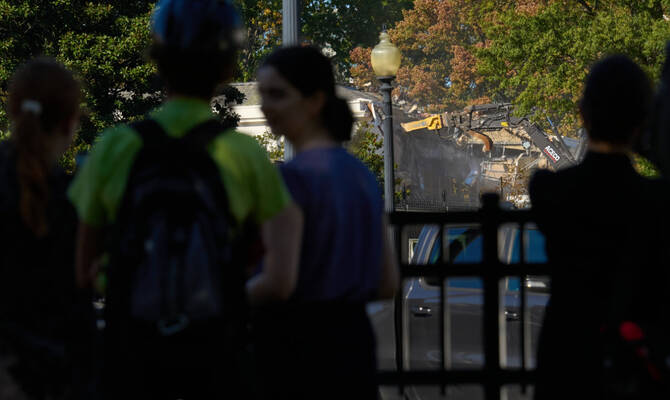
The 90,000-square-foot ballroom will be built where the East Wing sits with a seated capacity of 650 people. The East Wing houses several offices, including the first lady’s. Those offices will be temporarily relocated during construction and that wing of the building will be modernized and renovated, said White House press secretary Karoline Leavitt.
White House chief of staff Susie Wiles said the president, whose early career was in real estate and construction, and his White House are “fully committed” to working with the appropriate organizations to preserve the mansion’s “special history.”
“President Trump is a builder at heart and has an extraordinary eye for detail,” Wiles said in a statement.
Leavitt said at her briefing Thursday that Trump and other donors have committed to raising the approximately $200 million in construction costs. She did not name any of the other donors.
Renderings of what the future ballroom will look like were posted on the White House website.
The president chose McCrery Architects, based in Washington, as lead architect on the project. The construction team will be led by Clark Construction. Engineering will be provided by AECOM.
Trump also has another project in mind. He told NBC News in an interview that he intends to replace what he said was a “terribly” remodeled bathroom in the famous Lincoln Bedroom with one that is closer in style to the 19-th century.


![]()

White House announces new $200m ballroom as part of Trump’s latest makeover of ‘The People’s House’
Short Url
https://arab.news/jsky7
White House announces new $200m ballroom as part of Trump’s latest makeover of ‘The People’s House’
- The 90,000-square-foot ballroom will be built where the East Wing sits with a seated capacity of 650 people


Latest updates


Recommended


© 2026 SAUDI RESEARCH & PUBLISHING COMPANY, All Rights Reserved And subject to Terms of Use Agreement.