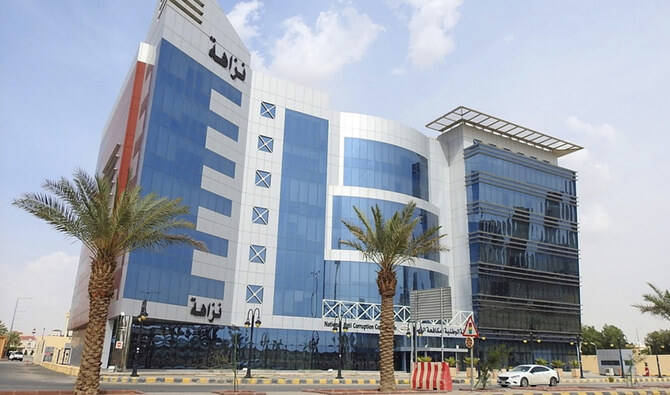

RIYADH: Saudi Arabia’s anti-corruption authority has arrested government employees taking bribes in exchange for awarding contracts, overlooking violations and issuing licenses, among other offenses, the Saudi Press Agency reported on Tuesday evening.
An employee working at the Ministry of Industry and Mineral Resources was arrested for receiving SR1.6 million ($433,285) in exchange for unlawfully issuing a quarry license for a company owned by a resident foreign investor, who was also arrested.
A Saudi citizen was arrested for receiving SR85,000 in exchange for canceling a demolition order issued against a plot of agricultural land that had no ownership deed.
Two more employees working at the municipality of the same region were also detained for receiving sums of money in exchange for halting demolition orders.
Another employee working at a local municipality, which was not identified, was arrested for receiving SR195,000 in exchange for unlawfully awarding a tender to an unnamed commercial entity.
In another case, the director of a desalination plant was suspended for receiving SR35,000 from a commercial entity contracted with the plant in exchange for not recording violations committed by that entity.
A municipality employee received a sum of SR30,000 out of an agreed total of SR240,000 in exchange for facilitating the unlawful disbursement of SR8,303,000 in financial dues to a commercial entity, for which they were arrested.
A non-commissioned officer working at the General Directorate of Civil Defense received SR10,430 in exchange for unlawfully issuing a permit to a commercial establishment, and was suspended.
An employee working at a government hospital was suspended for embezzling SR12,000 belonging to a catering company contracted to provide meals for the hospital.
One non-commissioned officer working at the Ministry of Defense was suspended for receiving sums of money from female citizens in exchange for promising to employ them at the ministry.
An employee at one of the Kingdom’s regional emirates was suspended after receiving a sum of money in exchange for facilitating the procedures of a marriage transaction for a resident.
Nazaha also announced the arrest of an employee working at a regional enforcement court for receiving a sum of money in exchange for removing a citizen’s name from the service suspension list.
An employee of the Zakat, Tax and Customs Authority was suspended for misappropriating several items that had been confiscated by customs at his work location.
A municipality employee was arrested for accepting airline tickets for himself and his family from a resident working for a company contracted with the municipality (who was also arrested), in return for expediting payment processes.
A municipality market inspector was suspended for conducting inspections at a commercial establishment and illegally taking SR7,500 along with various tobacco products without any legal authority to do so.
A Ministry of Human Resources and Social Development employee was suspended for receiving payment from a business in exchange for not issuing a regulatory violation against it.
A resident working at a health complex affiliated with the Ministry of Health was arrested for receiving payment for promising to issue a health care practice license without the test being taken.
A Ministry of Hajj and Umrah employee was arrested for accepting payment to refrain from canceling a hotel’s operating permit.
Nazaha also arrested a Saudi Electricity Company employee for receiving payment to illegally connect electrical service to a site.
The authority’s spokesperson emphasized its commitment to detecting and apprehending anyone who misappropriates public funds or abuses their position for personal benefit or to harm the public interest.
Such individuals will be held accountable even after their employment has ended, as financial and administrative corruption offenses have no statute of limitations.