

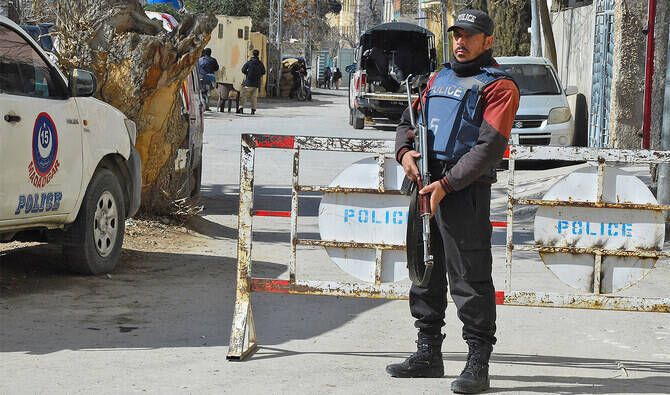
Two Pakistan police officers killed in drive-by shooting in restive Balochistan

Policeman stands guard in Quetta, Pakistan, on February 5, 2024. (AFP/File)
Short Url
Updated 22 October 2025
Follow

Two Pakistan police officers killed in drive-by shooting in restive Balochistan

  • Separately, security forces kill militant, destroy hideouts in northwest amid nationwide violence surge 
  • Islamabad has accused India and Afghanistan of supporting militants, both countries deny allegations

QUETTA: Two policemen were killed in a drive-by shooting in Pakistan’s southwestern Balochistan province, police said on Wednesday, as insurgents stepp up attacks in the resource-rich region bordering Afghanistan and Iran.

The shooting underscores the worsening security situation in Balochistan — Pakistan’s largest but least-developed province — where separatist and other militant groups have intensified assaults on police and security forces in recent months, targeting officials and infrastructure linked to the multibillion-dollar China-Pakistan Economic Corridor (CPEC).

The latest attack took place in Killi Ghareeb Abad near the Nushki city bypass, close to the Afghan border. It was the second assault on police in Balochistan’s Rakhshan division in less than a week, following the killing of senior officer Muhammad Qasim in Kharan district on Friday.

“Unknown armed men riding on a motorbike targeted the policemen identified as Ubaid Ullah and Abdul Razzaq who were going to perform their duties,” Nushki Station House Officer Zaheer Baloch told Arab News. “We have initiated an investigation and a search operation has started to hunt down the attackers.”

No group has claimed responsibility.

Balochistan, home to vast mineral reserves and key CPEC routes, has seen several major incidents this year, including the hijacking of a passenger train in March and a suicide bombing in Khuzdar in May that killed several children traveling to school.

Meanwhile, Pakistan’s security forces killed a militant in an operation in the northwestern Khyber Pakhtunkhwa (KP) province, destroying several hideouts and tunnels used by insurgents, state broadcaster Radio Pakistan reported.

The intelligence-based operation in the Shahi Tangi forest of Bajaur district led to an intense exchange of fire in which several militants were injured but managed to flee, the report said.

“During the operation, weapons, explosive materials and communication equipment used by Khwarij were also recovered,” Radio Pakistan said. 

Militant attacks across KP have surged since November 2022, when a fragile truce between the Pakistani Taliban, known as Tehreek-e-Taliban Pakistan (TTP), and Islamabad collapsed.

In recent months, Pakistan has accused India of supporting anti-state groups and Afghanistan of allowing its territory to be used for cross-border attacks. Both New Delhi and Kabul deny the allegations.


Pakistan’s Mahnoor Omer named among TIME’s ‘Women of the Year’ for 2026

Updated 01 March 2026
Follow

Pakistan’s Mahnoor Omer named among TIME’s ‘Women of the Year’ for 2026

  • Omer moved a Pakistani court against the so-called ‘period tax’ in Sept. 2025 which has since sparked a national debate
  • Taxes on sanitary pads in Pakistan can add up to 40 percent to retail price, UNICEF says only around 12 percent women use such products

ISLAMABAD: Pakistani women’s rights activist Mahnoor Omer, who fought against taxes on menstrual products, has been named among the TIME magazine’s ‘Women of the Year’ for 2026.

Omer’s efforts have been recognized alongside 16 activists, artists, athletes and businesswomen in the TIME’s Women of the Year 2026 list, including Olympic gold medalist Sydney McLaughlin-Levrone and Oscar-nominated filmmaker Chloe Zhao.

Dissatisfied with the efforts to educate Pakistani girls about sexual violence, Omer founded the Noor Foundation at the age of 14 and held her own workshops with village girls about everything from climate change to menstruation, according to the TIME magazine.

Two years later, a conversation with a domestic worker about the price of pads made her realize that not everyone could afford these essentials. She moved a court against the so-called “period tax” in Sept. 2025 and the case has sparked a national debate on the subject, considered a taboo by many in Pakistan, since its first hearing late last year.

“A decade and one law degree after her interest in activism was sparked, Omer, now 25, is putting her passion and expertise to work in the name of gender equity,” TIME wrote about Omer on its website.

Taxes imposed on sanitary products in Pakistan can add up to 40 percent to the retail price. UNICEF estimates just 12 percent of women in the country use commercially produced pads or tampons. The alternative, using cloth, risks health impacts including rashes and infections, and can make it impossible for girls to attend school while menstruating.

Omer’s suit, which awaits the government response, has sparked a national discussion. She says she spoke about menstruation to her father and male cousins, who thanked her for standing up for their daughters.
The 25-year-old, who is currently enrolled in a master’s degree in gender, peace, and security at the London School of Economics, sees this case as just the first of many.

“I’m not free until every woman is free,” she was quoted as saying by TIME. “I want to leave no stones unturned in terms of what I can do with the next few decades, as a lawyer for the women in my country and gender minorities in general.”