

Pakistan expects 3.5% growth this financial year despite floods, finance minister says

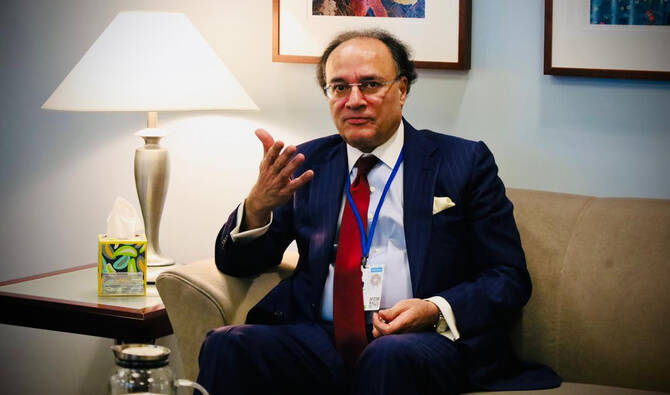
Federal Minister for Finance and Revenue, Muhammad Aurangzeb, speaks during a meeting with Baroness Jenny Chapman, UK Minister for International Development and Africa, on the sidelines of the Annual Meetings of the IMF and World Bank in Washington D.C., on October 18, 2025. (Finance Ministry/File)
Short Url
Updated 22 October 2025
Follow

Pakistan expects 3.5% growth this financial year despite floods, finance minister says

  • Muhammad Aurangzeb says privatization remains a challenge but expects to complete PIA sale before year-end
  • He says Pakistan’s economy is recovering, with all major credit rating agencies upgrading the country this year

ISLAMABAD: Pakistan expects its economy to grow by around 3.5% in the current financial year despite widespread flood damage to crops and farmland, Finance Minister Muhammad Aurangzeb said in an interview to a Chinese media outlet on Tuesday.

Ranked among the world’s most climate-vulnerable countries, Pakistan witnessed yet another devastating monsoon this year that led to massive flooding, killing more than 1,000 people and 22,000 livestock while washing away crops spread over 2.2 million acres since late June.

The country’s agricultural heartland of Punjab was the worst hit after India released excess floodwaters that triggered a catastrophic deluge in late August. The situation affected more than 4.5 million people and forced the provincial administration to evacuate over 2.6 million from high-risk areas.

“We grew at 3% GDP last year,” Aurangzeb told China’s CGTN news channel. “We had estimated growth a little over 4% this year, but given the flood situation, this will shave off a certain percentage. Still, I’m quite hopeful that we can manage anything close to 3.5% during this fiscal year.”

The minister said Pakistan’s broader economy was on a recovery path, with inflation easing, foreign exchange reserves improving and international rating agencies restoring confidence in the country’s financial direction.

“It’s after a hiatus of two and a half to three years that we have alignment between the rating agencies,” Aurangzeb said, referring to upgrades from Fitch, S&P and Moody’s earlier this year.

He acknowledged that privatization had long remained a challenge but pointed to recent progress while referring to the sale of the First Women’s Bank to a United Arab Emirates conglomerate.

Aurangzeb called it “a small bank” but noted it had been on the privatization list for a long time.

He added that Pakistan International Airlines was next in line.

“We are very sanguine that before the year is out, that’s going to be privatized as well,” he said.

The finance minister acknowledged the China-Pakistan economic ties had been vital for his country’s prosperity, saying the two countries were now pivoting from infrastructure development to industrialization. 


Pakistan, Saudi Arabia discuss regional situation, upcoming engagements

Updated 14 February 2026
Follow

Pakistan, Saudi Arabia discuss regional situation, upcoming engagements

  • Ishaq Dar and Prince Faisal bin Farhan agree to stay in contact amid Middle East tensions
  • The two officials speak ahead of Trump’s Feb. 19 Board of Peace meeting in Washington, DC

ISLAMABAD: Pakistan’s Deputy Prime Minister and Foreign Minister Ishaq Dar discussed regional developments and upcoming international engagements with Saudi Foreign Minister Prince Faisal bin Farhan in a phone call on Saturday, according to the foreign office in Islamabad.

The conversation took place against the backdrop of deepening strategic ties between Islamabad and Riyadh. In September last year, the two countries signed a bilateral defense agreement that formalized decades of military cooperation and included a commitment to view aggression against one as an attack on both countries.

“Deputy Prime Minister/Foreign Minister Mohammad Ishaq Dar held a telephonic conversation today with the Foreign Minister of Saudi Arabia, Faisal bin Farhan Al Saud,” Pakistan’s foreign ministry said in a statement.

“The two leaders discussed the evolving regional situation, forthcoming international engagements, and agreed to remain in close contact,” it added.

The two officials spoke at a time of heightened tensions in the Middle East, with the conflict in Gaza far from resolution amid ongoing ceasefire violations by Israel.

The region has also been on edge as the United States pursues nuclear negotiations with Iran, prompting regional states to call for diplomacy rather than new military flare-ups.

Both Pakistan and Saudi Arabia are participants in US President Donald Trump’s Board of Peace, which is scheduled to meet on Feb. 19 in Washington.

Islamabad and Riyadh have consistently coordinated positions over regional and global issues.

The foreign ministry did not provide further details of the discussion.