LONDON: Syria hopes US sanctions will be fully lifted in the coming months and has started the process of restructuring billions of dollars of debt amassed during Bashar Assad’s rule, Economy Minister Mohammad Nidal Al-Shaar said.
President Donald Trump ordered the lifting of most US sanctions on Syria in May after meeting President Ahmed Al-Sharaa, but the Caesar Syria Civilian Protection Act of 2019 that authorizes them remains US law.
“We have to do some push and some lobbying to continue with this path that started in the right direction, and we’re hoping by the end of the year the bill (to scrap the act) will reach the president (Trump), and hopefully he’ll sign it,” Al-Shaar told Reuters during a conference in London.
“And once that happens, then we are sanctions-free,” he said on the sidelines of the Future Resilience Forum.
HOPES FOR A REDUCTION OF US TARIFFS
The act’s removal will enable foreign investment, restore access to international banking and help revive key industries.
Al-Shaar hopes Washington will reduce its 41 percent tariffs on trade with Syria and that US firms will invest in the country as the economy opens up.
Gulf countries have pledged support and Chinese firms have committed hundreds of millions of dollars, Al-Shaar said, for “big” new cement, plastic and sugar factories.
The government is on course to introduce a new currency early next year, he said.
Sources said in August that new banknotes would be issued in December, removing two zeros — and Assad’s face — from the currency, to try to restore public confidence.
Syria’s pound has lost over 99 percent of its value since the civil war began in 2011 but has been broadly stable in recent months.
“We’re consulting with many entities, international organizations, experts, and eventually it will come very soon,” Al-Shaar said of the currency.
RECONSTRUCTION COSTS
A World Bank report on Tuesday estimated the cost of Syria’s reconstruction at $216 billion, saying the figure was a “conservative best estimate.”
Al-Shaar said the amount could be over 1 trillion dollars if the rebuild brought infrastructure up to date but would be spread over a long time, with the rebuilding of houses alone likely to take 6-7 years.
Asked about plans to overhaul Syria’s debt burden, Al-Shaar said the process had started already.
“The sovereign debt that we have, which is not very big actually, will be restructured,” he said, adding that Syria would be asking for grace periods and other relief.
Assad left Syria in disarray when he was ousted last December and fighting continued in the oil-producing north until a ceasefire was struck this month.
“I’m hopeful that the next maybe few weeks, or maybe a month or two, we will reach some kind of an agreement with those who are controlling that part of Syria,” Al-Shaar said.
“Once that happens, I think we will have greater ability, financial, natural resources, to really start meaningful (investment) projects,” he said, predicting a “quantum leap in our GDP.”


![]()

Syria hopes for full lifting of US sanctions in coming months

Short Url
https://arab.news/c7xau
Syria hopes for full lifting of US sanctions in coming months
- “We have to do some push and some lobbying to continue with this path that started in the right direction,” Syria’s economy minister said


Iran says can fight intense war for months
- Iran’s security chief accuses Trump administration of seeking to replicate a scenario similar to Venezuela
- Analysts warn there is still no clear path to ending a conflict that could last a month or longer
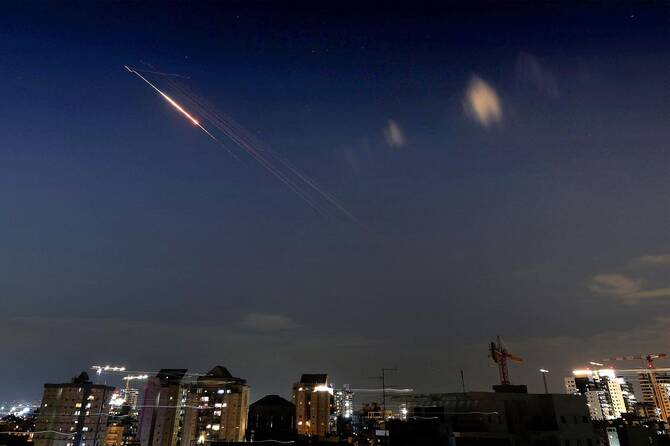
TEHRAN: Iran’s Revolutionary Guards said Sunday that the country’s forces could fight an intense war for six months against the United States and Israel.
Israeli Prime Minister Benjamin Netanyahu has vowed to press on with the war against Iran “with all our force,” with a plan to eradicate the country’s leadership after joint US-Israeli raids killed supreme leader Ayatollah Ali Khamenei last week, sparking the regional conflict.
Despite the threat, the Revolutionary Guards said Sunday that the Islamic republic’s forces could wage an “intense war” for six months at the current speed of fighting.
Guards spokesman Ali Mohammad Naini said Iran had so far used “first and second generation” missiles, but will use “advanced and less-used long-range missiles” in the coming days.
‘Trapped’
The widening reach of the war and Iran’s ability to inflict damage and harm were underscored by US President Donald Trump attending the return of six American service members killed in a drone strike on a US base in Kuwait last Sunday.
Iran’s security chief Ali Larijani accused the Trump administration of seeking to replicate a scenario similar to Venezuela where it ousted leader Nicolas Maduro.
“Their perception was that it would be like Venezuela — they would strike, take control and it would be over — but now they are trapped,” he said in a pre-recorded interview broadcast on state TV on Saturday.
Iran’s hardline judiciary chief Gholamhossein Mohseni Ejei also warned Middle East neighbors which are “openly and covertly at the disposal of the enemy” that “the heavy attacks on these targets will continue.”
Iranian President Masoud Pezeshkian said Sunday that Tehran “will be forced to respond” if a neighboring country were to be used as a launchpad for any attack or invasion attempt.
Tehran had vowed to go after US assets in the region, and Saudi Arabia, Qatar, the United Arab Emirates and Kuwait on Sunday all reported new attacks.
No clear way out
Analysts warn there is still no clear path to ending a conflict that US and Israeli officials say could last a month or longer.
Trump has suggested Iran’s economy could be rebuilt if a leader “acceptable” to Washington replaces the late supreme leader, which Tehran has rejected.
China and Russia have largely stayed on the sidelines despite close ties with Tehran.
China’s top diplomat Wang Yi said on Sunday that the war in the Middle East should “never have happened.”
“This is a war that should never have happened,” he told a press conference in Beijing, adding that “a strong fist does not mean strong reason. The world cannot return to the law of the jungle.”
Israeli Prime Minister Benjamin Netanyahu has vowed to press on with the war against Iran “with all our force,” with a plan to eradicate the country’s leadership after joint US-Israeli raids killed supreme leader Ayatollah Ali Khamenei last week, sparking the regional conflict.
Despite the threat, the Revolutionary Guards said Sunday that the Islamic republic’s forces could wage an “intense war” for six months at the current speed of fighting.
Guards spokesman Ali Mohammad Naini said Iran had so far used “first and second generation” missiles, but will use “advanced and less-used long-range missiles” in the coming days.
‘Trapped’
The widening reach of the war and Iran’s ability to inflict damage and harm were underscored by US President Donald Trump attending the return of six American service members killed in a drone strike on a US base in Kuwait last Sunday.
Iran’s security chief Ali Larijani accused the Trump administration of seeking to replicate a scenario similar to Venezuela where it ousted leader Nicolas Maduro.
“Their perception was that it would be like Venezuela — they would strike, take control and it would be over — but now they are trapped,” he said in a pre-recorded interview broadcast on state TV on Saturday.
Iran’s hardline judiciary chief Gholamhossein Mohseni Ejei also warned Middle East neighbors which are “openly and covertly at the disposal of the enemy” that “the heavy attacks on these targets will continue.”
Iranian President Masoud Pezeshkian said Sunday that Tehran “will be forced to respond” if a neighboring country were to be used as a launchpad for any attack or invasion attempt.
Tehran had vowed to go after US assets in the region, and Saudi Arabia, Qatar, the United Arab Emirates and Kuwait on Sunday all reported new attacks.
No clear way out
Analysts warn there is still no clear path to ending a conflict that US and Israeli officials say could last a month or longer.
Trump has suggested Iran’s economy could be rebuilt if a leader “acceptable” to Washington replaces the late supreme leader, which Tehran has rejected.
China and Russia have largely stayed on the sidelines despite close ties with Tehran.
China’s top diplomat Wang Yi said on Sunday that the war in the Middle East should “never have happened.”
“This is a war that should never have happened,” he told a press conference in Beijing, adding that “a strong fist does not mean strong reason. The world cannot return to the law of the jungle.”
Latest updates


© 2026 SAUDI RESEARCH & PUBLISHING COMPANY, All Rights Reserved And subject to Terms of Use Agreement.