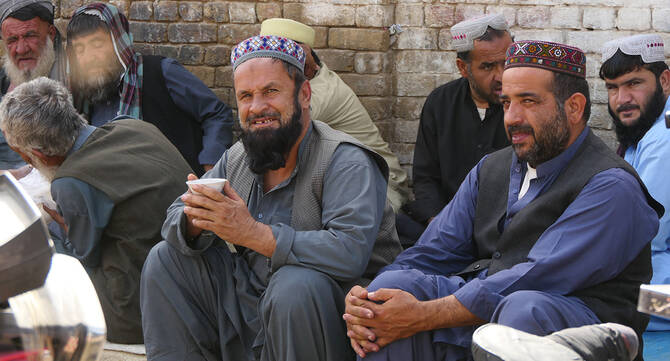

CHAMAN/BALOCHISTAN: Hajji Abdul Bari Achakzai’s office wears a deserted look. The empty chairs in his office in the southwestern Pakistani city of Chaman reflect the impact that border closures, triggered by clashes between Pakistan and Afghanistan, have had on bilateral trade in both countries.
Pakistan and Afghanistan saw fierce fighting on Oct. 11, when Afghan forces struck multiple Pakistani military posts. Afghanistan officials claimed to have killed 58 Pakistani soldiers in response to what they said were repeated violations of Afghan territory and airspace. Pakistan’s military gave lower figures, saying it lost 23 soldiers and killed more than 200 “Taliban and affiliated terrorists” during retaliatory fire along the border.
The clashes caused border closures between Pakistan and Afghanistan last week, through the northwestern border crossing in Torkham and southwestern Chaman crossing in Balochistan, effectively halting trade and the movement of people between the two countries.
Seventy-year-old Achakzai’s family has been in the business of importing and exporting goods from Chaman since the past 60 years. The border closures have taken a toll on his business and affected Chaman, he said.
“Due to these repeated border closures, Chaman has reached near-total unemployment,” Achakzai told Arab News on Saturday.
Pakistan is a key exporter of goods, mainly fresh fruits, rice, flour and other edible items to Afghanistan, while it imports dry fruits and other scrap material from the country.
Islamabad has repeatedly accused the administration in Kabul of failing to take action against militant outfits such as the Tehreek-e-Taliban Pakistan (TTP) and the separatist Balochistan Liberation Army (BLA), which it alleges carry out attacks targeting Pakistan from Afghan soil. Kabul denies the allegations.
The TTP have become emboldened since the Taliban returned to power in Afghanistan in 2021, carrying out attacks against Pakistani security forces. These attacks have caused repeated clashes between Pakistani and Afghan border forces, triggering frequent border closures.
Both countries agreed to a ceasefire in Doha on Saturday, though tensions remain heightened, amid closure of border crossings.
As per the Pak-Afghan Joint Chamber of Commerce and Industry (PAJCCI), the annual Pakistan-Afghan trade volume has declined from $2.5 billion dollars to $10 million during the last two fiscal years.
Apart from Torkham in the northwest, the Chaman–Spin Boldak crossing is one of the busiest and most strategically important trade routes between Pakistan and Afghanistan.
“Chaman used to be a key route for trade between Kabul-Karachi and Hirat-New Delhi and this transit point remained a source of income for us,” Achakzai noted.
Zia Ul Haq Sarhardi, senior vice president of the PAJCCI, said recent tensions between Pakistan and Afghanistan are causing losses worth billions of rupees that cannot be estimated accurately. He described the escalation in tensions as a “major tragedy.”
“I don’t see the border will reopen easily this time because the Pak-Afghan bilateral relations have been worsening,” Sarhardi said.
Muhammad Ayoub Meerani, president of the Quetta Chamber of Commerce and Industry (QCCI) in Balochistan’s capital city, blamed the Pakistani government’s policies for declining trade with Afghanistan.
“Afghanistan’s landlocked market has moved away from us and into the hands of Iran, Uzbekistan, and other countries,” Meerani told Arab News.
“Even small, perishable items are not being exported from here causing millions of dollars’ damages to the business community of Balochistan.”
He called on both countries to end their conflict and for border trade to resume.
DESERTED MARKETS
Local traders remain busy hunting for customers in Chaman, where Naimatullah Achakzai, 36, runs a shop selling dry fruits on Taj Road.
“The market is almost dead,” he said. “Around 60 percent of the goods in our shop come from Afghanistan, like almonds, raisins, cashews, walnuts, and all kinds of dry fruits. We bring them from across the border and supply them throughout Pakistan.”
He warned that if the situation persists, around 2 million people in Chaman and Afghanistan’s Spin Boldak border town would be “devastated.”
Hajji Jamal Shah Achakzai, president of the traders’ association in Chaman district, agreed.
“Our entire livelihood depends on the border. Goods that used to go out and come in from the border are now almost non-existent,” he said.
“Chaman has suffered heavy losses. If the situation continues, people will start migration from this bordering town.”