

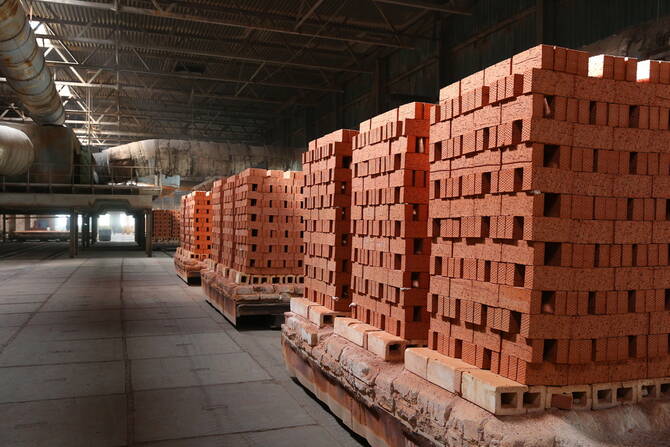

JEDDAH: Saudi Arabia’s red brick industry is seeing steady growth, with the number of operating factories rising to 41 in the first half of 2025 amid firm domestic and regional demand, according to an industry official.
Ibrahim Khayyat, head of the National Red Brick Committee, said that exports are increasing at an annual rate of 4 to 10 percent.
Total production reached 2.5 million tonnes in 2024, alongside 31 million cubic meters, 94,000 sq. meters, and 420 million units, Al-Eqtisadiah reported, citing the Ministry of Industry and Mineral Resources. Variations in measurement reflect differences in product types and factory standards.
It added that the number of licensed and operational red brick factories reached 21 in 2024, marking a 20 percent increase from the previous year.
“The number of factories during the first half of 2025 increased to 41, a 90 percent increase compared to the previous year, distributed among 12 factories in Riyadh, another 12 in Makkah, 5 in Madinah, 5 in the Eastern Province, 3 in Qassim, 2 in Asir, and 2 in Jizan,” the Al-Eqtisadiah report stated.
Citing Khayyat, the outlet reported that he indicated, “Saudi exports are directed to the UAE, Yemen, Kuwait, and a number of African countries, with the possibility of opening additional markets in the region, such as Syria.”
Khayyat said the industry aims to strengthen competitiveness by improving quality and relying more on local raw materials.
Red bricks, he added, offer technical efficiency and economic feasibility, helping reduce construction costs by about 9 percent compared with cement blocks, while improving thermal insulation and cutting air-conditioning use by 20–40 percent.
“Khayyat noted that competition with concrete blocks and AAC materials remains, but foreign demand focuses on high thermal performance products, enhancing export opportunities,” the news outlet reported.
He added that the construction sector is a major contributor to global greenhouse gas emissions, underscoring the need for solutions that reduce carbon footprints and conserve natural resources.
Saudi exports of all types of bricks totaled SR120 million ($32 million) between 2020 and July 2025, according to data from the General Authority for Statistics. Export values rose from SR21 million in 2023 to SR34 million in 2024, a 64 percent increase, while the first seven months of 2025 saw shipments worth SR29 million, pointing to continued growth.
“Khayyat emphasized that the current strategy focuses on supporting key domestic and international markets through quality enhancement and reliance on local resources,” Al-Eqtisadiah reported.


