

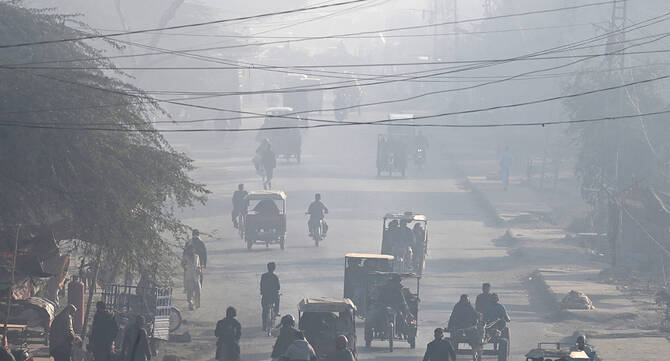

ISLAMABAD: The Pakistan Environmental Protection Agency (Pak-EPA) has rolled out a comprehensive Vehicular Emission Control Action Plan (VECAP) for the Islamabad Capital Territory (ICT), the climate change ministry announced on Sunday, marking a major policy initiative to combat air pollution and smog in the capital city.
The plan, unveiled by the climate ministry in coordination with the capital administration, Islamabad Transport Authority and Traffic Police, outlines both short- and long-term measures to regulate exhaust emissions, modernize urban transport and improve air quality in the capital.
After the heat-trapping industrial emissions, the rapidly increasing vehicular emissions have emerged as one of the leading sources of choking air pollution in Islamabad, according to Saleem Shaikh, a climate change ministry spokesman.
These emissions release high levels of carbon monoxide, nitrogen oxides, hydrocarbons and fine particulate matter (PM2.5), which contribute significantly to respiratory and cardiovascular illnesses.
“This ambitious action plan provides a clear and viable roadmap to cleaner, healthier air for Islamabad’s citizens,” Shaikh said in a statement. “It moves beyond temporary measures and builds a structured, long-term framework that combines enforcement with innovation and public engagement through awareness and advocacy.”
The short-term phase (0–18 months) focuses on strong enforcement and community awareness. Under this phase, Pak-EPA and the Islamabad Traffic Police will conduct regular and surprise roadside inspections to ensure compliance with National Environmental Quality Standards (NEQS).
The plan mandates 100 percent NEQS compliance for all government transport fleets within the specified timeframe and introduces third-party emission testing for private and commercial vehicles through certified laboratories. Vehicle owners will be required to obtain mandatory emission compliance certificates, which will be linked with registration and transfer processes.
Pakistan’s main urban centers routinely rank among the most polluted cities in the world, with vehicular emissions remaining one of the top contributors to air pollution. This severe air pollution also undermines economic productivity and diminishes the quality of life for millions of residents.
Shaikh said city-wide public awareness campaigns would be launched through television, radio and digital media to promote regular vehicle maintenance and discourage the use of smoke-emitting vehicles at all levels. Officials have recently fined 215 vehicles and impounded 32 others for violating emission limits, he added.
Special focus would now be placed on diesel-run buses, trucks and water tankers, while all petrol vehicles would be checked for catalytic converters, according to the climate change ministry. Burning of trash and solid waste would also be strictly prohibited and those found involved will be fined under the Pakistan Environmental Protection Act provisions.
“Above all, public participation is key,” Shaikh said. “Cleaner air cannot be achieved by enforcement alone. Citizens, transporters and institutions must all contribute by maintaining vehicles, avoiding open burning, and supporting the shift toward low-emission mobility.”
Sharing details of the long-term phase (18–60 months) of the EVPP, Shaikh said they would concentrate on a structural shift toward cleaner fuels and technologies in this stage.
“Under this long-term phase to overcome air pollution challenges in the capital, a Comprehensive Electric Vehicle Promotion Programme (EVPP) will be launched to establish EV charging stations across Islamabad, introduce a 10 percent EV quota in government fleets, and offer incentives such as tax exemptions and dedicated EV lanes,” the climate change ministry official said.
“The ministry’s overarching goal is to make Islamabad a model city for clean and climate-smart transport. This is part of Pakistan’s broader commitment to achieving sustainable urban air quality and reducing greenhouse gas emissions.”
Pakistan ranks among nations most vulnerable to climate change and has seen erratic changes in its weather patterns, which have led to frequent heat waves, untimely rains, storms, cyclones, floods and droughts in recent years. This year, monsoon floods killed 1,037 people and caused initial losses worth $1.31 billion.
Experts have warned that without urgent adaptation and mitigation measures, the human and economic toll of climate change will only deepen in the years ahead.
Discussing implementation of the new framework, Shaikh said it would be executed through multi-agency coordination, involving joint efforts of Pak-EPA, ICT Administration, Excise and Taxation Department, Capital Development Authority (CDA), Oil and Gas Regulatory Authority (OGRA), and Islamabad Traffic Police.
This collaborative approach combines policy reform, enforcement and technology adoption to deliver lasting environmental benefits, according to the official.
“The success of this plan will depend on sustained institutional support, inter-agency cooperation and active public participation,” he said. “Cleaner air for Islamabad is achievable only when every stakeholder, from policymakers to commuters, plays their role responsibly for the sake of their own and environmental health but also for the health of future generation and city’s environmental sustainability.”


