

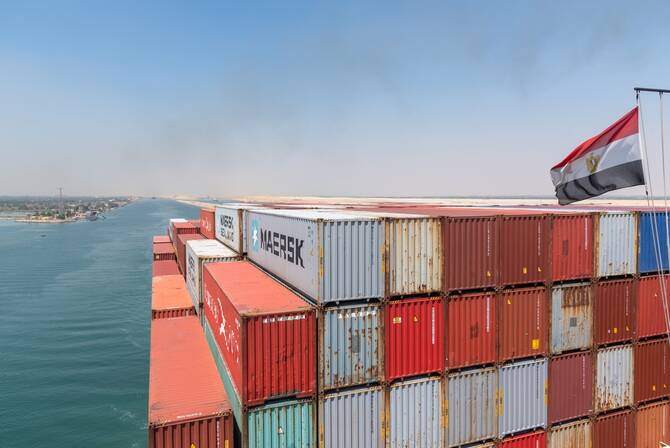
Egypt’s exports hit $30bn in first 7 months of 2025

The growth was largely driven by higher shipments of manufactured and semi-manufactured goods, which climbed to $23.7 billion from $19.4 billion a year earlier. Shutterstock
Short Url
Updated 19 October 2025
Follow

Egypt’s exports hit $30bn in first 7 months of 2025

JEDDAH: Egypt’s exports rose to $29.9 billion during the first seven months of 2025, up 17.3 percent compared with the same period last year, according to official data..

The growth was largely driven by higher shipments of manufactured and semi-manufactured goods, which climbed to $23.7 billion from $19.4 billion a year earlier, the Egyptian Cabinet said, citing a report by the Central Agency for Public Mobilization and Statistics.

Exports increased 20.1 percent year on year in January to $4.36 billion, compared with $3.63 billion in the same month of 2024.

Amid a rapidly evolving global economy, Egypt is aligning its development strategy with Vision 2030 and its broader economic reform program, focusing on high-productivity sectors and expanding export capacity.

 In its official Facebook account, the Egyptian Cabinet stated: “The value of exports from January to July 2025 rose to $29.9 billion compared to $25.5 billion during the same period of 2024.”

The rise in exports during the first seven months was supported by strong growth in several key categories: ready-made garments up 15 percent, pasta and food preparations up 31 percent, iron bars, rods, and wires up 24.7 percent, and dry pulses up 15.6 percent.

Some product categories, however, saw declines — including fresh fruits, down 0.2 percent; petroleum products, down 12.9 percent; fertilizers, down 25 percent; and primary plastics, down 16 percent. 

Egypt aims to strengthen its trade and investment sectors by promoting export-oriented industries and is working on activating free trade agreements with various economic blocs, such as the African Continental Free Trade Area, the COMESA agreement, and the South American free trade bloc Mercosur.

This focus was underscored by Deputy Finance Minister Yasser Sobhi in his meetings with international institutions, banks, and investors in Washington last week.

Sobhi affirmed that Egypt has executed a program of economic and structural reforms and balanced policies to maintain fiscal discipline, stimulate the private sector, and bolster production and export-led growth. 

He stated that these measures are contributing to increase the competitiveness of the Egyptian economy and attract more domestic and international investment flows.


Global investors commit more than $3bn to King Salman Park as Saudi giga-project secures new deals

Updated 10 March 2026
Follow

Global investors commit more than $3bn to King Salman Park as Saudi giga-project secures new deals

RIYADH: The King Salman Park Foundation has secured more than $3.8 billion in new private-sector commitments at the MIPIM 2026 real estate conference, including a landmark $3 billion fund backed by international investors to develop a major mixed-use district in the heart of Riyadh.

According to a press release, the announcements bring total committed investment in the 17.2 sq. kilometers urban regeneration project to over $5.3 billion across five major packages.

Launched in 2019 under Saudi Vision 2030, the development is designed to be the world’s largest city park and aims to boost green space, improve quality of life, and feature over 1 million trees and extensive leisure facilities.

A $3 billion metro-connected district

The largest of the two packages, designated Package 5, will see a consortium led by Kolaghassi Development Co. deliver a residential-led district with a total built-up area exceeding 1 million sq. meters. 

It will provide approximately 3,700 residential units, a K–12 school, around 300 hospitality keys and more than 100,000 sq m of Grade A office space alongside a wide variety of retail and dining offerings.

The development is supported by a Saudi-domiciled, Capital Market Authority-regulated fund managed by Mulkia Investment Co. that has attracted leading investors from the Kingdom and across the world.

Kolaghassi Development Co. will lead the project alongside Al Othaim Investment, one of the Kingdom’s real estate players, and RXR, a New York-headquartered real estate investor and operator.

“Securing investment of this scale, supported by international capital and expertise, is an important milestone for King Salman Park,” said George Tanasijevich, CEO of King Salman Park Foundation. 

$850 million cultural district package

In a separate announcement, the Foundation confirmed the award of Package 4 to a consortium led by Retal Urban Development Co., with support from a fund managed by SAB Invest.

The project has a total value exceeding $850 million and will host more than 600 residential units, over 140 hotel keys, and almost 50,000 sq m of Grade A office space, alongside curated retail and food and beverage experiences.

“This opportunity reflects the maturity of Saudi Arabia’s real estate investment landscape and our confidence in culture-led, mixed-use urban destinations as a driver of sustainable returns,” said Abdullah Al-Braikan, CEO and founder of Retal Urban Development Co.

Ali Al-Mansour, CEO of SAB Invest, said the fund structure brings together “long-term capital, experienced development partners, and a shared commitment to place-making excellence” while contributing to Riyadh’s cultural vibrancy and the Kingdom’s quality-of-life ambitions under Vision 2030.