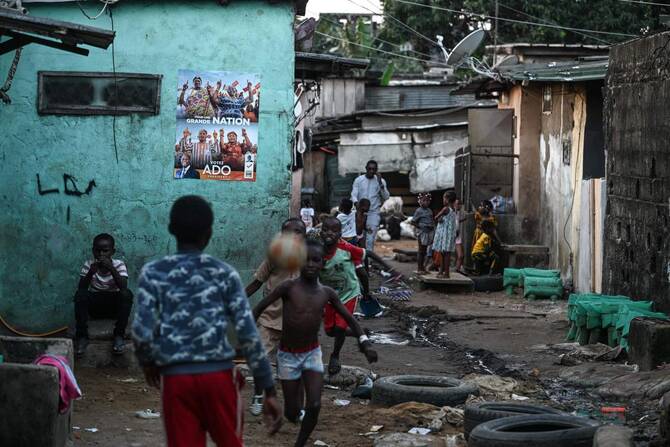
ABIDJAN: Ivory Coast authorities have imposed a sweeping two-month ban on political rallies and demonstrations just a week before a presidential election, in a move further restricting opposition activity.
The ban, announced late Friday by the interior and defense ministries, applies to all political parties and groups except the five candidates officially approved to contest the October 25 vote.
It comes amid rising tensions following the exclusion of opposition heavyweights Laurent Gbagbo and Tidjane Thiam from the race.
Hundreds of people rallied at protests in Abidjan last weekend, with security forces dispersing crowds. Sporadic unrest, including road and school blockades, has been reported in several regions.
Around 700 people have been arrested over the past week, according to public prosecutor Oumar Braman Kone, who said phone data revealed calls for attacks on public institutions which he described as “acts of terrorism.”
On Thursday, 26 protesters were sentenced to three years in prison for public order offenses, and another 105 are due to stand trial next week.
The opposition coalition, which includes Gbagbo’s African Peoples’ Party – Ivory Coast (PPA-CI) and Thiam’s Democratic Party of Ivory Coast (PDCI), has denounced President Alassane Ouattara’s bid for a fourth term.
Amnesty International urged authorities to stop “repressing” protests, but Justice Minister Sansan Kambile defended the crackdown, citing national security concerns.
Ouattara faces four challengers, including former minister Jean-Louis Billon and ex-first lady Simone Gbagbo.

Ivory Coast tightens protest ban ahead of presidential vote
https://arab.news/npzps
Ivory Coast tightens protest ban ahead of presidential vote
- Ban applies to all political parties and groups except the five candidates officially approved to contest the October 25 vote
Jakarta records nearly 2m respiratory infections as air quality worsens
- Toddlers make up over 19% of Jakarta’s 2025 respiratory-infection cases
- In 2024, Jakarta’s average air quality at least 6 times over WHO safe limit
JAKARTA: Air pollution in Jakarta has contributed to nearly 2 million cases of respiratory illness in 2025, local health authorities said on Tuesday, raising concerns about the long-term health of the residents of the world’s most populous city.
Jakarta has consistently ranked among the world’s most polluted cities, regularly recording “unhealthy” levels of PM2.5, a measurement of particulate matter — solid and liquid particles suspended in the air that can be inhaled and cause respiratory diseases.
There were more than 1.9 million acute respiratory-infection cases between January and October of this year, according to the Jakarta Health Agency.
“Based on our data, cases of acute respiratory infection increased from mid-year and peaked in October. We also found that toddlers make up for over 19 percent of the cases … There are more cases (overall in 2025) compared to 2024,” agency chief Ani Ruspitawati told Arab News on Tuesday.
Air pollution, as well as high population density and human mobility, were among the risk factors for the high prevalence of acute respiratory infections in Jakarta, she added.
These cases of respiratory illness were only recorded among the national capital region’s 11 million residents. And did not account for the entire 42 million people living in the greater Jakarta area — which ranked as the world’s most populated city in a UN report published last month.
Yet the capital’s satellite cities, such as South Tangerang, have also ranked among the world’s most polluted over the years, as levels of microscopic harmful particles in these areas exceeded the safety limit set by the World Health Organization.
According to a June report published by the Helsinki-based Center for Research on Energy and Clean Air, the 2024 level of PM2.5 across the Greater Jakarta area averaged between 30 to 55 micrograms per cubic meter, which is between six to 11 times the WHO’s threshold.
“These rising cases of acute respiratory infection is a sign that air quality in Indonesia has worsened, with air quality in the greater Jakarta area being the worst,” the Center for Indonesia’s Strategic Development Initiatives said in a statement.
“Air pollution is a huge threat for health and the climate. Air pollution in urban and rural areas can produce fine particles that can cause strokes, heart disease, lung cancer, and respiratory infections.”


