

ICC rejects Israel appeal bid over arrest warrants

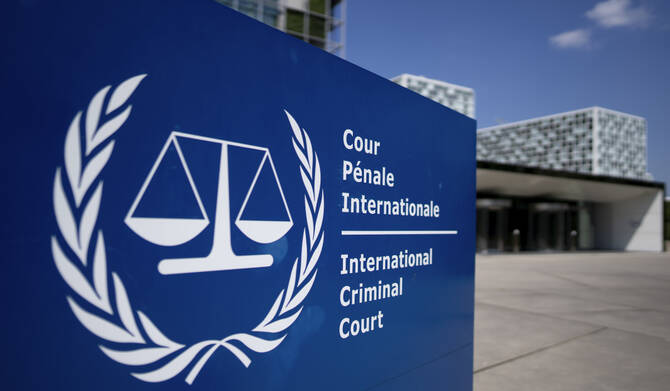
A view of the International Criminal Court in The Hague, Netherlands, Wednesday, June 26, 2024. (AP)
Short Url
Updated 18 October 2025
Follow

ICC rejects Israel appeal bid over arrest warrants

  • In a ruling that made headlines around the world, the ICC in November found "reasonable grounds" to believe Netanyahu and Gallant bore "criminal responsibility" for alleged war crimes and crimes against humanity in Gaza

THE HAGUE: The International Criminal Court Friday rejected Israel's bid to appeal against arrest warrants for its Prime Minister Benjamin Netanyahu and former defence minister Yoav Gallant over the Gaza war.
In a ruling that made headlines around the world, the ICC in November found "reasonable grounds" to believe Netanyahu and Gallant bore "criminal responsibility" for alleged war crimes and crimes against humanity in Gaza.
The ICC also issued arrest warrants for three top leaders from the Palestinian militant movement Hamas but dropped these after their deaths.
The warrants against Netanyahu and Gallant sparked outrage in Israel and also in the United States, which has since slapped sanctions on top ICC officials.
Netanyahu described it as an "anti-Semitic decision" and the then US president Joe Biden slammed it as "outrageous".
Israel had asked the court in May to dismiss the warrants while it weighed a separate challenge over whether the ICC had jurisdiction in the case.
The court rejected this on July 16, saying there was "no legal basis" for quashing the warrants while the jurisdiction challenge was pending.
A week later, Israel asked for leave to appeal that ruling, but judges ruled on Friday that "the issue, as framed by Israel, is not an appealable issue."
"The Chamber therefore rejects the request," said the ICC in a complex, 13-page ruling.
ICC judges are still weighing a wider Israeli challenge over jurisdiction.
When the court originally issued the arrest warrants in November, it simultaneously rejected an Israeli appeal against its jurisdiction.
However, in April, the ICC's Appeals Chamber ruled the Pre-Trial Chamber was wrong to dismiss the challenge and ordered it to look again in detail at Israel's arguments.
It is not clear when it will hand down a ruling on that issue.


French court slashes jails term for trio over 2020 teacher beheading

Updated 03 March 2026
Follow

French court slashes jails term for trio over 2020 teacher beheading

  • Brahim Chnina, the Moroccan father of a girl who falsely claimed that Paty had asked Muslim students to leave his classroom before showing the caricatures, had his 13-year sentence reduced to 10 years

PARIS, France: A French court on Monday reduced on appeal the jail sentences of three men convicted over the 2020 terrorist beheading of a teacher who showed a class cartoons of the Prophet Muhammad.
Samuel Paty, 47, was murdered in October 2020 by an 18-year-old radical Islamist of Chechen origin in an act that horrified France.
His attacker, Abdoullakh Anzorov, was killed in a shootout with police.
Two friends of Anzorov, French national Naim Boudaoud and Azim Epsirkhanov, a Russian of Chechen origin, had their sentences of 16 years in prison reduced to six and seven years respectively by a Paris court of appeal.
Both were accused of having driven Anzorov and helping him to procure weapons before the beheading.
Brahim Chnina, the Moroccan father of a girl who falsely claimed that Paty had asked Muslim students to leave his classroom before showing the caricatures, had his 13-year sentence reduced to 10 years.
His daughter, then aged 13, was not actually in the classroom at the time and during the first trial apologized to the teacher’s family.
The court however left the 15-year term for French-Moroccan Islamist activist Abdelhakim Sefrioui untouched.
The quartet were among the seven men and one woman found guilty in 2024 of contributing to the climate of hatred that led to the beheading of the history and geography teacher in Conflans-Sainte-Honorine, west of Paris.
Paty, who has become a free-speech icon, used the cartoons as part of an ethics class to discuss freedom of expression laws in France.