
KARACHI: Pakistan’s food trade deficit shot up to $1.14 billion in the first quarter of the current fiscal year (FY26), with economists on Friday attributing the increase to recent floods that damaged exportable crops like rice and disrupted supply chains.
Last year, in July-September, the country’s food trade deficit with the world stood at $45 million, according to the Pakistan Bureau of Statistics (PBS).
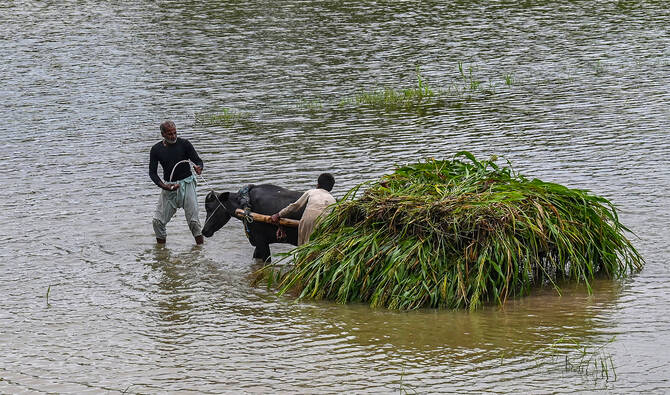
Ranked among the world’s most climate-vulnerable countries, Pakistan witnessed yet another devastating monsoon that led to massive flooding, killing more than 1,000 people and 22,000 livestock while washing away crops over 2.2 million acres since late June, as per the National Disaster Management Authority (NDMA).
“The widening deficit partly reflects flood damage caused to rice, maize and vegetable crops, which have reduced exports and lifted food imports,” Khaqan Najeeb, a former adviser to the Ministry of Finance, told Arab News.
Pakistan witnessed a food export decline of 31 percent to $1.1 billion in July through September, while its imports rose 36 percent to $2.25 billion, according to PBS data.
Najeeb attributed the surge in imports to higher machinery and raw-material inflows, signaling an uptick in economic reconstruction activity in the country.
Pakistan’s overall trade deficit widened by 34 percent to $9.43 billion in the first quarter of FY26, PBS data showed, with exports shrinking 4 percent to $7.6 billion and imports rising 14 percent to $17 billion.
Pakistan mainly exports textiles, rice, cotton yarn, meat and seafood, while its major imports include petroleum products, palm oil, electrical machinery, plastic materials, iron and steel, liquefied natural gas, mobile phones, steel scrap and motor vehicles.

Garment factory workers inside a manufacturing facility in Karachi on July 8, 2025. (AFP/File)
Given the situation, Najeeb said Pakistan should discuss the trade targets set by the International Monetary Fund (IMF) under the $7 billion loan program.
“The authorities and the IMF may need to revisit the $26.6 billion FY26 trade deficit target, with the gap already at $9.4 billion in the first quarter, well above projections,” he said.
Shankar Talreja, head of research at Topline Securities Limited, said lower rice sales have dragged Pakistan’s food exports in the ongoing fiscal year.
He noted that during the first three months, rice exports dropped 42 percent to $419 million, vegetables 41 percent to $42.2 million, tobacco 48 percent to $19.3 million, spices 9 percent to $20 million, and oilseeds, nuts, and kernels 68 percent to $37 million.
“The disruption is due to supply-chain-related issues after the floods,” he said.
NDMA data shows the floods damaged 2,811 kilometers of roads, 790 bridges and more than 229,000 houses.
“The impact of floods on crops will become visible in the second half of this fiscal year [between January and June],” he added.
Talreja said Pakistan’s food exports may further decline as a 10 percent loss to the rice crop could mean a reduction of about 500,000 tons in exports.
He said the government may also need to import wheat to stabilize domestic flour prices and cotton to ensure a steady supply of raw materials to its $18 billion textile industry.
“The cotton imports will be close to last year’s, around 700,000 tons, meaning four to five million bales would be required at minimum,” said Talreja, who believes Pakistan could avoid future crop losses by constructing additional waterways.
Pakistan’s textile sector consumes about 14 million cotton bales annually, double the country’s current production, which has fallen to seven million bales in recent years, partly due to climate change and governance challenges.
“There is no quick fix to this…. climate change is real,” he added.
Ahsan Mehanti, chief executive officer of Arif Habib Commodities Limited, said floods had affected rice, wheat, cotton and sugarcane crops, mostly in Punjab, which is Pakistan’s breadbasket.
“The impact on the overall trade deficit to the extent of $1 billion in the first quarter could reach $3 billion by the third,” he said.
Mehanti said the government could mitigate flood impacts by reviving degraded soil, providing quality seeds and repairing irrigation infrastructure in Punjab through flood-alleviation schemes.
Finance Minister Muhammad Aurangzeb has already said initial assessments suggest floods have damaged the rice and cotton sectors, likely denting economic growth to between 3.5 and 4 percent.
“The challenge is to sustain recovery without worsening external pressures,” Najeeb said.