NEW YORK CITY: The UN Security Council on Friday expressed its strong support for Lebanese authorities in their efforts to assert sovereignty over their entire territory, and called on international community to step up the assistance it provides to the Lebanese Armed Forces.
It comes as UN peacekeepers in southern Lebanon report violations of UN resolutions, including the discovery of unauthorized weapon caches.
In a unanimous statement, the 15 members of the Security Council welcomed the Lebanese government’s commitment to the extension of state authority across the country through the deployment of the army, and said no authority should be recognized other than that of the government.
They also called for increased international backing to ensure the “effective and sustainable deployment” of the Lebanese army south of the Litani River, a region in which tensions with neighboring Israel have frequently flared.
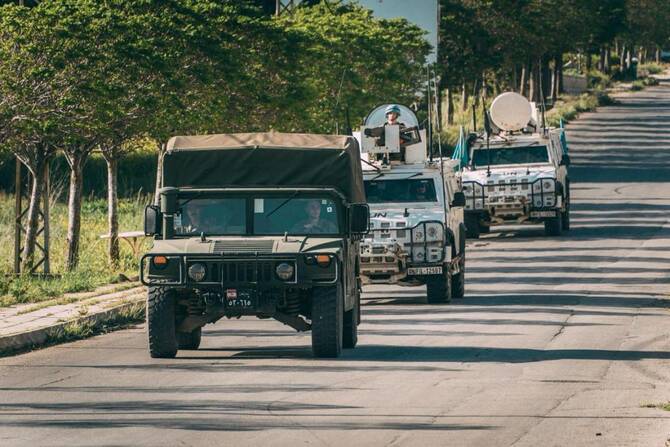
Members reiterated their full support for the UN Interim Force in Lebanon and urged all sides in the country to take “all necessary measures” to guarantee the safety of the peacekeepers and their facilities. “Peacekeepers must never be targeted by attack,” they said.
The council called on all parties to honor their commitments under the Nov. 26, 2024, cessation of hostilities agreement between Israel and Hezbollah, and to adhere to the principles of international humanitarian law by ensuring the protection of civilians.
Welcoming the stated willingness of Beirut to delineate and demarcate its border with Syria, and its efforts to curb cross-border smuggling, council members called for the full implementation of Security Council Resolutions 1701 and 1559, which address the disarmament of non-state militias and the authority of the Lebanese state.
Also on Friday, Stephane Dujarric, spokesperson for UN Secretary-General Antonio Guterres, said that UNIFIL peacekeepers in southern Lebanon, have been monitoring and reporting violations of resolution 1701, including unauthorized weapon caches, in their area of operations.
“On Thursday, mortar shells were found in Sector West, while on Tuesday, a joint patrol with the Lebanese army discovered damaged rockets and their launchers in Sector East,” he said.
“UNIFIL also continues to observe Israel Defense Forces military activities in the area of operations, including on Wednesday, where mortar fire from south of the Blue Line was detected, impacting near Yaroun in Sector West.”
The Blue Line is a line of demarcation separating Israel and Lebanon set by the UN in 2000 to confirm the withdrawal of Israeli forces.
“Also on Wednesday, in Sarda in Sector East, IDF soldiers pointed infrared lasers at UNIFIL patrol vehicles,” Dujarric said. “We once again stress these acts of interference must stop.
“Meanwhile, UNIFIL’s Maritime Task Force conducted training this week with Lebanese Navy personnel aboard a Maritime Task Force vessel. Separately, peacekeepers in Sector East trained with Lebanese army personnel to address threats posed by explosive remnants of war.”


![]()

UN Security Council backs Lebanon’s efforts to assert sovereignty, calls for global support of army
Short Url
https://arab.news/n2ftw
UN Security Council backs Lebanon’s efforts to assert sovereignty, calls for global support of army
- Council members offer unanimous support for UN Interim Force in Lebanon and urge all sides to take ‘all necessary measures’ to guarantee safety of the peacekeepers
- Spokesperson for UN secretary-general says peacekeepers in southern Lebanon report violations of UN resolutions, including unauthorized weapon caches


Latest updates


© 2026 SAUDI RESEARCH & PUBLISHING COMPANY, All Rights Reserved And subject to Terms of Use Agreement.