

UN rights chief urges rights-focused Gaza reconstruction as Palestinian FM presses EU on ceasefire

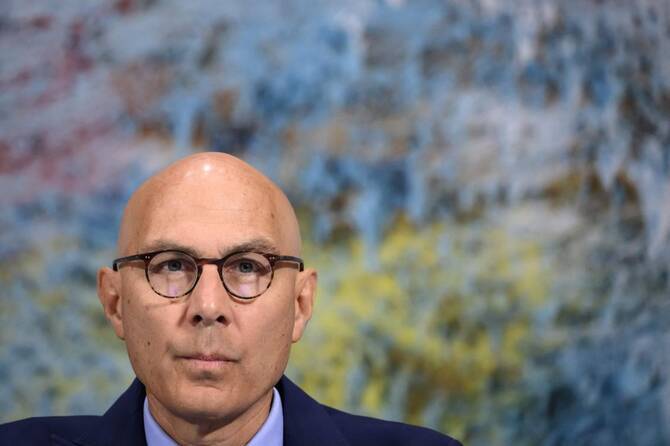
UN High Commissioner for Human Rights Volker Turk. (AFP/File Photo)
Short Url
Updated 17 October 2025
Follow

UN rights chief urges rights-focused Gaza reconstruction as Palestinian FM presses EU on ceasefire

GENEVA: The UN High Commissioner for Human Rights on Friday urged all parties to place human rights at the center of efforts to rebuild Gaza and establish a lasting peace, emphasizing that the ongoing ceasefire should serve as a foundation for sustainable security and stability.

Volker Turk said that while there was widespread relief at signs of an end to the war and humanitarian suffering, significant work remained to ensure lasting peace, justice and accountability for serious violations of human rights and international humanitarian law over the past two years.

He called for the full inclusion of all Palestinians in decision-making processes, regardless of age, gender or disability, and for the restoration of access to food, clean water, housing, medical care and education, alongside the protection of children’s rights to play and safety.

Turk also stressed that human rights must guide political efforts and the pursuit of a two-state solution in line with UN Security Council resolutions, General Assembly mandates, Human Rights Council recommendations, the New York Declaration and relevant International Court of Justice advisory opinions.

He underscored the importance of unrestricted access for humanitarian aid, international staff, journalists, protection workers and human rights observers, ensuring that they can operate freely throughout Gaza.

Also on Friday, Palestinian Minister of Foreign Affairs and Expatriates Varsen Aghabekian met EU policy advisers on the sidelines of the Mediterranean Dialogues conference in Naples.

She emphasized the need for the EU to take concrete measures to safeguard the Gaza ceasefire’s continuation, including strict monitoring of its implementation and preventing violations by Israeli forces.

Aghabekian also called for the US peace plan to align with the New York Declaration to advance a two-state solution and preserve Palestinian territorial unity.

She urged signatory countries, including EU member states, to take practical steps to implement the declaration’s provisions and support a just, lasting peace grounded in human rights and accountability.


First AI-aided retail transaction in Dubai promises to change the way consumers shop

Updated 7 sec ago
Follow

First AI-aided retail transaction in Dubai promises to change the way consumers shop

  • Artificial intelligence agent purchases movie tickets for a customer after asking a few questions

First AI-aided retail transaction in Dubai promises to change the way consumers shop

Khaled Al Khawaldeh

DUBAI: The CEO of Mastercard, Micheal Miebach, announced on Tuesday that the company, in conjunction with UAE retailer Majid Al Futtaim, had successfully completed the first agentic AI transaction in Dubai, with an AI agent purchasing movie tickets for a customer after asking a few questions.

Speaking at the Dubai Future forum alongside the UAE’s Minister of State for Artificial Intelligence, Omar Al Olama on Tuesday, Miebach said he believed that in the future “AI agents” would guide most transactions.

Olama hailed the transaction, saying it was part of a vision of the future that would streamline the way people consumed online and in person.

“I saw that transaction, I found it extremely seamless. It's very, very convenient, and it's like having the best personal assistant that will do everything for you, select the movie, get your best seats, find the best timing, the closest location to you, and make a payment without many instructions. And that's why it stood out,” Olama told the crowd at the Museum of the Future on Monday.

While retail chatbots that help customers have been around sometime, Mastercard’s new agentic solution differs in that it is able to make the transaction directly, working like a real-life assistant with access to your finances.

Asked by Olama, whether this ran the risk of agentic AI going on shopping sprees without our consent, likening it to giving away your card details to your child, Miebach said he believed that the risk could be mitigated through the right mix of controls and regulation.

“If you think about it from a perspective of powering a digital economy in a country like the UAE, a lot of things need to have in the background to make it safe, to make it secure, to make it intuitive,” Miebach told the forum.

“When AI starts to make decisions on your behalf for shopping, that can be very scary. So, we got to put in the controls, and all of that is what Mastercard’s agent pay has done.”

Miebach said he envisioned a future where agents would start to understand your preferences for groceries, movies and retail items and make purchases for you seamlessly when asked. A future he said that would substantially streamline the experience of customers.

Nevertheless, he believed that before the technology could really take off – companies and governments alike would have to gain the trust of individuals and communities alike.

“What happens if something goes wrong in the world of an AI generated transaction? And so, what do you do as a consumer? You say, I never intended to do this transaction, and you lose trust.” Miebach said.

“So we have to build in the safeguards. We have to build in the controls. And that is what our business does for a living. That’s what regulators look about. I think it's really important.”