

Western pressure to hit Asian buying of Russian oil from December, sources say

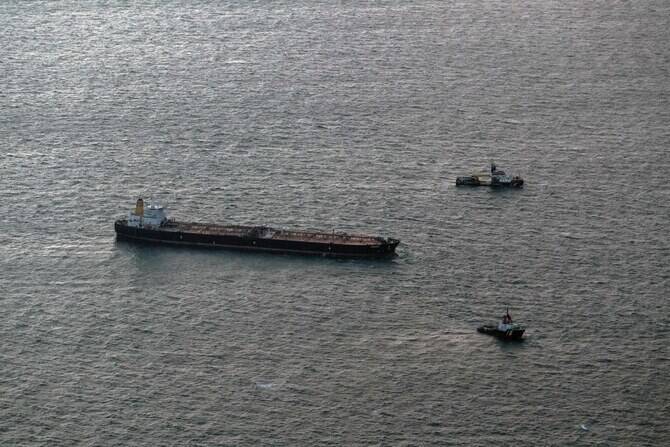
US and European pressure on Asian buyers of Russian energy could restrict India's oil imports from December, leading to cheaper supplies for China, while Japan is unlikely to halt its Sakhalin liquefied natural gas shipments for now, trade sources and analysts said. (AP/File)
Short Url
Updated 17 October 2025
Follow

Western pressure to hit Asian buying of Russian oil from December, sources say

  • Washington is exerting pressure on China, India and Japan through trade talks to reduce their purchases of Russian oil
  • China and India’s seaborne imports of key Russian crude grades are expected to rebound

NEW DELHI/SINGAPORE/TOKYO: US and European pressure on Asian buyers of Russian energy could restrict India’s oil imports from December, leading to cheaper supplies for China, while Japan is unlikely to halt its Sakhalin liquefied natural gas shipments for now, trade sources and analysts said.
Washington is exerting pressure on China, India and Japan through trade talks to reduce their purchases of Russian oil and LNG, while Britain has just imposed sanctions on Chinese and Indian entities. More sanctions from the European Union could follow. Western nations say Moscow is using its energy revenues to fund the Ukraine war.
The moves come after Russia ramped up crude exports this month as Ukrainian drone attacks on its refineries have reduced oil processing. China and India’s seaborne imports of key Russian crude grades are expected to rebound to about 3.1 million barrels per day in October, the highest volume since June, data from analytics firm Kpler showed.
These imports are expected to remain high through November given the sharp rise in exports from Russia, Kpler’s senior oil analyst Muyu Xu said.
“However, the sudden UK sanctions on Chinese and Indian refineries — and the possibility of more measures from the EU or even the US — could prompt buyers to take a more cautious approach when placing new orders until further clarification emerges,” she added.

INDIA CUTS NOT YET VISIBLE
A White House official said on Thursday that Indian refiners are already cutting Russian oil imports by 50 percent. Indian sources said the cut was not visible yet, though it could be reflected in import numbers for December or January. Refiners had already placed orders for November loading that included some cargoes for December arrival as well, multiple sources said.
“We do not think India can stop Russian crude purchases overnight, even if it has agreed to do so, as at least 700,000 bpd of India imports of Russian crude are on a term basis,” consultancy FGE said in a note.
“Therefore, the maximum volume of Russian crude flows to India we see as potentially being at risk in the short term is the 0.8-1 million bpd of spot volumes that Indian refiners take,” FGE analysts said. China could pick up some of the volumes backed out of India as Russian crude discounts will widen further, they added.
Meanwhile, Indian refiners have bought rare Guyanese crude as they diversify purchases that would mitigate the impact on their operations if Russian supply was cut.

SANCTIONS ON NAYARA, YULONG
Britain slapped sanctions on India’s Nayara refinery, which is already reeling from EU sanctions, and on Chinese refiner Yulong Petrochemical which operates a 400,000 barrels per day refinery in China’s eastern Shandong province.
The UK government has given Yulong until November 13 to complete outstanding transactions, allowing the refiner to handle its upcoming Middle Eastern imports, Kpler’s Xu said.
It’s unclear if Yulong can establish a new supply chain to circumvent the sanctions, she added.
“The move has undoubtedly sounded an alarm for other Russian oil buyers who may have previously overlooked sanctions from non-US authorities,” Xu said.
June Goh, a senior oil market analyst at Sparta Commodities, said the UK sanctions are unlikely to significantly impact Yulong, but the refiner will find it hard to maintain operations if the EU and the US follow suit.
Meanwhile, Taiwan’s Russian naphtha imports are set to fall after a group of non-governmental organizations criticized the island’s continued business with Russia.
However, Ukrainian attacks on Russian energy infrastructure, as well as a partial ban imposed by Moscow on Russian exports of gasoline and diesel, have already been capping Russian refined product shipments, traders said.

JAPAN LNG IMPORTS
The US has also called on Japan to halt Russian energy imports, ahead of US President Donald Trump’s expected visit to Asia later this month.
Tokyo has agreed with other G7 countries to phase out Russian oil imports in response to Moscow’s 2022 invasion of Ukraine, but it has exemptions to continue importing LNG from the Sakhalin-2 project under long-term contracts.
An early termination of these contracts would result in various penalties, said Yuriy Humber, CEO of Tokyo-based consultancy Yuri Group. Also, securing an additional 6 million metric tons of LNG annually on the spot market to replace Russian supply would not be easy and is “massively expensive,” he said.
Russian LNG, which accounts for about 9 percent of Japanese imports, is an important stable supply source for Japan, Kingo Hayashi, chairman of Japan’s Federation of Electric Power Companies, told reporters on Friday, adding that Japanese utilities want to continue using it.
Anne-Sophie Corbeau, a researcher at Columbia University’s Center on Global Energy Policy, said the US needs to have a consistent and coherent policy on Russian LNG.
“On the one side, they are pressuring their allies to stop importing Russian gas or LNG. But they are not implementing their own sanctions on Arctic LNG 2,” she said, referring to Russia’s large-scale LNG project in northern Siberia which is still delivering LNG to China despite being under US sanctions.


Women suicide bombers, new weapons give boost to insurgents in Pakistan

Updated 5 sec ago
Follow

Women suicide bombers, new weapons give boost to insurgents in Pakistan

  • Insurgents put images of women adherents on social media
  • Women recruits ‌fuel group’s propaganda, analysts say
ISLAMABAD: Wearing military fatigues with rifles slung over their shoulders, Yasma Baloch and her husband Waseem smile into the camera for a picture released by Pakistani insurgents after their final mission: detonating suicide bombs.
“They shared a marriage before they shared a final stand,” the Baloch Liberation Army (BLA) said in a statement accompanying the heavily-edited photograph sent to journalists and distributed on social media.
It was among half-a-dozen pictures and biographies that Reuters was unable to immediately verify, but which analysts see as part of a propaganda effort by insurgents in the resource-rich southwestern province to showcase their movement’s appeal.
Insurgent attacks in Pakistan’s largest yet poorest province hit a record last year, fanning risks to huge investments planned in the region, including Chinese and US interests.
Wider ethnic appeal
The growing numbers of women help to boost recruitment, said junior interior minister Talal Chaudhry, in the insurgents’ decades-long battle for greater autonomy and a bigger share of regional resources and critical minerals.
“It gives them popularity and reach, and it impresses on their community that the fight has entered their homes,” Chaudhry told Reuters.
Pakistan has taken up the issue of insurgent recruitment online with numerous social media platforms, ‌he added.
A spokesperson ‌for the BLA did not respond to a request for comment.
Three suicide bombers were among six ‌women ⁠who participated in the ⁠group’s largest wave of attacks in January that killed 58 and nearly brought the province to a standstill, said Hamza Shafaat, a top government official.
Before those attacks, records show a total of five women BLA suicide bombers, including the first such attack in 2022, while three more would-be bombers were captured in counter-terrorism operations in the last some months.
While authorities know of only a small number of women who have joined the ranks of the BLA, analysts say the recruitments point to the group’s widening appeal among ethnic Baloch residents.
“The … insurgency’s broader appeal … has now gone beyond male-dominated tribal and feudal chiefs to include a wider cross-section of society,” said Pearl Pandya, a senior South Asia analyst at conflict monitor ACLED.
‘Most lethal insurgent group’
The participation of women amplifies a ⁠movement that Pakistan’s military says has boosted its firepower with access to a massive cache of US weapons ‌left behind in Afghanistan after Washington pulled out of the neighboring country in 2021.
“In South ‌Asia today, the BLA is the most organized and lethal insurgent group,” said Abdul Basit, a researcher in insurgencies and militancy at Nanyang Technological University in Singapore.
He ‌cited the group’s use of drones to identify troop deployments and vulnerabilities, adding that it used satellite communication during a February 2025 hijack ‌of a train with more than 400 aboard.
Pakistan recovered 272 US made rifles and 33 night vision devices by June last year, its military says, apart from the weapons seized in the most recent Balochistan attacks.
The armed forces “keep on seeing these weapons in the hands of the terrorists operating inside Pakistan,” their spokesperson, Lt. General Ahmed Sharif Chaudhry, told Reuters before January’s attacks.
The Pentagon did not respond to a request for comment.
In reply to a request for comment, White House ‌spokeswoman Anna Kelly said, “As President Trump has said, Joe Biden’s botched Afghanistan withdrawal was the most embarrassing day in our country’s history, which tragically resulted in the deaths of 13 US service members and lost ⁠equipment to the Taliban.”
She added, “We do ⁠not discuss private conversations with foreign governments.”
During more than a dozen coordinated attacks in January, the insurgents stormed hospitals, government buildings, and markets, set off bombs and fired into crowds, killing 58 civilians and security officials.
‘Dangerous evolution in tactics’
Afterwards, from the 216 militants that security forces said were killed in nearly a week of fighting, they seized items ranging from grenade launchers to more than a dozen M16 and M4 rifles.
Reuters was unable to verify whether the sophisticated weapons used in the BLA attacks were made in the United States or came from elsewhere.
Among the $7 billion worth of equipment left in Afghanistan, the US defense department has said, Afghan forces had received more than 300,000 of a total of 427,300 weapons.
That was in addition to more than 42,000 items such as night vision goggles and surveillance devices, it said.
And the insurgents hope propaganda about women recruits will boost their impact.
“They are using women strategically in high-profile attacks for visibility,” Basit added.
The women hail from various socio-economic backgrounds, with some having university education, Pakistan’s counter terrorism department said in a December report seen by Reuters.
“The shift represents a dangerous evolution in terrorist tactics,” it said, about women’s growing participation.
The change was driven by psychological manipulation, online radicalization and strategic exploitation of vulnerable individuals, it added.
“The insurgency’s foot soldiers and leaders both now come from the middle class,” said Pandya, the ACLED analyst.