

Afghans return home to rubble hoping truce holds with Pakistan

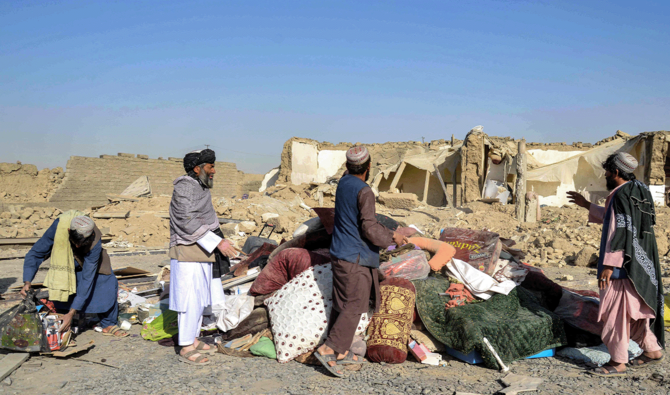
Afghan people stand along with belongings outside their damaged house in the Spin Boldak district of Kandahar province of Afghanistan on October 16, 2025, a day after the cross-border clashes between Afghanistan and Pakistan. (AFP)
Short Url
Updated 17 October 2025
Follow

Afghans return home to rubble hoping truce holds with Pakistan

  • The UN recorded 37 civilians killed and 425 injured in recent days on the Afghan side
  • Islamabad said the temporary truce would last 48 hours, which ends on Friday evening

KABUL: Abdul Rahim surveys the rubble that was his home in Kabul, where he lived with six family members.

A gaping hole in the living room reveals only charred belongings and debris, while blackened teddy bears and makeup lie in what once was a bedroom.

The explosion at his home was one of four that hit the Afghan capital within a week, as unusually intense violence broke out with Pakistan — then suddenly halted under a temporary truce.

The fighting — which has left dozens of troops and civilians dead on both sides, mostly in border regions — represents the worst clashes between the neighbors since the Taliban returned to power in 2021.

“We were attending a graduation ceremony when I learned that an explosion had struck my house around 4:00 pm,” Rahim, a motorcycle vendor, tells AFP.

Two explosions occurred Wednesday afternoon following aerial bombardments, according to Kabul police spokesman Khalid Zadran. The strikes plunged central Kabul into terror.

Pakistani security sources meanwhile said they carried out “precision strikes” against an armed group.

Stunned residents have been clearing the rubble, hoping the ceasefire will hold.

“When I returned, I saw shattered windows, injured people lying on the road, and several dead,” says Rahim, now forced to live with relatives.

“War is not a solution — we hope for dialogue,” he pleads.

Next door, a yellow-walled school has also been gutted.

‘NOT A SOLUTION’

At least five dead and 35 injured were transported to a Kabul hospital Wednesday afternoon, according to Italian NGO EMERGENCY, which runs the facility.

No official death toll has been released.

Passersby stop to stare at the devastation, kept at a distance by security cordons and numerous personnel.

Three hundred meters away, a market in a residential area was also hit, with videos shared by local media showing a fireball engulfing the neighborhood.

Next to a tall building where at least seven stories can be seen charred, Safiullah Hamidi, a 21-year-old student says his uncle’s apartment was among those impacted.

“Pakistan should fight with our army if they want a confrontation, but not by bombing civilians,” he says.

Nearby, Samir Ousmani gathers up metal bars littering his car wash station, almost entirely destroyed.

“One of my employees was killed, and two others, along with my uncle, were injured,” reports the 22-year-old.

HOLDING THEIR BREATH

At the border, where the clashes have been concentrated, residents who had fled are returning home.

“Stores have reopened, and everyone is going about their business, but the border is still closed,” says Naqibullah, a 35-year-old merchant in Spin Boldak, Kandahar province.

The death toll continues to mount.

In the border town, 40 civilians were killed Wednesday in exchanges of fire with the Pakistani army, according to local health authorities.

The UN recorded 37 civilians killed and 425 injured in recent days on the Afghan side.

“Yesterday, the situation was terrible because of the war. I hope it doesn’t resume because there have already been too many victims,” says Aminullah, 22.

Islamabad said the temporary truce would last 48 hours, which ends on Friday evening.

“We are waiting to see what happens tomorrow,” says Shamsullah, 36, a biryani vendor.

Pakistan’s Prime Minister Shehbaz Sharif said Thursday that for the truce to endure, the ball was “in the court” of the Taliban government.

Kabul has not immediately commented.


Pakistan offers Kyrgyzstan Arabian Sea access as two states sign 15 cooperation accords

Updated 05 December 2025
Follow

Pakistan offers Kyrgyzstan Arabian Sea access as two states sign 15 cooperation accords

  • Pakistan and Kyrgyzstan sign MOUs spanning trade, energy, agriculture, ports, education, security cooperation
  • Kyrgyz president is on first visit to Pakistan in 20 years as both sides push connectivity and CASA-1000 power links

ISLAMABAD: Pakistan on Thursday offered Kyrgyzstan the shortest and most economical route to the Arabian Sea as the two countries signed 15 agreements and memoranda of understanding aimed at boosting cooperation across trade, energy, agriculture, education, customs data-sharing and port logistics.

The accords were signed during a visit to Islamabad by President Sadyr Zhaparov, the first by a Kyrgyz head of state to Pakistan in two decades, and part of Islamabad’s renewed push to link South Asia with landlocked Central Asian economies through ports, power corridors and transport routes.

For Pakistan, Kyrgyzstan offers access to hydropower through CASA-1000, a $1.2 billion regional electricity transmission project designed to carry surplus summer electricity from Kyrgyzstan and Tajikistan through Afghanistan into Pakistan. For Bishkek, Pakistan provides overland access to warm-water ports on the Arabian Sea, creating a shorter commercial route to global markets.

“President Asif Ali Zardari has reiterated Pakistan’s readiness to offer Kyrgyzstan the shortest and most economical route to the Arabian Sea,” Radio Pakistan reported after Zhaparov met the Pakistani president. 

The two leaders also discussed expanding direct flights to deepen business, tourism and people-to-people ties.

Zardari welcomed Kyrgyzstan’s completion of its segment of the CASA-1000 project and “reaffirmed Pakistan’s commitment to completing its part of the project, which is now at an advanced stage,” the state broadcaster said. 

Zhaparov thanked Islamabad for supporting Bishkek’s candidacy for a non-permanent UN Security Council seat and invited Zardari to visit Kyrgyzstan at a time of his convenience. Both sides expressed satisfaction with progress under the Quadrilateral Traffic in Transit Agreement, designed to facilitate road movement between Pakistan, Kyrgyzstan, Kazakhstan and China.

Earlier, both governments exchanged 15 sectoral cooperation documents covering commerce, mining, geosciences, power, agriculture, youth programs, the exchange of convicted persons, customs electronic data systems and a sister-city linkage between Islamabad and Bishkek.

According to APP, the MOUs were signed by ministers representing foreign affairs, commerce, economy, energy, power, railways, interior, culture, health and tourism. Agreements also covered cooperation between Pakistan’s Foreign Service Academy and the Diplomatic Academy of Kyrgyzstan, as well as collaboration between universities, youth ministries and cultural institutions.

“Our present mutual trade, comprising of about $15–16 million will be enhanced to $200 million in the next two years,” Prime Minister Shehbaz Sharif said after the agreements were signed, calling them “a framework for structured, result-oriented engagement and closer institutional linkages.”

Sharif said Pakistan was ready to serve as a maritime outlet for the landlocked Central Asian republic, offering access to Karachi, Port Qasim and Gwadar to help Kyrgyz goods reach regional and global markets.