

PM Sharif says ball in Afghanistan’s court as Qatar helps ease tensions between two countries

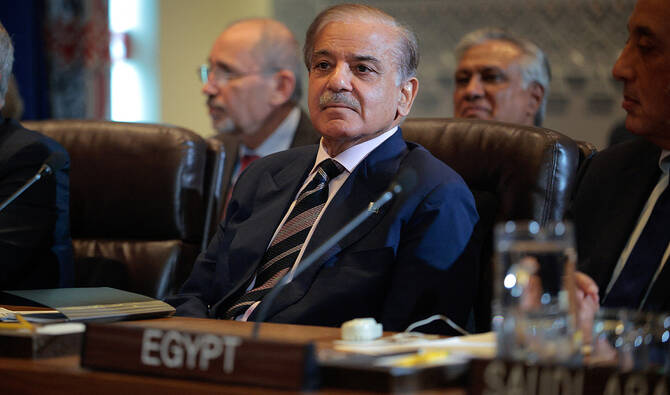
Prime Minister of Pakistan Shehbaz Sharif attends a multilateral meeting with U.S. President Donald Trump and leaders from several Arab and Muslim-majority countries at the 80th session of the UN’s General Assembly (UNGA) at the United Nations headquarters on September 23, 2025 in New York City. (AFP/File)
Short Url
Updated 16 October 2025
Follow

PM Sharif says ball in Afghanistan’s court as Qatar helps ease tensions between two countries

  • Border clashes killed dozens in both neighboring states before a temporary ceasefire was announced on Wednesday
  • Pakistan says it is willing to resolve issues peacefully but warns​ ceasefire should not be used by Kabul to buy time

ISLAMABAD: Prime Minister Shehbaz Sharif said on Thursday his country’s international partners, particularly Qatar, were playing a role in efforts to resolve ongoing hostilities with Afghanistan, adding that Islamabad had agreed to a 48-hour ceasefire announced a day earlier at Kabul’s request and that “the ball is now in their court.”

Relations between Pakistan and Afghanistan have sharply deteriorated in recent years, with Islamabad accusing Kabul of sheltering fighters from the banned Tehreek-e-Taliban Pakistan (TTP) and separatist Baloch Liberation Army (BLA), allowing them to stage cross-border attacks from Afghan soil. Kabul denies the allegation, saying it does not permit its territory to be used against other countries.

Sporadic clashes between the two countries began last Saturday night, killing dozens of people on both sides, after Afghan officials accused Pakistan of violating its airspace and bombing a border town. The escalation has strained already frayed ties, coming as Afghanistan’s foreign minister visited India. Pakistan views New Delhi’s growing influence in Afghanistan as a regional security threat, given their long-standing rivalry.

Islamabad and Kabul announced a temporary ceasefire on Wednesday afternoon, with Pakistan’s foreign office saying “both sides will make a sincere effort to find a constructive solution to this complex yet resolvable issue through meaningful dialogue.”

“They [the Afghans] requested for a ceasefire,” Sharif said in his opening remarks to the federal cabinet. “If they want to resolve bilateral issues peacefully, we are ready to do so. They were given this message yesterday. The ball is now in their court.”

The prime minister said Pakistan wanted friendly relations with Afghanistan but accused the Taliban authorities in Kabul of giving a free rein to anti-Pakistan militant groups and facilitating their cross-border raids.

“Militants operating from Afghanistan are not only martyring innocent citizens in Pakistan, but have also martyred soldiers, police and law enforcement officials,” he said, adding that the recent surge in militant incidents had tested Islamabad’s patience.

Sharif said his government had engaged Kabul repeatedly through diplomatic channels to resolve tensions.

“The deputy prime minister and defense minister have both been to Kabul more than once,” he said. “We talked to them in a good manner. We are neighbors and will continue to live side by side till the Day of Judgment. It is up to us to resolve our issues peacefully.”

He added that Pakistan’s “friends, especially Qatar,” were working to help defuse the situation.

Qatar has long played a key diplomatic role in Afghanistan.

The Afghan Taliban were allowed to open their political office in Doha while US-led forces were still in Kabul, and it was there that American officials and the Taliban reached a negotiated settlement before international troops withdrew from Afghanistan in August 2021.

Pakistan has since said the intensity of militant attacks by groups such as the TTP and BLA has increased, suggesting they operate under Kabul’s patronage.

Sharif reiterated Pakistan’s willingness to pursue peace through dialogue with the Afghan Taliban but warned against insincerity.

“This ceasefire has come into existence at their request,” he said. “But if it is only to buy time, we will not accept it.”



Pakistan offers Turkmenistan its Arabian Sea ports for wider access to ‘South Asia and beyond’

Updated 4 sec ago
Follow

Pakistan offers Turkmenistan its Arabian Sea ports for wider access to ‘South Asia and beyond’

  • PM Sharif meets Turkmen president in Ashgabat, calls for deeper trade and energy cooperation
  • Islamabad cites Karachi and Gwadar as key to boosting regional connectivity, including TAPI links

ISLAMABAD: Pakistan on Thursday urged Turkmenistan to expand trade and connectivity through Karachi and Gwadar, saying its Arabian Sea ports offer Turkmen businesses and exporters a direct route to South Asian and global markets, Prime Minister Shehbaz Sharif’s office said after high-level talks in Ashgabat.

Pakistan and Turkmenistan have long discussed regional transport corridors and energy cooperation, including the Turkmenistan–Afghanistan–Pakistan–India (TAPI) gas pipeline, a proposed multibillion-dollar project that would carry Turkmen natural gas south through Afghanistan into Pakistan and India. Islamabad has also pushed to link the landlocked Central Asian states to the sea by offering transit access through its deep-water ports, which sit at the crossroads of the Middle East, Central Asia and South Asia.

On Thursday, Pakistan's Sharif met Serdar Berdimuhamedov, the president of Turkmenistan, in Ashgabat as both countries look to revive momentum in bilateral engagement after years of regional instability. Pakistan has supported Turkmen neutrality policies at the United Nations, while Ashgabat has backed Pakistan during crises, including helping evacuate Pakistani nationals caught in Iran during the Iran–Israel conflict earlier this year.

“The Prime Minister reaffirmed Pakistan’s desire to enhance connectivity with Turkmenistan through land and sea routes and said that Karachi and Gwadar ports were ideally located to be utilized by the Turkmen side to enhance their outreach to South Asia and beyond,” Sharif’s office said in a statement.

Sharif reiterated his intention to deepen trade and economic ties with Turkmenistan, saying enhanced transport links and energy cooperation could anchor long-term regional integration. He invited President Berdimuhamedow and Turkmenistan’s national leader, Gurbanguly Berdimuhamedow, on official visits to Pakistan next year.

Sharif is on a two-day visit to Turkmenistan for the International Forum on Peace and Trust, accompanied by Deputy Prime Minister and Foreign Minister Ishaq Dar, Energy Minister Awais Leghari, Information Minister Attaullah Tarar and senior officials.

Turkmenistan’s president thanked Sharif for attending the UN-backed peace forum and said Ashgabat was keen to expand cooperation across multiple sectors, according to the statement.