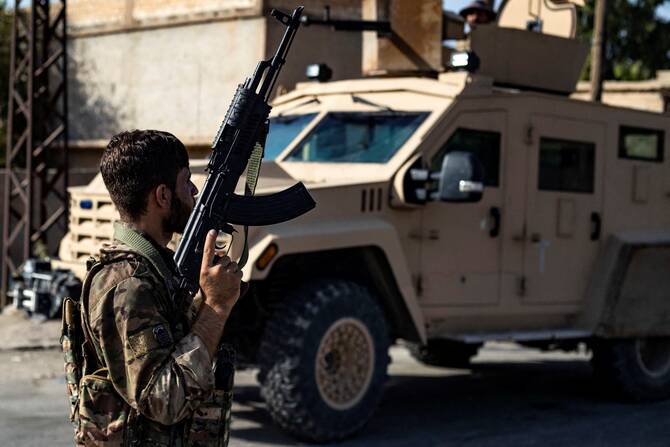
DAMASCUS: A blast targeting a bus in Syria’s eastern province of Deir Ezzor on Thursday killed at least five defense ministry personnel, an official from the ministry told AFP.
“An explosive device detonated as a bus carrying oil facility guards affiliated with the defense ministry passed by, killing five of them and wounding 13 others, including civilian bystanders,” the official said, requesting anonymity.
State television said a blast hit a bus on the road between the cities of Deir Ezzor and Mayadeen, some 50 kilometers (30 miles) away.
No group immediately claimed responsibility for the attack, but a human rights observatory said the perpetrators were “likely affiliated with a Daesh group cell.”
Daesh militants, once in control of large swathes of Iraq and Syria, were territorially defeated in Syria in 2019 in a battle spearheaded by the US-backed, Kurdish-led Syrian Democratic Forces (SDF) with support from an international coalition.
The militants still maintain a presence, particularly in Syria’s vast desert, launching attacks mostly on Kurdish-controlled areas in the country’s northeast.
During Syria’s civil war, which erupted in 2011, Daesh carried out similar attacks on buses targeting the forces of former ruler Bashar Assad.
Since the new Islamist-led authorities took power after Assad’s December ouster, militant attacks on government-controlled areas have been scarce.
In May, Daesh claimed its first attack on the new forces, with the Observatory saying one member of Syrian army personnel was killed and three others wounded.
The following month, authorities accused Daesh of being behind a deadly suicide attack in a Damascus church that killed 25 people, though the group never claimed responsibility.

Syria bus blast kills five defense ministry personnel: official
Short Url
https://arab.news/8nvee
Syria bus blast kills five defense ministry personnel: official
- “An explosive device detonated as a bus carrying oil facility guards affiliated with the defense ministry passed by,” the official said
- No group immediately claimed responsibility for the attack
Syria opens first public trial over deadly coastal violence
ALEPPO: The first trial was opened on Tuesday of some of the hundreds of suspects linked to deadly clashes in Syria’s coastal provinces earlier this year that quickly spiraled into sectarian attacks.
State media reported that 14 people were brought to Aleppo’s Palace of Justice following a monthslong, government-led investigation into the violence in March involving government forces and supporters of ousted Syrian President Bashar Assad. The investigating committee referred 563 suspects to the judiciary.
Seven of the defendants in the court were Assad loyalists, while the other seven were members of the new government’s security forces. A judge was heard during the televised proceedings asking they were military or civilian.
The trial follows pressure from local civil society and the international community for the country’s new rulers to commit to judicial reform after decades under the autocratic rule of the Assad dynasty.
Despite initial reports from state media that charges could quickly be brought against the defendants, the judge closed the session and rescheduled the next hearing for December.
The charges could include sedition, inciting civil war, attacking security forces, murder, looting and leading armed gangs, state media reported.
Given the scale of the violence and number of suspects, it’s unclear how long the proceedings will take.
The clashes in March erupted after armed groups aligned with Assad ambushed the new government’s security forces. A counteroffensive then spiraled into sectarian revenge attacks and massacres of hundreds of civilians from the Alawite religious minority to which Assad belongs and who largely live along the coast.
The attacks on the Alawite religious minority mounted pressure on interim President Ahmad Al-Sharaa. Since coming to power in December, his government has scrambled to step out from diplomatic isolation and convince the US to drop crippling sanctions and boost trade to rebuild the war-torn country.
The government’s investigating committee in July concluded that over 1,400 people, mostly civilians, were killed during several days of sectarian violence. But the inquiry said there was no evidence that Syria’s new military leaders had ordered attacks on the Alawite community.
A United Nations probe, however, said violence targeting civilians by government-aligned factions were “widespread and systematic.”
The UN commission said during the violence homes in Alawite-majority areas were raided and civilians were asked “whether they were Sunni or Alawite.” It said: ”Alawite men and boys were then taken away to be executed.”
State media reported that 14 people were brought to Aleppo’s Palace of Justice following a monthslong, government-led investigation into the violence in March involving government forces and supporters of ousted Syrian President Bashar Assad. The investigating committee referred 563 suspects to the judiciary.
Seven of the defendants in the court were Assad loyalists, while the other seven were members of the new government’s security forces. A judge was heard during the televised proceedings asking they were military or civilian.
The trial follows pressure from local civil society and the international community for the country’s new rulers to commit to judicial reform after decades under the autocratic rule of the Assad dynasty.
Despite initial reports from state media that charges could quickly be brought against the defendants, the judge closed the session and rescheduled the next hearing for December.
The charges could include sedition, inciting civil war, attacking security forces, murder, looting and leading armed gangs, state media reported.
Given the scale of the violence and number of suspects, it’s unclear how long the proceedings will take.
The clashes in March erupted after armed groups aligned with Assad ambushed the new government’s security forces. A counteroffensive then spiraled into sectarian revenge attacks and massacres of hundreds of civilians from the Alawite religious minority to which Assad belongs and who largely live along the coast.
The attacks on the Alawite religious minority mounted pressure on interim President Ahmad Al-Sharaa. Since coming to power in December, his government has scrambled to step out from diplomatic isolation and convince the US to drop crippling sanctions and boost trade to rebuild the war-torn country.
The government’s investigating committee in July concluded that over 1,400 people, mostly civilians, were killed during several days of sectarian violence. But the inquiry said there was no evidence that Syria’s new military leaders had ordered attacks on the Alawite community.
A United Nations probe, however, said violence targeting civilians by government-aligned factions were “widespread and systematic.”
The UN commission said during the violence homes in Alawite-majority areas were raided and civilians were asked “whether they were Sunni or Alawite.” It said: ”Alawite men and boys were then taken away to be executed.”
© 2025 SAUDI RESEARCH & PUBLISHING COMPANY, All Rights Reserved And subject to Terms of Use Agreement.