Economists warn floods could weigh on Pakistan’s economy as IMF clears $1.2 billion in reviews

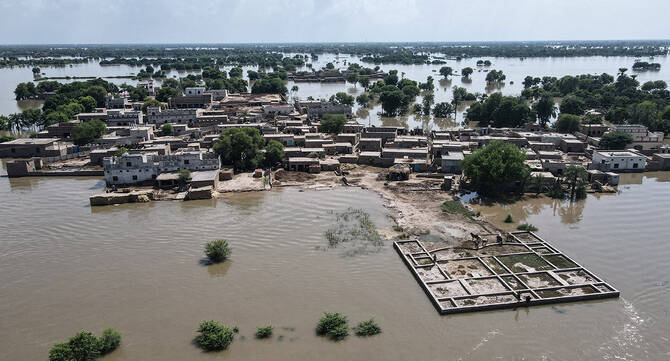
An aerial view shows partially submerged residential houses in Jalalpur Pirwala, in the Multan district of Pakistan's Punjab province on September 9, 2025, after the Chenab River overflowed following heavy monsoon rains. (AFP/ file)
Short Url
Updated 17 October 2025
Follow

Economists warn floods could weigh on Pakistan’s economy as IMF clears $1.2 billion in reviews

  • Flood losses may force higher cotton imports and increase poverty and unemployment in coming days, economists warn
  • They also call the IMF staff-level agreement a ‘significant development’ that could help maintain macroeconomic stability

KARACHI: Pakistani economists warned this week that recent floods could weigh down the national economy, even as the International Monetary Fund (IMF) approved Islamabad’s economic performance in its latest reviews under two lending programs this week, paving the way for the release of $1.2 billion.

The IMF announced on Tuesday that it had reached a staff-level agreement with Pakistan on the second review of its $7 billion Extended Fund Facility (EFF) and the first review of the $1.4 billion Resilience and Sustainability Facility (RSF).

The agreement, pending approval by the Fund’s executive board, will provide balance-of-payments support and strengthen the country’s capacity to respond to climate shocks.

“This time, the government has this fiscal pressure, and this is a key risk,” said Muhammad Waqas Ghani, head of research at JS Global Capital Ltd., referring to flood losses estimated at around $3.5 billion.

“The government will have to really cope up with the challenge,” he added.

Finance Minister Muhammad Aurangzeb, who met IMF Managing Director Kristalina Georgieva in Washington this week, expressed satisfaction with the staff-level agreement, saying Pakistan had achieved macroeconomic stabilization.

He said the government was “committed to staying the course on reforms in taxation, energy, state-owned enterprises and privatization,” while seeking investments in mining, digital infrastructure, agriculture, oil and gas, and pharmaceuticals.

Economist Ahsen Mehanti, chief executive officer of Arif Habib Commodities Ltd., described the IMF agreement as a “significant development,” noting that earlier uncertainty had weighed on Pakistan’s markets amid reports that the Fund had identified a “mismatch” in Pakistan’s trade data and wanted adjustments.

“There was quite a bit of uncertainty, which was causing the markets, especially the stock markets, to fall in Pakistan, because the IMF tranche of around $1.2 billion was in question,” he said.

Pakistan’s benchmark KSE-100 Index rebounded sharply after the announcement, recovering more than 7,000 points in a single session on Oct. 14 and gaining about 5 percent over the next two days.

Mehanti said his estimates suggested that the floods had caused about $5 billion in losses that would impact the exchequer through higher import costs, particularly for cotton.

“Cotton will be important in the coming period,” he said.

All Pakistan Textile Mills Association Chairman Kamran Arshad has echoed the same opinion, saying millers were likely to double cotton imports to about $3 billion this year as floods destroyed thousands of acres of crops in the eastern Punjab province.

“In the upcoming period, the impact of flood losses in terms of increased poverty and unemployment levels will be seen,” Mehanti said.

However, economists said the staff-level agreement would largely help Pakistan maintain macroeconomic stability and encourage foreign investment from partners such as China and Saudi Arabia.

“We are expecting this development [signing of the agreement] to maintain economic stability, which is [expected to bring] in Chinese investment,” said Mehanti, adding that he also expected to see positive movement in the mining and agricultural sectors alongside a potential $10 billion refinery investment from Saudi Arabia after its defense pact with Pakistan.

While the IMF deal has eased short-term concerns, analysts said Pakistan would continue to face the perpetual threat of political unrest, as demonstrated by the recent protests by a religio-political party that led to serious clashes with the police.

“This is one of the major problems the country faces,” Ghani said, referring to sporadic political demonstrations.

“If we remember 2017, the economy basically got derailed because of political instability,” he added. “So, obviously, it’s serious.”


Pakistan making diplomatic efforts to de-escalate Middle East tensions, FM says

Updated 02 March 2026
Follow

Pakistan making diplomatic efforts to de-escalate Middle East tensions, FM says

  • The statement came as Iran pressed on with a third day of strikes in the Gulf in response to US-Israeli air raids
  • Pakistan’s position is clear that all countries must abide by principles of UN Charter, international law, FM says

ISLAMABAD: Pakistan is making diplomatic efforts to de-escalate heightened tensions in the Middle East, Foreign Minister Ishaq Dar said on Monday, amid US-Israeli strikes on Iran and Tehran’s counterstrikes against US bases in Gulf countries.

Tensions escalated across the Middle East on Saturday after coordinated US-Israel strikes killed Supreme Leader Ali Khamenei among other senior Iranian officials. Tehran responded by targeting US military bases in the UAE, Bahrain, Qatar, Kuwait and Jordan. Saudi Arabia said Iran also launched attacks targeting Riyadh and the Eastern Province.

The Iranian missile and drone strikes continued on Monday in retaliation for the ongoing US-Israeli air raids, casting uncertainty over the future of the Islamic republic and heightening the risk of broader instability in the already volatile region.

Speaking at a press conference, FM Dar, who recently returned from Saudi Arabia where he attended an Organization of Islamic Cooperation OIC) meeting on Palestine, said Pakistan is very closely monitoring the evolving situation in Iran and the tensions which are building up in the region.

“These serious developments have taken place at a time when diplomatic efforts were underway to reach a peaceful and negotiated solution to [Iran nuclear program],” he said.

“We are making our full diplomatic efforts and, you know, requesting all parties to de-escalate and to refrain.”

Dar said Islamabad was concerned over a violation of the norms and international law, and the age-old tradition that the heads of state and the government should not be targeted.

“Post-World War II, we all know that these institutions were created to create some international, you know, law and order, and that’s why there was a UN Charter. There are certain conventions which we all are supposed to follow,” he said.

“But things are on ground moving very differently, which obviously is worrisome... The international law must prevail and the conventions must be respected.”

The statement came hours after the Ras Tanura oil refinery in Saudi Arabia sustained limited damage as a result of debris from the interception of two drones in its vicinity, the Saudi Press Agency reported, citing an official source at the Saudi Ministry of Energy.

Several American warplanes crashed in Kuwait on Monday morning but their crew survived, Kuwait’s defense ministry said, as Iran pressed on with a third day of strikes in the Gulf.

Dar said Pakistan’s position has been clear and persistent that all countries must abide by the principles of UN Charter and international law, including respect for the sovereignty and territorial integrity of other states as well as international humanitarian law.

“In my latest conversation with [Iranian] Foreign Minister Abbas Araqshi on 28th of February, I conveyed Pakistan’s condemnation of the attacks and called for restraint and diplomacy and dialogue, which he positively responded,” he shared.

“But on ground, we are seeing that things are not yet settling or easing out.”

Pakistan stands in full solidarity with all its brotherly countries and underscores the need to exercise maximum restraint, according to FM Dar.

“This is a message we have been giving to whosoever prime minister speaks, whosoever I speak, or whosoever Field Marshal Asim Munir speaks to, his counterparts on the defense side,” he said.