

Pakistan’s finance chief says economic liberalization, structural reforms to trigger ‘East Asia moment’

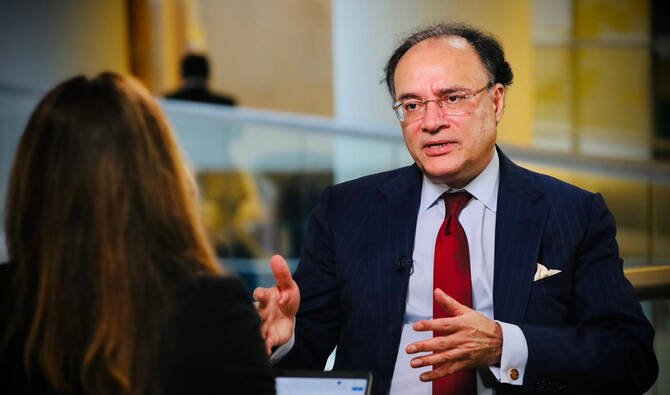
Pakistan’s Federal Minister for Finance and Revenue, Muhammad Aurangzeb, during an interview with an American news channel, CNBC, in Washington D.C., on October 15, 2025. (Finance Ministry)
Short Url
Updated 15 October 2025
Follow

Pakistan’s finance chief says economic liberalization, structural reforms to trigger ‘East Asia moment’

  • Aurangzeb says Pakistan cannot keep shielding protected industries and must build competitiveness to boost exports
  • Finance minister cites progress in taxation, energy, privatization and public finance reforms under IMF-backed program

KARACHI: Federal Minister for Finance and Revenue Muhammad Aurangzeb on Wednesday highlighted Pakistan’s policy of trade and economic liberalization during an interview with an American news channel, saying that combined with the ongoing reform momentum, these policies could generate an “East Asia moment.”

Aurangzeb, currently in Washington D.C. to attend the World Bank and International Monetary Fund annual meetings, spoke to CNBC about Pakistan’s improving macroeconomic indicators and the government’s focus on structural transformation to sustain growth and stability.

Speaking about the overall global trade dynamics, the finance minister said Pakistan’s economic focus was shifting away from protectionism.

“We cannot continue to shield industries which have received protection for the longest time,” he said, adding that if Pakistan has to grow, “it has to have industries which are competitive and which can export.”

He noted that macroeconomic stability and structural reforms must go hand in hand, citing progress in taxation, energy, privatization of state-owned enterprises and public finance management as integral to the government’s reform agenda.

Pakistan began implementing stringent economic reforms after finding itself on the verge of default in mid-2023.

The country’s performance has also been recognized by all three major global rating agencies, which have upgraded Pakistan’s outlook in recent months, a validation of what Aurangzeb described as the country’s improving “economic trajectory and reform agenda.”

“We feel this can be an ‘East Asia moment’ for Pakistan in terms of liberalizing the economy,” he said, drawing a broader perspective on the country’s reform path.

He also acknowledged the strong partnership with the United States and commended the World Bank Group for supporting Pakistan’s reform efforts, reaffirming the government’s commitment to sustaining implementation and positioning the country on a “sustainable, outward-looking growth path.”


IMF board to approve Pakistan reviews today ‘if all goes well,’ say officials

Updated 08 December 2025
Follow

IMF board to approve Pakistan reviews today ‘if all goes well,’ say officials

  • IMF’s executive board is scheduled to meet today to discuss the disbursement of $1.2 billion
  • Economists say the money will boost Pakistan’s forex reserves, send positive signals to investors

KARACHI: The International Monetary Fund’s (IMF) executive board is scheduled to meet today, Monday, to approve the release of about $1.2 billion for Pakistan under the lender’s two loan facilities, said IMF officials who requested not to be named.

The IMF officials confirmed the executive board was going to decide on the Fund’s second review under the $7 billion Extended Fund Facility (EFF) and first review under the $1.4 billion Resilience and Sustainability Facility (RSF), a financing tool that provides long-term, low-cost loans to help countries address climate risks.

“The board meeting will be taking place as planned,” an IMF official told Arab News.

“The board is on today yes as per the calendar,” said another.

A well-placed official at Pakistan’s finance ministry also confirmed the board meeting was scheduled today to discuss the next tranche for Pakistan.

The IMF executive board’s meeting comes nearly two months after a staff-level agreement (SLA) was signed between the two sides in October.

Procedurally, the SLAs are subject to approval by the executive board, though it is largely viewed as a formality.

“If all goes well, the reviews should pass,” said the second IMF official.

On approval, Pakistan will have access to about $1 billion under the EFF and about $200 million under the RSF, the IMF said in a statement in October after the SLA.

The fresh transfer will bring total disbursements under the two arrangements to about $3.3 billion, it added.

Experts see smooth sailing for Pakistan in terms of the passing of the two reviews, saying the IMF disbursements will help the cash-strapped nation to strengthen its balance of payments position.

Samiullah Tariq, group head of research at Pakistan Kuwait Investment Company Limited, said the IMF board’s approval will show that Pakistan’s economy is on the right path.

“It obviously will help strengthen [the country’s] external sector, the balance of payments,” he told Arab News.

Until recently, Pakistan grappled with a macroeconomic crisis that drained its financial resources and triggered a balance of payments crisis.

Pakistan has reported financial gains since 2022, recording current account surpluses and taming inflation that touched unprecedented levels in mid-2023.

Economists also viewed the IMF’s bailout packages as crucial for cash-strapped Pakistan, which has relied heavily on financing from bilateral partners such as Saudi Arabia, China and the United Arab Emirates, as well as multilateral lenders.

Saudi Arabia, through the Saudi Fund for Development, last week extended the term of its $3 billion deposit for another year to help Pakistan boost its foreign exchange reserves, which stood at $14.5 billion as of November 28, according to State Bank of Pakistan statements.

“In our view this [IMF tranche] will be approved,” said Shankar Talreja, head of research at Karachi-based brokerage Topline Securities Limited.

“This will help strengthen reserves and will eventually help a rating upgrade going forward,” he said.

The IMF board’s nod, Talreja said, would also send a signal to the international and local investors regarding the continuation of the reform agenda by Pakistan’s government.
