

KSrelief initiative to promote sustainable food security globally

1 / 3
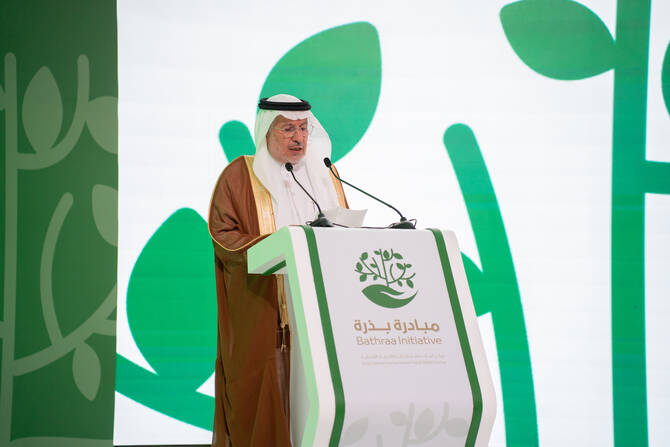
Dr. Abdullah Al-Rabeeah, supervisor-general of KSrelief, speaks at the launch of the Bathraa initiative. (AN photo by Jaafer Alsaleh)
2 / 3
Dr. Abdullah Al-Rabeeah, supervisor-general of KSrelief, speaks at the launch of the Bathraa initiative. (AN photo by Jaafer Alsaleh)
3 / 3
Dr. Abdullah Al-Rabeeah, supervisor-general of KSrelief, speaks at the launch of the Bathraa initiative. (AN photo by Jaafer Alsaleh)
Short Url
Updated 15 October 2025
Follow

KSrelief initiative to promote sustainable food security globally

  • Program aims to reduce dependency and strengthen long-term agricultural resilience
  • Yemeni farmers gain access to technology, training, and sustainable farming methods

RIYADH: In an effort to improve global food security, Saudi aid agency KSrelief launched an initiative on Wednesday in Riyadh aimed at transforming small rural farm producers from aid recipients into active participants.

Among developing countries, the agency is taking the Bathraa initiative first into Yemen, where almost half of the population struggles with severe food insecurity. KSrelief officials hope to address the urgent needs of Yemenis while building long-term agricultural resilience.

Dr. Abdullah Al-Rabeeah, supervisor-general of KSrelief, told Arab News that Bathraa is among various initiatives undertaken by the agency “to empower communities, especially fragile communities globally, in the region and beyond, to ensure that we reach the sustainable development goals of the UN.”

He added: “If we look at Bathraa, it actually converts people, or communities, from being dependent on food to making food for themselves by supporting agriculture, farming, honey production, fishing, and you name it.”

The aim, he said, is to transform Bathraa “from a small initiative to a global initiative that will be supported by the UN, international communities, local governmental agencies, and NGOs.”

While more than 70 percent of Yemen’s population relies on agriculture, the country still imports 90 percent of its food. Initiatives such as Bathraa are therefore highly beneficial for these communities.

The Arabic word bathraa means “seed,” reflecting KSrelief’s goal to reduce dependency through comprehensive agricultural empowerment. Unlike other KSrelief initiatives that typically collaborate with UN agencies, Bathraa takes a different approach by leveraging Saudi Arabia’s own agricultural strengths.

It partners with the Ministry of Environment, Water and Agriculture, the Saudi Reef Academy, the National Research and Development Center for Sustainable Agriculture, and the Cooperative Societies Council for this humanitarian program.

Through these collaborations, local communities will gain access to advanced technologies, sustainable farming methods, and technical expertise.

Bathraa follows a structured process, starting with field assessments, capacity building, provision of agricultural equipment and solar energy solutions, value chain enhancement, and the establishment of model farms.

KSrelief plans to extend its work beyond Yemen to other nations with similar conditions, creating a new model for humanitarian aid aligned with the UN Sustainable Development Goals.


Royal reserve intensifies efforts for environmental conservation

Updated 16 sec ago
Follow

Royal reserve intensifies efforts for environmental conservation

  • Protection contributes toward sustainability to align with Saudi Vision 2030

RIYADH: The King Salman bin Abdulaziz Royal Reserve Development Authority is intensifying efforts to protect the vegetation, wildlife, and public property within its reserve, the largest in the Kingdom at 130,700 sq. km.

Distinguished by its nature, terrain and archaeological sites (some dating back to 8000 B.C.), its protection contributes to environmental sustainability and aligns with Saudi Vision 2030’s goal of making the Kingdom a global environmental tourist destination, the Saudi Press Agency reported.

The authority’s efforts include enforcing regulations against violators, in partnership with the Special Forces for Environmental Security; rehabilitating damaged lands affected by overgrazing and desertification; planting nearly 4 million seedlings; rehabilitating 750,000 hectares of degraded land to restore plant life; and distributing tonnes of native wild seeds.

The authority has urged adherence to regulations, stressing continuous monitoring and enforcement against violations.

The royal reserve, a vast ecological haven across the Northern Borders, Jouf, Tabuk and Hail regions, is a vital hub for migratory birds. It is home to more than 290 bird species, with 88 percent being migratory and 12 percent resident.

This accounts for 58 percent of all bird species recorded in the Kingdom. The reserve also protects 26 bird species listed as threatened on the International Union for Conservation of Nature Red List.

The reserve serves as the Kingdom’s first stop for flocks arriving from Asia and Europe in the autumn, and their last station before departing in spring.

With its rich biodiversity, balanced environment and varied landscapes, the reserve also stands as a natural sanctuary, hosting remarkable species such as the steppe eagle, the eastern imperial eagle, and the houbara bustard.