

Egypt poised to hit 18m tourists as grand museum opens

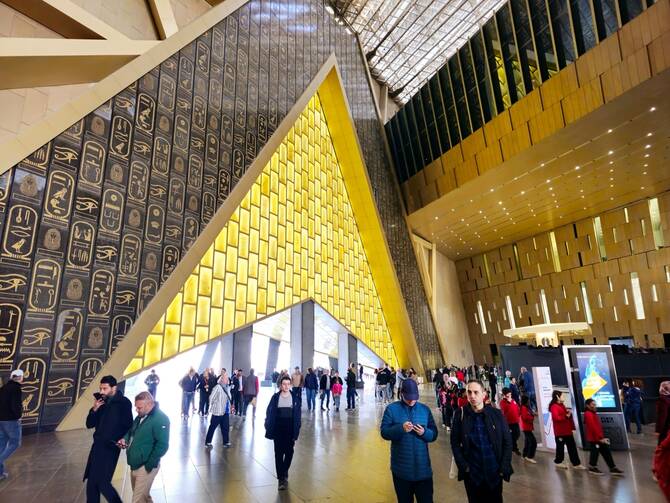
With the full opening of the Grand Egyptian Museum in early November, visitor numbers are expected to triple from the current 5,000 to 6,000 daily visitors. Shutterstock
Short Url
Updated 15 October 2025
Follow

Egypt poised to hit 18m tourists as grand museum opens

JEDDAH: Egypt has welcomed 15 million tourists in the first nine months of 2025, a 21 percent increase compared with last year, bringing the country close to its end-of-year target of 18 million visitors, an official said.

Speaking to Asharq, Egyptian Minister of Tourism and Antiquities Sherif Fathy said: “The growth is continuing, and I hope that by the end of the year we can reach our target of 17.5 to 18 million tourists. Tourism revenues also rose by nearly 18 percent.”

Tourist arrivals reached 8.7 million in the first half of the year, rose to 12.8 million by the end of August, and reached around 15 million by the end of September, Fathy noted.

Tourism remains one of Egypt’s most important sources of foreign exchange. Last year, the country welcomed 15.78 million tourists, marking a record high.

The government has launched a national tourism strategy aiming to attract 30 million visitors by 2028 through expanded capacity and enhanced visitor experiences.

Fathy said: “Egypt is the world’s leading country in tourism diversity. We are the unmatched diversity.”

The minister did not provide figures for tourism revenues in the first nine months of 2025. Asharq cited Central Bank of Egypt data showing that revenues in 2024 rose 9 percent year on year to $15.3 billion.

With the full opening of the Grand Egyptian Museum in early November, Fathy said visitor numbers are expected to triple from the current 5,000 to 6,000 daily visitors.

The 120-acre museum, the world’s largest archeological museum, is projected to attract around 5 million visitors annually and will house approximately 100,000 artifacts, including items from King Tutankhamun’s tomb.

Beyond established attractions, Egypt continues to uncover new archaeological sites that could further boost tourism.

In June, authorities announced the discovery of the ancient city of Emet in the Tell El-Faraoun area of Sharqia governorate, following excavations by a British team from the University of Manchester.

The dig revealed residential buildings dating back to the early or mid-fourth century BC, including multi-story “tower houses” designed for large populations, as well as service structures for grain storage and animal shelters.

In the temple area, archaeologists uncovered a large limestone floor and remnants of two massive mudbrick columns above a processional road linked to the historic Wadjet Temple.

Notable artifacts included a finely crafted green faience ushabti statue from the 26th Dynasty, a stone stela depicting Horus, and a bronze sistrum decorated with Hathor heads from the Late Period.

These discoveries highlight Egypt’s enduring archaeological richness, offering new attractions for cultural tourism and supporting the country’s broader strategy to strengthen its tourism sector.e


OPEC+ approves gradual output increase from April amid market uncertainty 

Updated 7 sec ago
Follow

OPEC+ approves gradual output increase from April amid market uncertainty 

RIYADH: Eight OPEC+ producers agreed to raise oil output gradually from April, citing healthy market fundamentals and a stable global economic outlook, after ministers met virtually to assess market conditions and determine future supply policy. 

Saudi Arabia, Russia, Iraq, the UAE, Kuwait, Kazakhstan, Algeria and Oman approved a production increase of 206,000 barrels per day for April, according to a statement. 

The increase marks the start of a gradual unwinding of 1.65 million barrels per day in voluntary reductions introduced in April 2023 to shore up prices.  

The move comes as the US-Israeli conflict with OPEC+ member Iran and Tehran’s retaliation have disrupted shipments in the Middle East. Oil, gas and other cargoes moving through the Strait of Hormuz have faced interruptions since Feb. 28 after shipowners received warnings from Iran that the area was closed to navigation, Reuters reported. 

In a statement released after the talks, the eight nations cited a “steady global economic outlook and current healthy market fundamentals, as reflected in the low oil inventories,” as the rationale for the measured production increase. 

The statement stressed that the full 1.65 million bpd “may be returned in part or in full subject to evolving market conditions and in a gradual manner.” 

They also stressed they retain flexibility to increase, pause or reverse the supply hike if needed. That includes the option of reinstating cuts announced in November 2023, when several members pledged additional voluntary reductions totaling 2.2 million barrels per day. 

The producers reiterated their commitment to the broader Declaration of Cooperation and said compliance with output targets, including voluntary adjustments, will continue to be monitored by the Joint Ministerial Monitoring Committee. 

The group also reaffirmed plans to compensate for any overproduction recorded since January 2024, saying the phased increase would allow participating countries to accelerate those efforts. 

Brent crude futures jumped on Feb. 27 to $73 per barrel, the highest level since July, amid fears of a wider Middle East conflict and potential supply disruptions through Hormuz, which accounts for more than 20 percent of global oil transit, Reuters reported. 

Oil prices are expected to rise, with Barclays lifting its Brent crude forecast to around $100 a barrel from $80 a day earlier, while analysts said prices could jump by as much as $20 per barrel when trading resumes on March 2 if tensions escalate further.

The eight countries will continue holding monthly reviews of market conditions, conformity and compensation levels, with the next meeting scheduled for April 5.