Pakistan to launch first hyperspectral satellite from China to boost agriculture, climate mapping

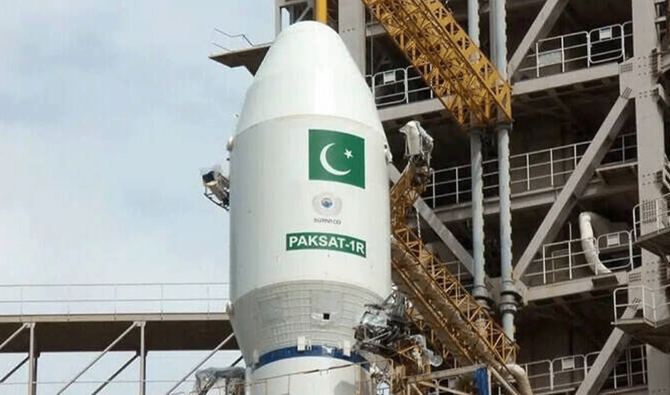
This screengrab, taken from a handout video released by Pakistan’s Special Investment Facilitation Council on October 17, 2024, shows country’s first multi-mission communication satellite, PAKSAT MM1. (Photo courtesy: SIFC/File)
Short Url
Updated 15 October 2025
Follow

Pakistan to launch first hyperspectral satellite from China to boost agriculture, climate mapping

  • HS-1 satellite to strengthen Pakistan’s space-based monitoring of agriculture, urban growth and climate resilience
  • SUPARCO says data from the mission will improve crop yield estimates and disaster-response capability across the country

ISLAMABAD: Pakistan’s Space and Upper Atmosphere Research Commission (SUPARCO) on Wednesday announced the launch of the country’s first Hyperspectral Satellite (HS-1) from China’s Jiuquan Satellite Launch Center on October 19, marking what officials described as a major leap in national space and climate-monitoring capability.

The HS-1 mission will capture hundreds of spectral bands across visible and infrared wavelengths to help detect changes in soil, vegetation, water bodies and man-made structures with far greater precision than conventional imaging satellites. Officials say the technology will be applied to improve agricultural productivity, monitor environmental degradation and strengthen early-warning systems for floods and landslides.

SUPARCO said the satellite will provide “detailed insights into crop health, soil moisture and irrigation patterns— enhancing yield estimation by 15–20 percent and contributing significantly to food security.” 

The agency added that HS-1’s sensors would also enable mapping of infrastructure and tracking of urban expansion to support sustainable city planning and land-use management.

“The HS-1 launch represents a transformative milestone in Pakistan’s national space program,” SUPARCO said in its statement. “The mission aligns with the National Space Policy and SUPARCO’s Vision 2047, which aim to position Pakistan at the forefront of space technology and innovation for sustainable national development.”

The new satellite will join Pakistan’s growing remote-sensing fleet, which includes PRSS-1 launched in 2018 and two Earth-observation satellites— EO-1 and KS-1— placed in orbit earlier this year. 

Officials said integrating HS-1 will expand Pakistan’s capacity for disaster assessment, water-resource modelling and climate-change monitoring, while deepening collaboration with China in the civilian space sector.


Nine Afghan citizens killed, 10 injured in accident in southwestern Pakistan— police 

Updated 5 sec ago
Follow

Nine Afghan citizens killed, 10 injured in accident in southwestern Pakistan— police 

  • Pickup truck carrying Afghan nationals collided with oil tanker in Nokundi town, says police official
  • Says Afghan nationals were attempting to enter Europe illegally via Iran as per preliminary probe

QUETTA: At least nine Afghan nationals were killed and 10 others injured in southwestern Pakistan on Sunday when the pickup truck they were traveling in collided with an oil tanker, a police official said.

The collision occurred in Nokundi, a town located on Pakistan’s border with Iran in the southwestern Balochistan province. District Police Officer Muhammad Shareef Kalhoro told Arab News that the Zamyad vehicle (a pickup truck made by Iranian automobile manufacturer Zamyad Co.) was transporting Afghan nationals illegally when the accident took place.

“Twenty-one illegal Afghan migrants were onboard the Zamyad vehicle when it was hit by an oil tanker in the kacha [remote] area of Nokundi,” Kalhoro said.

“Nine Afghans were killed on the spot and 10 were injured in the serious accident,” he added.

The police official said the bodies and injured persons were sent back to Afghanistan through cross-border coordination and in accordance with legal protocol.

Kalhoro said preliminary investigations indicate the Afghan nationals were attempting to enter Europe illegally from Afghanistan via Iran, facilitated by an organized human smuggling network.

“All legal proceedings have been initiated, and the human smuggling network is being traced for further action,” he said.

Pakistan launched a nationwide crackdown against people living in the country illegally in 2023, with Afghan refugees bearing the brunt of the deportation drive. Pakistan says it has deported over 1.5 million Afghans since then. The crackdown was launched after a spate of suicide attacks in the country that Islamabad blamed on Afghan nationals without providing proof.

Thousands of migrants travel illegally through the desolate areas of Chaghi district in Balochistan every year in an attempt to reach Europe via Iran.

Balochistan, home to the multi-billion-dollar China-Pakistan Economic Corridor project, is considered by experts to be Pakistan’s most underdeveloped province across almost all social and economic indicators.

The province is also home to multi-billion-dollar mineral projects such as Saindak and Reko Diq. However, most districts in Balochistan have dilapidated roads, which often lead to fatal accidents.