

Pakistan military warns India against ‘provocative propaganda’ ahead of state polls

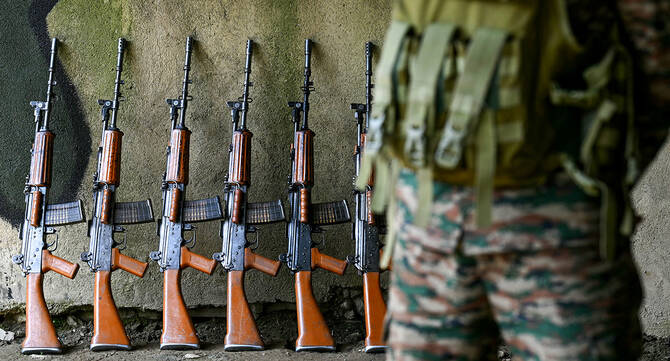
Indian army soldiers' rifles are pictured near the Line of Control (LoC) between Pakistan and India in Indian-administered Kashmir on May 20, 2025. (AFP)
Short Url
Updated 15 October 2025
Follow

Pakistan military warns India against ‘provocative propaganda’ ahead of state polls

  • ISPR says Indian commanders issuing ‘irresponsible’ pre-election statements
  • Five months after May war, Pakistan cautions against jingoism escalating tensions

ISLAMABAD: Pakistan’s military on Wednesday accused India’s armed forces of reviving “delusional, fabricated and provocative propaganda” ahead of state elections, warning that chest-thumping by a nuclear-armed military could stoke a cycle of jingoism and destabilize South Asia.

The statement comes five months after the May 2025 India-Pakistan conflict, termed “Marka-e-Haq” (“Battle of Truth”) by Pakistan’s military, which saw the two nations exchange artillery, missile and drone strikes before a US-brokered ceasefire was announced on May 10. The calm has largely held since the truce.

On Wednesday the military’s media wing, the Inter-Services Public Relations (ISPR), alleged Indian military leaders have resumed pre-election rhetoric in the run-up to Bihar assembly polls scheduled for Nov. 6 and 11, 2025, and West Bengal’s assembly elections due in 2026. ISPR said such statements were being issued “under immense political pressure.”

Indian political and security rhetoric in recent months has included public statements blaming Pakistan for supporting terrorism in Kashmir, claims that Pakistani forces plan incursions ahead of India’s elections and assertions of “bloodshed” narratives designed to rally domestic political support. 

“Any professional soldier would know that unnecessary chest-thumping and unwarranted statements might initiate a cycle of jingoism and lead to serious consequences for peace and stability in South Asia,” ISPR said.

“Every act of aggression will be dealt with a swift, resolute and intense response that will be remembered by posterity.”

The military said it viewed with “grave concern” what it called repeat pre-poll narratives from India and described them as attempts to “mold history” with “Bollywood-style scripts.”

The heaviest fighting in decades between nuclear-armed India and Pakistan was sparked by an April 22 attack in Indian-administered Kashmir that killed 26 people, most of them tourists. New Delhi blamed the incident on “terrorists” backed by Pakistan, a charge denied by Islamabad.

On May 7, Indian jets bombed what New Delhi called “terrorist infrastructure” sites across the border. Pakistan has said it downed six Indian planes, including at least three Rafale fighters, in the initial clashes. Islamabad has denied it suffered any losses of planes but has acknowledged its air bases suffered some hits although losses were minimal.

Pakistan and India have been at loggerheads since their independence from British colonial rule in 1947 and both claim the disputed Kashmir region in full but rule it in part. 


Pakistan says defense pact with Saudi Arabia elevated brotherly ties to ‘new heights’

Updated 6 sec ago
Follow

Pakistan says defense pact with Saudi Arabia elevated brotherly ties to ‘new heights’

  • Pakistan, Saudi Arabia signed strategic defense pact last year pledging aggression against one will be treated as attack on both
  • Deputy PM Ishaq Dar says enduring bonds with Islamic and Arab nations form vital pillar of Pakistan’s foreign policy 

ISLAMABAD: Deputy Prime Minister Ishaq Dar said on Wednesday that Pakistan’s defense pact with Saudi Arabia elevated its brotherly ties with the Kingdom to “new heights,” stressing that close ties with Arab and Islamic nations form a key pillar of Islamabad’s foreign policy. 

Pakistan and Saudi Arabia signed a Strategic Mutual Defense Agreement on Sept. 17 last year, pledging that aggression against one country would be treated as an attack on both, enhancing joint deterrence and formalizing decades of military and security cooperation.

Both nations agreed in October 2025 to launch an economic cooperation framework to strengthen trade and investment ties. 

“In the Middle East, our landmark Strategic Mutual Defense Agreement with Saudi Arabia has elevated our brotherly ties to new heights,” Dar said while speaking at the Pakistan Governance Forum 2026 event in Islamabad. 

The Pakistani deputy prime minister was speaking on the topic “Navigating International Relations Amidst Changing Geo-Politics.”

Dar noted that Pakistan has reinforced partnerships with other Middle Eastern nations such as the UAE, Qatar, Jordan, Oman, Egypt and Bahrain. He said these partnerships have yielded “concrete agreements” in investment, agriculture, infrastructure, and energy sectors. 

“Our enduring bonds with Islamic and Arab nations form a vital pillar of our foreign policy, and we will continue to expand our partnerships across Asia, Latin America, and Africa,” he said. 

Dar pointed out that the presidents of Kazakhstan, Uzbekistan and Kyrgyzstan have undertaken visits to Pakistan in recent months, reflecting Central Asian nations’ desire to boost cooperation with Islamabad.

On South Asia, the Pakistani deputy PM said Pakistan has successfully transformed its fraternal ties with Bangladesh into “a substantive partnership.”

“Similarly, the trilateral mechanism involving China, Pakistan, and Bangladesh has been launched with a view to expanding and deepening regional cooperation and synergy,” the Pakistani minister said. 

He said Islamabad has strengthened its “all-weather” partnership with China via the second phase of the multi-billion-dollar China-Pakistan Economic Corridor agreement and “unwavering support” from both sides for each other’s core interests. 

Dar said Pakistan had also reinvigorated its partnership with the US, advancing cooperation in trade, technology, investment, and regional stability. 

“This calibrated approach has enhanced our ability to navigate complexity with skill and confidence, ensuring that our national interests are served without compromising our core foreign policy principles,” he said.