

Online businesses risk $700,000 in losses as Internet slowdown hits Pakistan

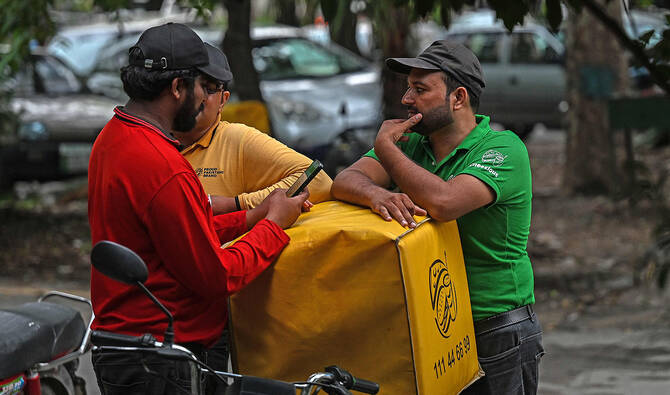
A food delivery man uses his mobile phone near a restaurant in Islamabad, Pakistan, on August 17, 2024. (AFP/File)
Short Url
Updated 14 October 2025
Follow

Online businesses risk $700,000 in losses as Internet slowdown hits Pakistan

  • Internet service providers cite undersea cable maintenance for nationwide disruption
  • Digital rights expert says Internet outages hurt productivity, cause heavy business losses

ISLAMABAD: Pakistan’s online businesses risk losing nearly Rs200 million ($700,000) a day as Internet services slowed nationwide on Tuesday amid widespread disruption caused by “maintenance activity” on a major submarine cable, according to the Chain Store Association of Pakistan (CAP).

The slowdown followed announcements by major Internet providers, including Nayatel and the Pakistan Telecommunication Company Limited (PTCL), that emergency maintenance was being carried out on one of the country’s undersea cables.

Nayatel said in a post on X that the work, which began around 11 a.m., could last up to 18 hours and cause Internet slowness across Pakistan.

Mobile Internet services were also suspended in Islamabad and Lahore over the weekend following protests by the religio-political party Tehreek-e-Labbaik Pakistan (TLP), whose activists clashed repeatedly with police.

“Our estimate is that when Internet services, both mobile and fixed broadband, are down nationwide for 24 hours, it causes approximately Rs200 million in daily losses,” Asfandyar Farrukh, the CAP chairman, told Arab News.

CAP represents more than 150 of Pakistan’s leading retail businesses and small- and medium-sized enterprises (SMEs).

He added that the full financial impact of Tuesday’s slowdown could only be assessed after 24 hours of monitoring.

GIG ECONOMY

For gig-economy workers, however, the disruption means a complete loss of income.

Muhammad Riaz, an online cab driver, said slow or no Internet means he cannot feed his four children.

“It drives me crazy when the Internet is slow,” he said. “It takes half an hour just to get one ride. You know how Internet signals are in the streets. Even in normal places, it can get very difficult, extremely difficult.”

Riaz said he earned nothing when the Internet was down over the weekend, as he had to stay home.

“Ordinary people are the ones suffering the most,” he continued. “A daily-wage earner, if he doesn’t earn during the day, he can’t eat. How long can he feed his children like this?”

Adil Zahid, a food delivery rider, said outages make his work impossible.

“When we face signal issues here in Pakistan, our delivery work stops, which causes us major losses,” he said. “Our daily loss without Internet is around two to three thousand rupees [$7-$11].”

Zahid added that without Internet access, he cannot use navigation maps or receive orders.

Another delivery worker, Waseem Barkat, said the disruptions make it extremely difficult to contact customers or locate delivery points.

“When we go to different places, we can’t contact the customer because their number and location details don’t load properly,” he said. “Everything just shuts down in those areas.”

Digital rights experts say such disruptions ripple far beyond the gig economy, hampering productivity and eroding public confidence in the country’s digital infrastructure.

“Internet disruptions, whether planned or unplanned, inflict massive economic losses on online businesses, disrupt supply chains and erode customer trust,” said Haroon Baloch, a digital rights activist.

“In a digital economy where every second of downtime can translate to millions in losses for e-commerce platforms, freelancers and startups, these interruptions aren’t just inconveniences,” he continued. “They become barriers to growth and innovation.”


Pakistan reports current account surplus in Jan. owing to improved trade, remittances

Updated 17 February 2026
Follow

Pakistan reports current account surplus in Jan. owing to improved trade, remittances

  • Pakistan’s exports crossed the $3 billion mark in Jan. as the country received $3.5 billion in remittances
  • Last month, IMF urged Pakistan to accelerate pace of structural reforms to strengthen economic growth

ISLAMABAD: Pakistan recorded a current account surplus of more than $120 million in January, the country’s finance adviser said on Tuesday, attributing it to improved trade balance and remittance inflows.

Pakistan’s exports rebounded in January 2026 after five months of weak performance, rising 3.73 percent year on year and surging 34.96 percent month on month, according to data released by the country’s statistics bureau.

Exports crossed the $3 billion mark for the first time in January to reach $3.061 billion, compared to $2.27 billion in Dec. 2025. The country received $3.5 billion in foreign remittances in Jan. 2026.

Khurram Schehzad, an adviser to the finance minister, said Pakistan reported a current account surplus of $121 million in Jan., compared to a current account deficit of $393 million in the same month last year.

“Improved trade balance in January 2026, strong remittance inflows, and sustained momentum in services exports (IT/Tech) continue to reinforce the country’s external account position,” he said on X.

Pakistan has undergone a difficult period of stabilization, marked by inflation, currency depreciation and financing gaps, and international rating agencies have acknowledged improvements after Islamabad began implementing reforms such as privatizing loss-making, state-owned enterprises (SOEs) and ending subsidies as part of a $7 billion International Monetary Fund (IMF) loan program.

Late last month, the IMF urged Pakistan to accelerate the pace of these structural reforms to strengthen economic growth.

Responding to questions from Arab News at a virtual media roundtable on emerging markets’ resilience, IMF’s director of the Middle East and Central Asia Jihad Azour said Islamabad’s implementation of the IMF requirements had been “strong” despite devastating floods that killed more than 1,000 people and devastated farmland, forcing the government to revise its 4.2 percent growth target to 3.9 percent.

“What is important going forward in order to strengthen growth and to maintain the level of macroeconomic stability is to accelerate the structural reforms,” he said at the meeting.

Azour underlined Pakistan’s plans to privatize some of the SOEs and improve financial management of important public entities, particularly power companies, as an important way for the country to boost its capacity to cater to the economy for additional exports.

“This comes in addition to the effort that the authorities have made in order to reform their tariffs, which will allow the private sector of Pakistan to become more competitive,” the IMF official said.