

Pakistan, UAE agree to boost cooperation in AI, digital governance at GITEX Global 2025

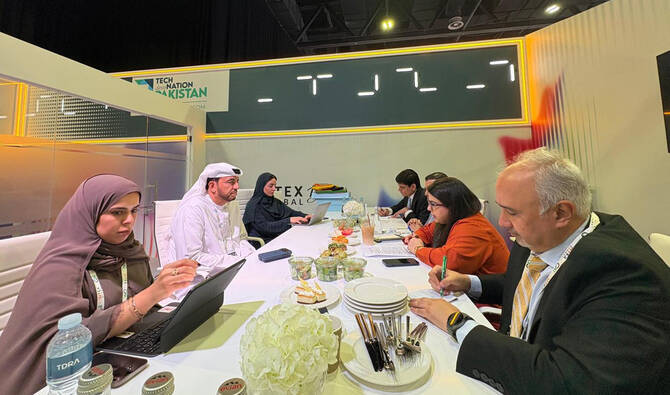
The handout photograph released on October 14, 2025, shows Pakistan’s Federal Minister for IT and Telecom, Shaza Fatima Khawaja (second right), meeting with Omar Suwaina Al Suwaidi (second left), Undersecretary at the UAE Ministry of Industry and Advanced Technology, on the sidelines of GITEX 2025, in Dubai, UAE. (Ministry of IT and Telecom)
Short Url
Updated 14 October 2025
Follow

Pakistan, UAE agree to boost cooperation in AI, digital governance at GITEX Global 2025

  • Shaza Fatima Khawaja held meetings on the sidelines of the event featuring Pakistani startups and tech firms
  • Pakistan and the UAE also discussed joint work on cybersecurity, data sovereignty and cloud infrastructure

KARACHI: Pakistan and the United Arab Emirates on Tuesday agreed to deepen cooperation in artificial intelligence, digital governance and data innovation during a meeting held on the sidelines of GITEX Global 2025 in Dubai, Pakistan’s IT ministry said.

The event, which runs from Oct 13 to 17 and features more than 6,500 companies from over 180 countries, is the world’s largest tech exhibition, drawing nearly 200,000 professionals and speakers on AI, cybersecurity, quantum computing and sustainable technologies.

Pakistan has set up a National Pavilion with 10 startups and more than 26 technology firms to highlight the country’s expanding digital potential at the event. The pavilion was inaugurated by IT Minister Shaza Fatima Khawaja, who held talks with Omar Suwaina Al Suwaidi, undersecretary at the UAE Ministry of Industry and Advanced Technology, on expanding collaboration in advanced technology and startup development.

“The minister highlighted Pakistan’s Digital Nation Pakistan Act, National Data Exchange Layer and initiatives promoting a cashless economy, smart governance and AI integration," the ministry said. "Both sides agreed to strengthen cooperation in advanced technology, data innovation and cross-border startup investment.”

The Digital Nation Pakistan vision seeks to position the country as a regional hub for innovation and public-sector digitization through policies encouraging AI adoption and e-governance.

Khawaja also met Dr Mohamed Al Kuwaiti, head of the UAE Cybersecurity Council, to discuss joint work on cyber-resilience, cloud governance and data-infrastructure security. Both sides agreed to develop frameworks for data sovereignty, cybersecurity capacity-building and training initiatives.

Meetings with Abu Dhabi’s G42 cloud group and the Abu Dhabi Investment Office explored partnerships on sovereign-cloud infrastructure, AI innovation hubs and digital investment under Pakistan’s Cloud First Policy.

The minister further held discussions with Vasile Catalin, advisor at Romania’s Ministry of Economy, on cooperation in cybersecurity policy, ethics and digital governance and explored institutional linkages between Pakistan’s National Cyber Emergency Response Team (PKCERT) and Romania’s National Cybersecurity Directorate (DNSC).

In separate sessions, Dr Ramin Hasani, CEO of Liquid AI, and Andrew Feldman, CEO of Cerebras Systems, briefed Khawaja on AI research and infrastructure projects, agreeing to collaborate on AI-skill development, startup incubation and access to advanced compute systems supporting Pakistan’s National Artificial Intelligence Policy 2025.

Pakistan’s expanding footprint at GITEX has coincided with rising IT exports to the UAE, which reached $380 million this year, up from $280 million in 2024, according to Pakistan’s ambassador to the UAE, Faisal Niaz Tirmizi.


Pakistan offers Kyrgyzstan Arabian Sea access as two states sign 15 cooperation accords

Updated 5 sec ago
Follow

Pakistan offers Kyrgyzstan Arabian Sea access as two states sign 15 cooperation accords

  • Pakistan and Kyrgyzstan sign MOUs spanning trade, energy, agriculture, ports, education, security cooperation
  • Kyrgyz president is on first visit to Pakistan in 20 years as both sides push connectivity and CASA-1000 power links

ISLAMABAD: Pakistan on Thursday offered Kyrgyzstan the shortest and most economical route to the Arabian Sea as the two countries signed 15 agreements and memoranda of understanding aimed at boosting cooperation across trade, energy, agriculture, education, customs data-sharing and port logistics.

The accords were signed during a visit to Islamabad by President Sadyr Zhaparov, the first by a Kyrgyz head of state to Pakistan in two decades, and part of Islamabad’s renewed push to link South Asia with landlocked Central Asian economies through ports, power corridors and transport routes.

For Pakistan, Kyrgyzstan offers access to hydropower through CASA-1000, a $1.2 billion regional electricity transmission project designed to carry surplus summer electricity from Kyrgyzstan and Tajikistan through Afghanistan into Pakistan. For Bishkek, Pakistan provides overland access to warm-water ports on the Arabian Sea, creating a shorter commercial route to global markets.

“President Asif Ali Zardari has reiterated Pakistan’s readiness to offer Kyrgyzstan the shortest and most economical route to the Arabian Sea,” Radio Pakistan reported after Zhaparov met the Pakistani president. 

The two leaders also discussed expanding direct flights to deepen business, tourism and people-to-people ties.

Zardari welcomed Kyrgyzstan’s completion of its segment of the CASA-1000 project and “reaffirmed Pakistan’s commitment to completing its part of the project, which is now at an advanced stage,” the state broadcaster said. 

Zhaparov thanked Islamabad for supporting Bishkek’s candidacy for a non-permanent UN Security Council seat and invited Zardari to visit Kyrgyzstan at a time of his convenience. Both sides expressed satisfaction with progress under the Quadrilateral Traffic in Transit Agreement, designed to facilitate road movement between Pakistan, Kyrgyzstan, Kazakhstan and China.

Earlier, both governments exchanged 15 sectoral cooperation documents covering commerce, mining, geosciences, power, agriculture, youth programs, the exchange of convicted persons, customs electronic data systems and a sister-city linkage between Islamabad and Bishkek.

According to APP, the MOUs were signed by ministers representing foreign affairs, commerce, economy, energy, power, railways, interior, culture, health and tourism. Agreements also covered cooperation between Pakistan’s Foreign Service Academy and the Diplomatic Academy of Kyrgyzstan, as well as collaboration between universities, youth ministries and cultural institutions.

“Our present mutual trade, comprising of about $15–16 million will be enhanced to $200 million in the next two years,” Prime Minister Shehbaz Sharif said after the agreements were signed, calling them “a framework for structured, result-oriented engagement and closer institutional linkages.”

Sharif said Pakistan was ready to serve as a maritime outlet for the landlocked Central Asian republic, offering access to Karachi, Port Qasim and Gwadar to help Kyrgyz goods reach regional and global markets.