

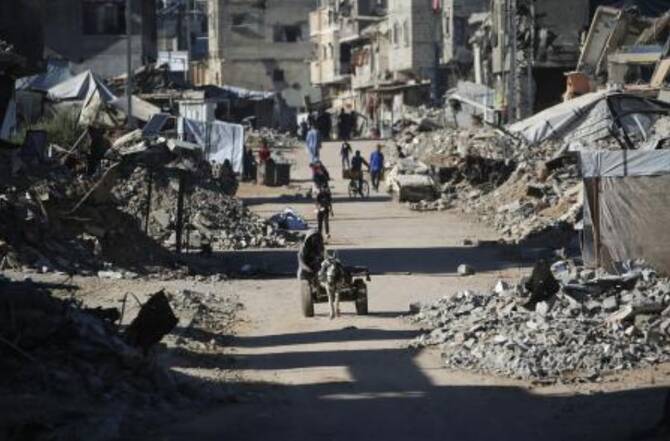

GAZA/JERUSALEM: Israel delayed aid into Gaza and kept the enclave’s border shut on Tuesday, while re-emergent Hamas fighters demonstrated their grip by executing men in the street, darkening the outlook for US President Donald Trump’s plan to end the war.
Three Israeli officials said Israel had decided to restrict aid into the shattered Gaza Strip and delay plans to open the border crossing to Egypt at least through Wednesday, because Hamas had been too slow to turn over bodies of dead hostages. The militant group has said locating the bodies is difficult.
Meanwhile, Hamas has swiftly reclaimed the streets of Gaza’s urban areas, following the partial withdrawal of Israeli troops last week.
In a video circulated late on Monday, Hamas fighters dragged seven men with hands tied behind their backs into a Gaza City square, forced them to their knees and shot them from behind, as dozens of onlookers watched from nearby shopfronts.
A Hamas source confirmed that the video was filmed on Monday and that Hamas fighters participated in the executions. Reuters was able to confirm the location by visible geographic features.
DELAY IN HANDING OVER BODIES
Trump has given his blessing to Hamas to reassert some control of Gaza, at least temporarily. Israeli officials, who say any final settlement must permanently disarm Hamas, have so far refrained from commenting publicly on the reemergence of the group’s fighters.
On Monday the US president proclaimed the “historic dawn of a new Middle East” to Israel’s parliament, as Israel and Hamas were exchanging the last 20 living Israeli hostages in Gaza for nearly 2,000 Palestinian detainees and prisoners.
But so far, Hamas has handed over only four coffins of dead hostages, leaving at least 23 presumed dead and one unaccounted for, still in Gaza.
Aid trucks have yet to be permitted to enter Gaza at the full anticipated rate of hundreds per day, and plans have yet to be implemented to open the crossing to Egypt to let some Gazans out, initially to evacuate the wounded for medical treatment.
HAMAS RETURN DEMONSTRATES HURDLES TO SETTLEMENT
The highly public return of Hamas to control of Gaza’s streets demonstrates the hurdles to progressing from the initial ceasefire — phase one of Trump’s plan — to a permanent settlement that would prevent a new eruption of fighting.
Gaza residents said Hamas fighters were increasingly visible on Tuesday, deploying along routes needed for aid deliveries.
Palestinian security sources said dozens of people had been killed in clashes between Hamas fighters and rivals in recent days.
Meanwhile, Israeli drone fire killed five people as they went to check on houses in a suburb east of Gaza City and an airstrike killed one person and injured another near Khan Younis, Gaza health authorities said.
Hamas accused Israel of violating the ceasefire. The Israeli military said it had fired on people who crossed truce lines and approached its forces after ignoring calls to turn back.
A summit co-hosted by Trump in Egypt on Monday ended with no public announcement of major progress toward establishing an international military force for Gaza, or a new governing body.
HAMAS ASSERTS CONTROL
Israeli Prime Minister Benjamin Netanyahu has consistently maintained that the war cannot end until Hamas gives up its weapons and ceases to control Gaza, a demand that the fighters have rejected, torpedoing all previous peace efforts.
But Trump, having announced that the war is now over, said on Monday Hamas still had a temporary green light to keep order.
“They do want to stop the problems, and they’ve been open about it, and we gave them approval for a period of time,” he said.
Hamas sources told Reuters on Tuesday the group would tolerate no more violations of order in Gaza and would target collaborators, armed looters and drug dealers.
The group, though greatly weakened after two years of pummelling Israeli bombardment and ground incursions, has been gradually reasserting itself since the ceasefire took hold.
It has deployed hundreds of workers to start rubble clearing on key routes needed to access damaged or destroyed housing and to repair broken water pipes. Road clearance and security provision will also be needed for increased aid delivery.
AID AND HOSTAGES
The ceasefire has stopped two years of devastating warfare in Gaza triggered by the October 7, 2023 attack in which Hamas-led gunmen killed around 1,200 people and seized 251 hostages, according to Israeli tallies.
Israel’s military campaign in Gaza killed nearly 68,000 people according to local health authorities, with thousands more feared dead under the rubble. Gaza’s Civil Defense Service said 250 bodies had been recovered since the truce began.
Swathes of Gaza are in ruins and the global hunger monitor said in August there was famine in the territory. Thousands of Gazans have been returning to homes since the ceasefire, many finding whole streets bombed into dust.
UNICEF spokesperson Tess Ingram said that while aid was getting into Gaza with tents, tarpaulin sheets, winter clothes, family hygiene kits and other critical items, she hoped for a significant increase later this week.


