

Western governments waging sustained attack on right to protest: Study

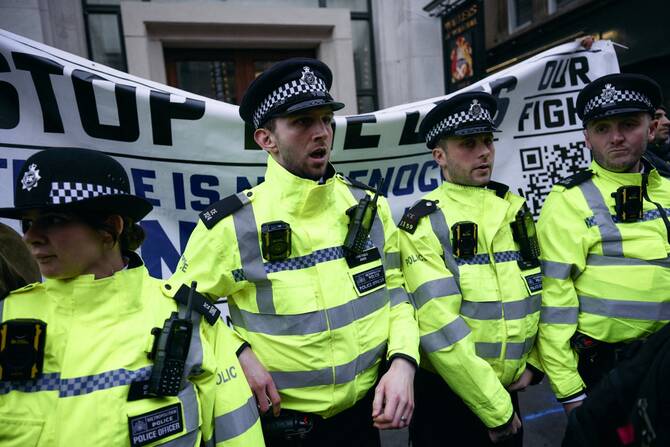
Police officers intervene as a pro Israel banner is held during a combined March for Global Climate Justice, organized by the Cimate Justice Coalition, in London on November 16, 2024, "to demand the UK government ends our reliance on fossil fuels, pays up for climate finance – and ends its complicity in Israel’s escalating genocidal violence". (File/AFP)
Short Url
Updated 14 October 2025
Follow

Western governments waging sustained attack on right to protest: Study

  • International Federation for Human Rights cites measures in UK, US, France, Germany against pro-Palestine movement
  • ‘The crackdown on solidarity with Palestinians reveals a profound crisis in societies that claim to be democratic’

LONDON: Western governments are waging a sustained attack against the right to protest, the International Federation for Human Rights has warned, citing the growing criminalization of pro-Palestine demonstrations.

Governments in the UK, US, France and Germany have “weaponized” domestic counterterrorism legislation and fears of antisemitism to suppress public anger over the Gaza war, the study found, drawing on open-source research, eyewitness testimonies and reports from international organizations.

“This trend reflects a worrying shift towards the normalization of exceptional measures in dealing with dissenting voices,” said Yosra Frawes, head of the Maghreb and Middle East desk at FIDH.

The study, which was conducted between October 2023 and September 2025, highlights concerns over the censorship of elected politicians, violations of media rights, and the silencing of civil society and academic freedom in the four major Western countries, where pro-Palestine protests have regularly been held since the outbreak of the war.

It warns that the “right to protest has come under sustained attack from the British government across administrations and party lines,” and that it has “pushed to legitimize Israel’s genocidal violence” and “continued to justify support for Israel.”

Senior figures in the UK, such as former Home Secretary Suella Braverman, have also pushed a censorious narrative against pro-Palestine demonstrators exercising their free speech by calling weekly rallies “hate marches,” the study said.

When considered with statements made by government figures, the public narrative has stigmatized “support for Palestine and Palestinian resistance movements,” and “worked to discriminate against Muslims and other racialized groups in the UK,” it added.

Despite Labour’s election victory last year, there has been “little” change in government narratives about the war and domestic protest movements, the study found.

The government continues to link criticism of Israel and support for Palestine to “violent antisemitism” and “targeted Muslim and racialized groups.”

Hate crimes against Muslims in the UK have risen by almost one-fifth, recent government data shows.

But according to Tell Mama, an organization that records anti-Muslim incidents in the UK, Islamophobic attacks surged by 73 percent last year.

Despite the variation in protest laws and rights among the four major Western countries, the FIDH report highlighted a broad trend of repression against Palestinian solidarity globally.

Pro-Palestine rallies in the US, France and Germany have been met with blanket bans in some cases, as well as legal action and arrests.

The study calls on the UK government to launch an independent body to monitor policing practices during demonstrations.

It also says section 12 of the UK Terrorism Act, which criminalizes support for outlawed groups, must be overhauled to exclude protected political opinions and broad slogans of solidarity.

“​​Ultimately, the crackdown on solidarity with Palestinians reveals a profound crisis, not only of human rights in the occupied territories but of freedom itself, in societies that claim to be democratic,” it warned.


Cambodia says Thailand bombs casino hub on border

Updated 18 December 2025
Follow

Cambodia says Thailand bombs casino hub on border

  • The renewed fighting between the Southeast Asian neighbors this month has killed at least 21 people in Thailand and 17 in Cambodia, while displacing around 800,000

PHNOM PENH: Cambodia said Thailand’s military on Thursday bombed the casino town of Poipet, a major crossing between the two nations, as foreign powers pressured them to halt reignited border clashes.
Thai forces “dropped two bombs in the area of Poipet Municipality, Banteay Meanchey Province” at around 11:00 am (0400 GMT) Thursday, the Cambodian defense ministry said in a statement.
Thailand has not yet confirmed any strike on Poipet — a bustling casino hub popular with Thai gamblers.
The renewed fighting between the Southeast Asian neighbors this month has killed at least 21 people in Thailand and 17 in Cambodia, while displacing around 800,000, officials said.
The conflict stems from a territorial dispute over the colonial-era demarcation of their 800-kilometer (500-mile) border and a smattering of ancient temple ruins situated on the frontier.
Each side has blamed the other for instigating the fresh fighting and traded accusations of attacks on civilians.
Thailand said Tuesday that between 5,000 and 6,000 Thai nationals remained stranded in Poipet after Cambodia closed its land border crossings with its neighbor.
Cambodia’s interior ministry said the border closures were a “necessary measure” to reduce risks to civilians amid the ongoing combat, adding that air travel remained an option for those seeking to leave.
At least four casinos in Cambodia have been damaged by Thai strikes, the interior ministry said this week.
- ‘Shuttle-diplomacy’ -
Five days of fighting between Cambodia and Thailand in July killed dozens of people before a truce was brokered by the United States, China and Malaysia, and then broken within months.
US President Donald Trump, who has repeatedly intervened in the long-standing conflict this year, claimed last week that the two countries had agreed to a new ceasefire.
But Bangkok denied any truce had been agreed, and fighting with artillery, tanks, drones and jets has continued daily since a border skirmish earlier this month sparked the latest round of conflict.
China said it was sending its special envoy for Asian affairs to Cambodia and Thailand on Thursday for a “shuttle-diplomacy trip” to help bridge the gaps and “rebuild peace.”
“Through its own way, China has been working actively for deescalation,” Beijing’s foreign ministry said in a statement late Wednesday.
Foreign ministers from ASEAN regional bloc nations are due to meet on Monday in Malaysia for emergency talks aimed at finding a diplomatic solution.
“Our duty is to present the facts but more important is to press upon them that it is imperative for them to secure peace,” Malaysian Prime Minister Anwar Ibrahim told journalists late Wednesday.
“We are appealing to them to immediately stop this frontline offensive and if possible, an immediate ceasefire,” Anwar said at his official residence in Putrajaya, adding that he was “cautiously optimistic” about the talks.
European Commission vice president Kaja Kallas said in a statement that she had spoken with the foreign ministers of Cambodia and Thailand on Wednesday, offering the European Union’s support for ceasefire monitoring with satellite imagery.
“The conflict between Thailand and Cambodia must not be allowed to spiral further. That’s why the ceasefire needs to be immediately restored,” Kallas said.