

Gunmen kill security official protecting polio team in northwest Pakistan

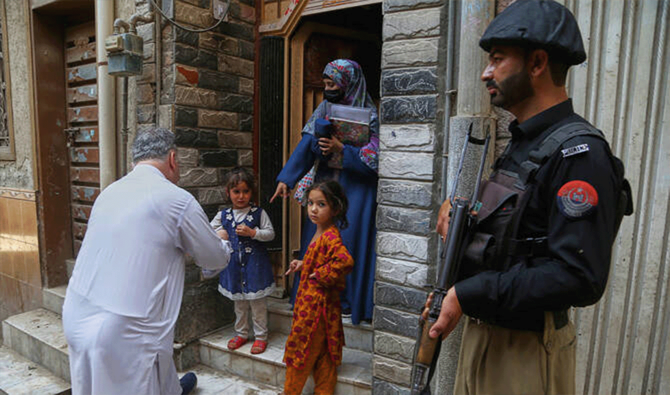
A police officer stands guard as a health worker (left) marks a finger of a child after administering a polio vaccine at a neighborhood in Peshawar, Pakistan, on May 26, 2025. (AP/File)
Short Url
Updated 14 October 2025
Follow

Gunmen kill security official protecting polio team in northwest Pakistan

  • Attack took place in Swat Valley’s Matta Town during week-long vaccination campaign
  • Pakistan and Afghanistan are the only two countries where polio remains endemic

PESHAWAR: A paramilitary Levies soldier deployed to protect a polio vaccination team was killed in Pakistan’s restive northwestern Khyber Pakhtunkhwa province, police said on Tuesday.

The attack took place in the Matta Town of Swat Valley while a week-long nationwide campaign to inoculate 45 million children was underway, according to District Administration Official Amjad Khan.

Pakistan and Afghanistan are the only countries where polio remains endemic. While the country has made major gains since the 1990s when annual cases exceeded 20,000, reducing the toll to eight by 2018, vaccine hesitancy, fueled by misinformation and resistance from some religious hard-liners, continues to undermine efforts.

“The attackers opened fire on the security team while women polio workers were inside a house administering vaccinations,” he told Arab News.

“The deceased identified as Abdul Kabir succumbed to injuries on the spot.”

Pakistan recorded 74 cases in 2024, a sharp rise from six in 2023 and just one in 2021. This year, it has reported 29 polio cases so far, including 18 from Khyber Pakhtunkhwa, nine from Sindh and one each from Punjab and Gilgit-Baltistan.

Polio is a highly infectious and incurable disease that can cause lifelong paralysis. The only effective protection is through repeated doses of the Oral Polio Vaccine for every child under five during each campaign, alongside timely completion of all routine immunizations.

Pakistan’s efforts to eliminate poliovirus have been hampered by parental refusals, widespread misinformation and repeated attacks on anti-polio workers by militant groups. In remote and volatile areas, vaccination teams often operate under police protection, though security personnel themselves have also been targeted and killed in attacks.


Terror at Friday prayers: witnesses describe blast rocking Islamabad mosque

Updated 6 sec ago
Follow

Terror at Friday prayers: witnesses describe blast rocking Islamabad mosque

  • ’Extremely powerful’ explosion ripped through Imam Bargah Qasr-e-Khadijatul Kubra just after Friday prayers started, worshipper says
  • The attack was the deadliest in the Pakistani capital since September 2008, when 60 people were killed in a suicide truck bomb blast

ISLAMABAD: A worshipper at the Shiite mosque in Islamabad where dozens of people were killed in a suicide blast on Friday described an “extremely powerful” explosion ripping through the building just after prayers started.

Muhammad Kazim, 52, told AFP he arrived at the Imam Bargah Qasr-e-Khadijatul Kubra mosque shortly after 1:00 p.m. (0800 GMT) on Friday and took up a place around seven or eight rows from the Imam.

“During the first bow of the Namaz (prayer ritual), we heard gunfire,” he told AFP outside the Pakistan Institute of Medical Sciences (PIMS) hospital, where many of the wounded were brought for treatment.

“And while we were still in the bowing position, an explosion occurred,” he said.

Kazim, who is from Gilgit-Baltistan in northern Pakistan and lives in Islamabad, escaped unharmed, but accompanied his wounded friend to the PIMS hospital for treatment.

“It was unclear whether it was a suicide bombing, but the explosion was extremely powerful and caused numerous casualties,” Kazim said.

“Debris fell from the roof, and windows were shattered,” he added. “When I got outside, many bodies were scattered... Many people lost their lives.”

The Daesh (Islamic State) group has claimed responsibility for the attack, according to the SITE Intelligence Group, which monitors such communications.

Another worshipper, Imran Mahmood, described a gunfight between the suicide bomber, a possible accomplice and volunteer security personnel at the mosque.

“The suicide attacker was trying to move forward, but one of our injured volunteers fired at him from behind, hitting him in the thigh,” Mahmood, in his fifties, told AFP.

“He fell but got up again. Another man accompanying him opened fire on our volunteers,” he said, adding the attacker “then jumped onto the gate and detonated the explosives.”

As of Saturday morning, the death toll stood at 31, with at least 169 wounded.

The attack was the deadliest in the Pakistani capital since September 2008, when 60 people were killed in a suicide truck bomb blast that destroyed part of the five-star Marriott hotel.

LAX SECURITY

Describing the aftermath of the attack, Kazim said unhurt worshippers went to the aid of those wounded.

“People tried to help on their own, carrying two or three bodies in the trunks of their vehicles, while ambulances arrived about 20 to 25 minutes later,” he told AFP.

“No one was allowed near the mosque afterwards.”

Kazim, who has performed Friday prayers at the mosque “for the past three to four weeks,” said security had been lax.

“I have never seen proper security in place,” he told AFP.

“Volunteers manage security on their own, but they lack the necessary equipment to do it effectively,” he said.

“Shiite mosques are always under threat, and the government should take this seriously and provide adequate security,” he added.