LIBREVILLE: Cameroon’s opposition challenger Issa Tchiroma Bakary claimed election victory on Tuesday against incumbent President Paul Biya, who has been in power for 43 years, although official results for the weekend vote are not expected for two weeks.
“Our victory is clear. It must be respected,” Tchiroma declared in a post on Facebook.
He urged the government to “accept the truth of the ballot box” or “plunge the country into turmoil” and promised to publish detailed results by region.
“The people have chosen,” he added.
While the tally sheets are allowed to be published, final official results must be announced by the country’s Constitutional Council – a “red line that must not be crossed,” according to the government.
In the 2018 presidential election, opposition challenger Maurice Kamto declared himself winner the day after the vote.
He was subsequently arrested and his supporters’ rallies were dispersed with tear gas and water cannon, with dozens arrested.
Biya, the world’s oldest serving head of state, is vying for an eighth term to extend his decades in power.
But former employment minister Tchiroma generated unexpected enthusiasm among voters in the central African nation and a duel had been emerging, with supporters on both sides claiming victory.
Images of sheets and blackboards tallying the results have circulated on social media, fueling the victory claims among both Biya and Tchiroma’s camps.
Lively campaign
Biya faced 11 opponents, including Tchiroma, who resigned from the government in June to join the opposition after 20 years at Biya’s side.
He became the leading challenger after Kamto was barred from standing by the Constitutional Council.
Biya has been in power since 1982 and has won every election in the past 20 years with more than 70 percent of the vote.
Most of the eight million Cameroonians who were eligible to vote in Sunday’s one-round election have only known one ruler in their lifetime.
Cameroonian political scientist Stephane Akoa said before the vote: “We shouldn’t be naive. We know full well the ruling system has ample means at its disposal to get results in its favor.”
But he said that the campaign had been “much livelier” during the final days than was usually the case at that stage and the vote was “therefore more likely to throw up surprises.”
When Biya first became president in 1982, US president Ronald Reagan’s era was in full swing and the Cold War had nearly a decade to run.
Biya, Cameroon’s second head of state since independence from France in 1960, has ruled with an iron fist, personally appointing and dismissing key officials and ruthlessly repressing all political and armed opposition.
He has succeeded in holding onto power through social upheaval, economic disparity and separatist violence.

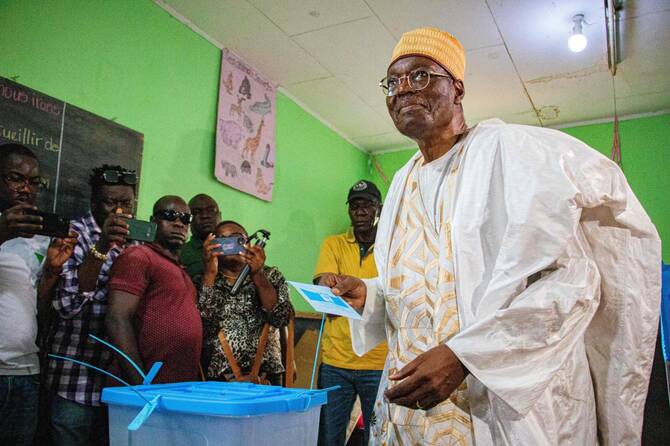
Cameroon’s opposition candidate Tchiroma declares victory in presidential vote
Short Url
https://arab.news/69hrz
Cameroon’s opposition candidate Tchiroma declares victory in presidential vote
- Issa Tchiroma Bakary: ‘Our victory is clear. It must be respected’
- Paul Biya, the world’s oldest serving head of state, is vying for an eighth term
UK govt bans pro-Palestinian march over alleged Iran support
- The UK government has banned an annual pro-Palestinian march planned for Sunday which London police claim is organized by a group “supportive of the Iranian regime“
LONDON: The UK government has banned an annual pro-Palestinian march planned for Sunday which London police claim is organized by a group “supportive of the Iranian regime.”
Interior minister Shabana Mahmood said late Tuesday she had approved the rare police request to prevent “serious public disorder” if the Al-Quds Day march and counter-protests had gone ahead.
It is the first time a protest march has been banned since 2012 but a static demonstration will be permitted, according to London’s Metropolitan police.
Mahmood said she was “satisfied” a ban was “necessary” due to “the scale of the protest and multiple counter-protests, in the context of the ongoing conflict in the Middle East.”
The minister added that she expected to see “the full force of the law applied to anyone spreading hatred and division.”
The Islamic Human Rights Commission (IHRC), an NGO which organizes the annual Al-Quds Day march, said it “strongly condemns” the decision, which it called “politically charged.”
“We are seeking legal advice and this decision will not go unchallenged,” it added, accusing the Met of having “brazenly abandoned their sworn principle of policing without fear or favor.”
It said the London force “unashamedly regurgitate Zionist talking points about the IHRC “without a shred of evidence.”
The group describes the day and march as an “international demonstration ... in support of Palestinians and all the oppressed around the world.”
- ‘Unique risks’ -
Al-Quds day, which takes its name from the Arabic for Jerusalem, originated in Iran in 1979 in support of the Palestinian people, and is now marked annually in various countries, notably in the Muslim world. It aims to protest Israel’s occupation of east Jerusalem.
But the Met’s Assistant Commissioner Ade Adelekan said it was “uniquely contentious having originated in Iran and in London is organized by the Islamic Human Rights Commission.”
He claimed that the organization was “supportive of the Iranian regime.”
“The threshold to ban a protest is high and we do not take this decision lightly,” Adelekan said.
He noted the Met has “a proven track record” of permitting free speech and protest rights at dozens of major pro-Palestinian and other demonstrations in recent years.
“But in our assessment this march raises unique risks and challenges,” he said.
“We must consider the likely high numbers of protesters and counter protesters coming together and the extreme tensions between different factions.
“We have taken into consideration the likely impact on protests of the volatile situation in the Middle East, with the Iranian regime attacking British allies and military bases overseas.”
The ban on the march and any associated counter-protest marches is valid for a month from Wednesday.
Interior minister Shabana Mahmood said late Tuesday she had approved the rare police request to prevent “serious public disorder” if the Al-Quds Day march and counter-protests had gone ahead.
It is the first time a protest march has been banned since 2012 but a static demonstration will be permitted, according to London’s Metropolitan police.
Mahmood said she was “satisfied” a ban was “necessary” due to “the scale of the protest and multiple counter-protests, in the context of the ongoing conflict in the Middle East.”
The minister added that she expected to see “the full force of the law applied to anyone spreading hatred and division.”
The Islamic Human Rights Commission (IHRC), an NGO which organizes the annual Al-Quds Day march, said it “strongly condemns” the decision, which it called “politically charged.”
“We are seeking legal advice and this decision will not go unchallenged,” it added, accusing the Met of having “brazenly abandoned their sworn principle of policing without fear or favor.”
It said the London force “unashamedly regurgitate Zionist talking points about the IHRC “without a shred of evidence.”
The group describes the day and march as an “international demonstration ... in support of Palestinians and all the oppressed around the world.”
- ‘Unique risks’ -
Al-Quds day, which takes its name from the Arabic for Jerusalem, originated in Iran in 1979 in support of the Palestinian people, and is now marked annually in various countries, notably in the Muslim world. It aims to protest Israel’s occupation of east Jerusalem.
But the Met’s Assistant Commissioner Ade Adelekan said it was “uniquely contentious having originated in Iran and in London is organized by the Islamic Human Rights Commission.”
He claimed that the organization was “supportive of the Iranian regime.”
“The threshold to ban a protest is high and we do not take this decision lightly,” Adelekan said.
He noted the Met has “a proven track record” of permitting free speech and protest rights at dozens of major pro-Palestinian and other demonstrations in recent years.
“But in our assessment this march raises unique risks and challenges,” he said.
“We must consider the likely high numbers of protesters and counter protesters coming together and the extreme tensions between different factions.
“We have taken into consideration the likely impact on protests of the volatile situation in the Middle East, with the Iranian regime attacking British allies and military bases overseas.”
The ban on the march and any associated counter-protest marches is valid for a month from Wednesday.
© 2026 SAUDI RESEARCH & PUBLISHING COMPANY, All Rights Reserved And subject to Terms of Use Agreement.



