

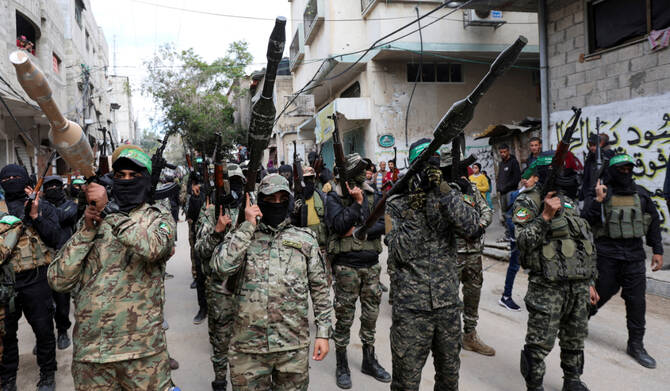

GAZA CITY: Hamas has sought to reassert itself in Gaza since a ceasefire took hold, killing dozens of people in a crackdown on groups that have tested its grip and appearing to get a US nod to police the shattered enclave temporarily.
Pummelled by Israel during the war ignited by the Oct. 7, 2023, attacks, Hamas has gradually sent its men back into the streets of Gaza since the ceasefire began on Friday, moving cautiously in case it suddenly collapses, according to two security sources in the territory.
On Monday, Hamas deployed members of its Qassam Brigades military wing as it freed the last living hostages seized two years ago. It was a reminder of one of the significant challenges facing US President Donald Trump’s effort to secure a lasting deal for Gaza, as the US, Israel, and many other nations demand that Hamas disarm.
Reuters footage showed dozens of Hamas fighters lined up at a hospital in southern Gaza, one wearing a shoulder patch identifying him as a member of the elite “Shadow Unit” that Hamas sources say was tasked with guarding hostages.
Trump’s plan foresees Hamas out of power in a demilitarized Gaza run by a Palestinian committee under international supervision.
It calls for deploying an international stabilization mission to train and support a Palestinian police force.
But Trump, speaking on his way to the Middle East, suggested Hamas had been given a temporary green light to police Gaza.
“They do want to stop the problems, and they’ve been open about it, and we gave them approval for a period of time,” he said, responding to a journalist’s question about reports that Hamas was shooting rivals and instituting itself as a police force.
After the ceasefire took effect, Ismail Al-Thawabta, head of Hamas’ Gaza government media office, said the group would not allow a security vacuum and that it would maintain public safety and property.
Hamas has ruled out any discussion of its arsenal, saying it would be ready to surrender its arms to a future Palestinian state. The group has said it seeks no role in Gaza’s future governing body, but that Palestinians should agree upon this with no foreign control.
As the war dragged on, a diminished Hamas faced growing internal challenges to its control of Gaza from groups with which it has long been at odds, often affiliated with clans.
Israeli Prime Minister Benjamin Netanyahu said earlier this year that Israel had been arming clans that oppose Hamas, without identifying them.
One of the Gaza sources, a security official, said that since the ceasefire, Hamas forces had killed 32 members of “a gang affiliated with a family in Gaza City,” while six of its personnel had also been killed.
The Gaza City clashes mostly pitted Hamas against members of the Doghmosh clan, residents and Hamas sources said.
The security official did not identify the group, nor say whether it was one of those suspected of receiving support from Israel.
The most prominent anti-Hamas clan leader is Yasser Abu Shabab, who is based in the Rafah area — an area from which Israel has yet to withdraw.
Offering attractive salaries, his group has recruited hundreds of fighters, a source close to Abu Shabab said earlier this year. Hamas calls him a collaborator with Israel, which he denies.
The Gaza security official said that, separate from the clashes in Gaza City, Hamas security forces had killed Abu Shabab’s “right-hand man” and efforts were underway to kill Abu Shabab himself.
Abu Shabab did not immediately respond to questions on the official’s comments.
Hussam Al-Astal, another anti-Hamas figure based in Khan Younis in areas controlled by Israel, taunted the group in a video message on Sunday, saying that once it hands over the hostages, its role and rule in Gaza would be over.
Palestinian analyst Reham Owda said Hamas’s actions were aimed at deterring groups that had collaborated with Israel and contributed to insecurity during the war. Hamas also aimed to show that its security officers should be part of a new government, though this would be rejected by Israel, she said.


