

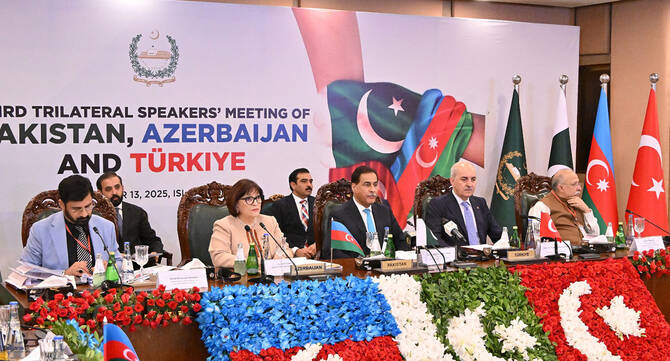

ISLAMABAD: A trilateral meeting of parliamentary speakers of Pakistan, Turkiye and Azerbaijan on Monday called for collective efforts to curb the use of militant proxies to destabilize any state, describing terrorism as a global menace.
The development comes amid Islamabad’s repeated accusations in recent months against Afghanistan of allowing the use of its soil by militant groups, particularly the Tehreek-e-Taliban Pakistan (TTP), and India’s backing of them for attacks inside Pakistan. Kabul and New Delhi deny those allegations.
Pakistan and Afghanistan exchanged cross-border fire over the weekend that killed 23 Pakistani soldiers and more than 200 Afghan Taliban fighters, according to the Pakistani military. Foreign governments, including Saudi Arabia, China and
Russia, expressed concern over the skirmishes, the worst between the neighbors since the Taliban returned to power in 2021.
On Monday, the speakers of Pakistan, Turkiye and Azerbaijan parliaments issued a joint declaration after talks in Islamabad, which addressed militancy, climate change, women participation in decision-making among a host of issues.
“The declaration also recognized terrorism as a global menace, including the use of terrorist groups as proxies, and stressed the need for collective and comprehensive strategies to address such challenges,” Pakistan’s National Assembly Secretariat said in a statement.
“The three sides reaffirmed adherence to international law and multilateral cooperation, especially within frameworks such as the United Nations (UN), Organization of Islamic Cooperation (OIC), Economic Cooperation Organization (ECO), and D-8.”
The speakers reaffirmed the shared bonds of history, culture, and values among the three brotherly nations and expressed a strong desire to deepen cooperation in diverse areas, including political, strategic, trade, economic, defense, peace and security, science and technology, climate change, environment, and cultural exchange.
“On climate change, the declaration urged joint efforts to address its adverse impacts, welcomed the upcoming COP29 in Baku as a milestone for strengthened global climate action, and highlighted the need for adequate climate finance for developing countries,” the statement said.
“It called for enhanced cooperation in the implementation of Sustainable Development Goals (SDGs) and the promotion of green energy and environmental sustainability.”
Reiterating their unwavering support for the Palestinian people, the three speakers stressed that any sustainable solution to the crisis must ensure an end to Israeli aggression, delivery of humanitarian aid, and the establishment of an independent Palestinian state, with Al-Quds Al-Sharif as its capital, according to the Pakistani National Assembly statement.
The participants of the summit also expressed solidarity with Azerbaijan over challenges posed by land mines and remnants of its war with Armenia in liberated territories, and reaffirmed support for its efforts to rehabilitate and rebuild those areas and ensure the safe return of internally displaced persons (IDPs).
Armenia and Azerbaijan committed to a lasting peace as US President Donald Trump hosted the leaders of the South Caucasus rivals at a White House signing event in August, ending decades of conflict.
“The speakers agreed to strengthen trilateral cooperation in defense and connectivity projects,” the statement read. “The conference concluded with the decision to convene the next Trilateral Speakers’ Meeting in Azerbaijan in 2026 on mutually agreed dates.”


