

Pakistan, Turkiye, Azerbaijan summit calls for collective efforts to curb use of militant proxies

Short Url
Updated 13 October 2025
Follow

Pakistan, Turkiye, Azerbaijan summit calls for collective efforts to curb use of militant proxies

  • The development comes amid Islamabad’s accusations against Afghanistan and India of backing militant groups for attacks inside Pakistan
  • Pakistan, Afghanistan exchanged cross-border fire over the weekend that killed 23 Pakistani soldiers and over 200 Afghan Taliban fighters

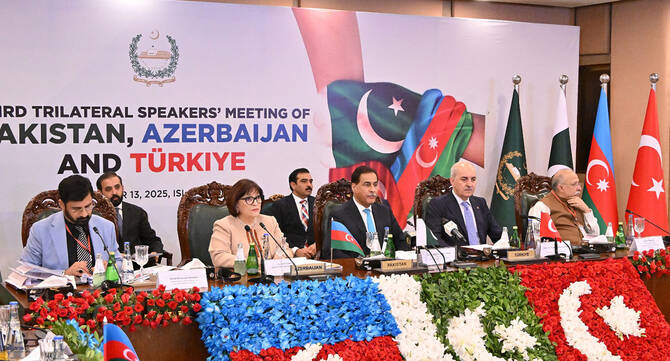
ISLAMABAD: A trilateral meeting of parliamentary speakers of Pakistan, Turkiye and Azerbaijan on Monday called for collective efforts to curb the use of militant proxies to destabilize any state, describing terrorism as a global menace.

The development comes amid Islamabad’s repeated accusations in recent months against Afghanistan of allowing the use of its soil by militant groups, particularly the Tehreek-e-Taliban Pakistan (TTP), and India’s backing of them for attacks inside Pakistan. Kabul and New Delhi deny those allegations.

Pakistan and Afghanistan exchanged cross-border fire over the weekend that killed 23 Pakistani soldiers and more than 200 Afghan Taliban fighters, according to the Pakistani military. Foreign governments, including Saudi Arabia, China and

Russia, expressed concern over the skirmishes, the worst between the neighbors since the Taliban returned to power in 2021.

On Monday, the speakers of Pakistan, Turkiye and Azerbaijan parliaments issued a joint declaration after talks in Islamabad, which addressed militancy, climate change, women participation in decision-making among a host of issues.

“The declaration also recognized terrorism as a global menace, including the use of terrorist groups as proxies, and stressed the need for collective and comprehensive strategies to address such challenges,” Pakistan’s National Assembly Secretariat said in a statement.

“The three sides reaffirmed adherence to international law and multilateral cooperation, especially within frameworks such as the United Nations (UN), Organization of Islamic Cooperation (OIC), Economic Cooperation Organization (ECO), and D-8.”

The speakers reaffirmed the shared bonds of history, culture, and values among the three brotherly nations and expressed a strong desire to deepen cooperation in diverse areas, including political, strategic, trade, economic, defense, peace and security, science and technology, climate change, environment, and cultural exchange.

“On climate change, the declaration urged joint efforts to address its adverse impacts, welcomed the upcoming COP29 in Baku as a milestone for strengthened global climate action, and highlighted the need for adequate climate finance for developing countries,” the statement said.

“It called for enhanced cooperation in the implementation of Sustainable Development Goals (SDGs) and the promotion of green energy and environmental sustainability.”

Reiterating their unwavering support for the Palestinian people, the three speakers stressed that any sustainable solution to the crisis must ensure an end to Israeli aggression, delivery of humanitarian aid, and the establishment of an independent Palestinian state, with Al-Quds Al-Sharif as its capital, according to the Pakistani National Assembly statement.

The participants of the summit also expressed solidarity with Azerbaijan over challenges posed by land mines and remnants of its war with Armenia in liberated territories, and reaffirmed support for its efforts to rehabilitate and rebuild those areas and ensure the safe return of internally displaced persons (IDPs).

Armenia and Azerbaijan committed to a lasting peace as US President Donald Trump hosted the leaders of the South Caucasus rivals at a White House signing event in August, ending decades of conflict.

“The speakers agreed to strengthen trilateral cooperation in defense and connectivity projects,” the statement read. “The conference concluded with the decision to convene the next Trilateral Speakers’ Meeting in Azerbaijan in 2026 on mutually agreed dates.”


Pakistan says EU notes progress on rights commitments during GSP+ compliance discussions

Updated 7 sec ago
Follow

Pakistan says EU notes progress on rights commitments during GSP+ compliance discussions

  • The review formed part of a wide-ranging EU-Pakistan Joint Commission meeting held in Brussels
  • The two sides also covered irregular migration, climate cooperation and safe Afghan refugee return

ISLAMABAD: The European Union reviewed Pakistan’s compliance with its preferential GSP+ trade scheme this week and welcomed progress on key human rights commitments, according to a statement on Saturday, as Islamabad seeks to protect access to European markets vital for its export-led growth strategy.

The EU’s Generalized Scheme of Preferences Plus (GSP+) grants duty-free access to most European markets for eligible developing countries in return for their commitment to implement 27 international conventions covering human rights, labor standards, environmental protection and good governance. Pakistan, which has benefited from the scheme since 2014, is one of the biggest beneficiaries, with the EU its second-largest trading partner and a destination for roughly a third of its exports.

Pakistan’s GSP+ status has come under scrutiny in the past after, in April 2021, the European Parliament adopted a resolution calling for an immediate review, citing concerns over violence against religious minorities, curbs on media freedom and broader human rights issues. The move followed widespread anti-France protests in Pakistan over the publication of anti-Islamic caricatures, which EU legislators said raised questions about Islamabad’s commitment to fundamental freedoms.

“Both sides reviewed Pakistan’s progress on the implementation of the 27 international conventions as required under the GSP+ framework,” the foreign office said in a statement circulated in Islamabad. “The EU welcomed progress made in bringing Pakistan’s application of the death penalty in line with international standards and encouraged further steps in this regard.”

“It also recognised important first steps against torture, as well as the creation of a Commission on Minorities,” it added.

IRREGULAR MIGRATION, CLIMATE COOPERATION

The discussions took place during the 15th meeting of the EU–Pakistan Joint Commission, held in Brussels on Dec. 17, where officials also addressed irregular migration, including cooperation on the return and readmission of migrants without legal status, and legal mobility pathways under the bloc’s broader migration framework.

The foreign office statement came just a day after Greek authorities said they rescued more than 500 migrants from a fishing boat in the Mediterranean, adding that the group included several Pakistani nationals, highlighting continued migration pressures despite tighter controls.

Climate cooperation was another focus, with both sides reviewing ongoing collaboration on climate resilience, disaster risk reduction and sustainable development, areas of growing importance for Pakistan after repeated climate-related shocks.

The meeting also touched on the situation of Afghan refugees.

The statement said the EU welcomed the ongoing discussions between Pakistan and the UN refugee agency “to identify and compile a list of vulnerable cases, to ensure their adequate protection.”

“The EU appreciated that Pakistan is hosting millions of Afghan nationals for over four decades,” it continued. “They emphasised that any return must be safe, dignified and in line with international standards.”

The two sides agreed to continue engagement under the EU–Pakistan Strategic Engagement Plan, a framework guiding cooperation on political dialogue, trade, development, security and people-to-people exchanges, with the next joint commission meeting scheduled to be held in Islamabad next year.