

Palestinians freed from Israeli jails return to loved ones

1 / 4
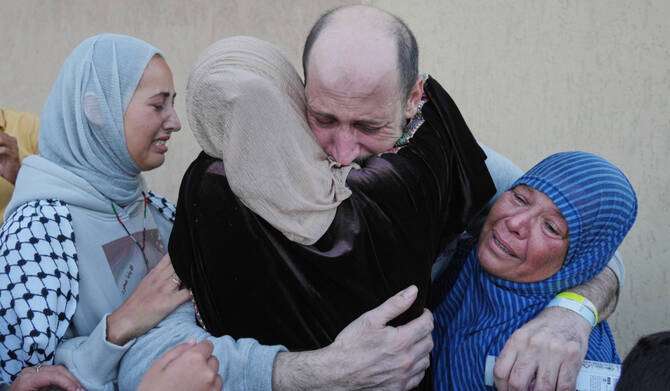
A freed Palestinian prisoner is welcomed by relatives upon arriving in the Gaza Strip after being released from Israeli jails under a ceasefire agreement between Hamas and Israel, in Khan Younis, southern Gaza Strip, Monday, Oct. 13, 2025. (AP)
2 / 4
One of the Palestinian prisoners, who was released in a prisoner-hostage swap and ceasefire deal, embraces a boy upon arrival by bus at Ramallah Culture Centre, on October 13, 2025. (AFP)
3 / 4
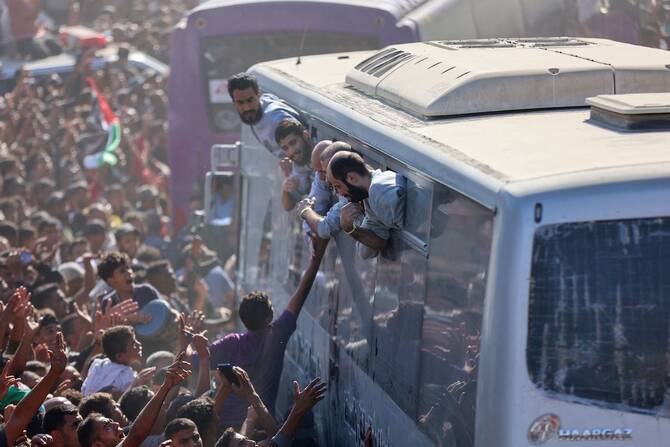
Buses carrying Palestinians released from Israeli prisons arrive outside the Nasser hospital in Khan Yunis in the southern Gaza Strip on October 13, 2025. (AFP)
4 / 4
One (R) of the Palestinian prisoners is embraced by his father upon arrival by bus at Ramallah Cultural Centre in Ramallah in the occupied West Bank, on October 13, 2025. (AFP)
Short Url
Updated 13 October 2025
Follow

Palestinians freed from Israeli jails return to loved ones

  • Israel is set to release 250 Palestinians convicted of murder and other serious crimes as well as 1,700 Palestinians detained in Gaza since the war began
  • 22 Palestinian minors and the bodies of 360 militants will also be handed over

KHAN YOUNIS: Thousands of Palestinians erupted with joy in the southern Gaza city of Khan Younis on Monday, as Red Cross buses brought back nearly 1,700 former prisoners.
Some climbed the sides of the slowly moving buses as they weaved through the dense crowds gathered at Nasser Hospital to hug or kiss a loved one they recognized.
“The greatest joy is seeing my whole family gathered to welcome me,” said Yusef Afana, a 25-year-old released prisoner from north Gaza.
“I spent 10 months in prison — some of the hardest days I’ve ever lived. The pain in prison isn’t only physical; it’s pain in the soul,” he said, adding, like many of his comrades, that he hoped for all other prisoners in Israeli jails to be released soon.
At Nasser Hospital, men in military fatigues and black balaclavas struggled to keep order as the prisoners wearing the Israel Prison Service’s grey jumpsuits came off the buses.
Patriotic music blared on speakers, while Palestinian flags flew alongside those of Hamas or the Popular Front for the Liberation of Palestine.

Shadi Abu Sidu, a 32-year-old from Gaza City’s Rimal neighborhood, alleged that he and other prisoners were mistreated in jail.
“Even right before our release, they continued to mistreat and humiliate us,” he said
“But now, we hope to erase those painful memories and begin life anew.”
Among the Palestinians released under a US-brokered Gaza ceasefire deal, about 1,700 were detained by the Israeli army in Gaza during the war, while 250 are security detainees, including many convicted of killing Israelis.
Israel agreed to free them in exchange for the release of hostages held in Gaza, under the first phase of US President Donald Trump’s plan to end a war that was sparked by the attack on Israel on Oct. 7, 2023.
In the occupied West Bank city of Ramallah, too, a large crowd had gathered to greet another group of roughly 100 prisoners released under the deal.
Some threw victory signs while others struggled to walk without assistance as they got off the bus and were met by a crowd cheering their return.
“It’s an indescribable feeling, a new birth,” Mahdi Ramadan told AFP, flanked by his parents, with whom he said he would spend his first evening out of jail.
Nearby, relatives exchanged hugs, young men in tears pressed their foreheads against each other — some even fainting from the emotion of seeing loved ones again after years, and sometimes decades, in jail.

Nour Soufan, now 27, was due to meet his father, Moussa, who had been jailed a few months after his birth, outside the jail for the first time.
Soufan and half a dozen relatives came to Ramallah from Nablus, in the north of the West Bank, and spent the night in their vehicle.
“I have never seen my father, and this is the first time I will see him. This is a very beautiful moment,” Soufan said.
Like him, many had defied the travel restrictions that punctuate daily life in the Palestinian territory, with Israeli army checkpoints proliferating in two years of war.
Palestinian media reported on Sunday that families of detainees had been contacted by Israeli authorities, asking them not to organize mass celebrations.
“No reception is allowed, no celebration is allowed, no gatherings,” said Alaa Bani Odeh, who came from the northern town of Tammun to find his 20-year-old son, who had been jailed for four years.
Several prisoners said they would return home and stay with their families in their first hours of freedom.
During previous releases, mass gatherings had flooded entire streets in Ramallah, with people waving Palestinian flags as well as those of political factions, including Hamas.
Many prisoners wore a black-and-white keffiyeh around their necks — the traditional scarf that has become synonymous with the Palestinian cause.
Some of the newly released prisoners happily let themselves be carried away on relatives’ shoulders.
“Prisoners live on hope ... Coming home, to our land, is worth all the gold in the world,” said one freed detainee, Samer Al-Halabiyeh.
“God willing, peace will prevail, and the war in Gaza will stop,” Halabiyeh added. 
“Now I just want to live my life.”
Journalists rushed to talk to the prisoners, but many declined to engage, sometimes explaining that, before their release, they were advised not to speak.


MSF says conditions for Gaza medics ‘as hard as it’s ever been’ despite truce

Updated 4 sec ago
Follow

MSF says conditions for Gaza medics ‘as hard as it’s ever been’ despite truce

DOHA: Conditions for medics and patients in Gaza are as severe as ever despite a nearly two-month truce in the territory, the president of medical charity Doctors Without Borders (MSF) said in an AFP interview.
Israel and Palestinian militant group Hamas agreed in October to a US-backed truce deal for Gaza which stipulated an influx of aid to the territory devastated by two years of war and in the grip of a humanitarian crisis.
“It’s as hard as it’s ever been,” Javid Abdelmoneim said of conditions for medical staff operating in Gaza’s hospitals, speaking on the sidelines of the annual Doha Forum on diplomacy on Sunday.
“While we’re able to continue doing operations, deliveries, wound care, you’re using protocols or materials and drugs that are inferior, that are not the standard. So you’ve got substandard care being delivered,” he explained.
Abdelmoneim, who worked as a doctor in Gaza in 2024, said the ongoing truce was only a “ceasefire of sorts” with “still several to dozens of Palestinians being killed every day by Israel.”
Despite the truce, 376 Palestinians have been killed in Gaza, according to local health authorities, as well as three Israeli soldiers.
“We’re seeing the injured patients in the emergency rooms in which we work throughout the strip,” he added.
Aid agencies are pushing for more access for humanitarian convoys to enter Gaza while Israel has resisted calls to allow aid through the Rafah crossing from Egypt.
Aid ‘weaponized’
The MSF president said that since the truce began, aid “hasn’t come in to the level that’s necessary.”
“There isn’t a substantial change and it is being weaponized... So as far as we’re concerned that is an ongoing feature of the genocide. It’s being used as a chip and that’s something that should not happen with humanitarian aid,” Abdelmoneim said.
In 2024, MSF said its medical teams had witnessed evidence on the ground in Gaza and concluded that genocide was taking place.
Israel’s foreign ministry rejected the report saying at the time that it was “fabricated.”
Abdelmoneim said both the lack of supplies and the destruction of hospitals in the Palestinian territory — still not offset by the provision so far of field hospitals — meant care remained inadequate.
“Those two things together mean increased infection rates, increased stays and greater risk of complications. So it is a substandard level of care that you’re able to deliver,” he said.
The MSF president also sounded the alarm over the safety of medical staff in Sudan where at the end of October the paramilitary Rapid Support Forces (RSF) seized the North Darfur capital of El-Fasher, the army’s last stronghold in the western region.
The paramilitaries’ final advance after a bitter 18-month siege was followed by reports of widespread atrocities.
“One feature that has been consistent, no matter where you are in Sudan, no matter who controls the territory, are attacks on health care and blockages to supply movements and provision of health care,” Abdelmoneim said.
’Freedom, protection access’
The World Health Organization said at the end of October that it had received reports that more than 460 patients and their companions had been shot dead at a maternity hospital in El-Fasher during its capture by the RSF and of six health workers being abducted.
On Thursday, an RSF drone attack on the army-held town of Kalogi in Sudan’s South Kordofan state hit a children’s nursery and a hospital, killing dozens of civilians including children, a local official told AFP.
“Both sides need to allow humanitarian and medical workers freedom, protection and access to the population, and that includes supplies,” said Abdelmoneim, who also worked as a doctor in Omdurman in Sudan in February.
The MSF president said the charity’s medical teams receiving displaced people in Sudan and neighboring Chad were encountering “harrowing tales of sexual violence, tales of ethnically targeted violence, extortion” as well of “evidence that really does point to famine-like conditions.”
In Tawila, a town now sheltering more than 650,000 people fleeing El-Fasher and nearby Zamzam camp, also under RSF control, Abdelmoneim said the MSF had been told by survivors “that family members are detained and never seen again.”
“So our question is, what has happened to that population?” he said.
The medical charity was backing calls by the UN Human Rights Council for an enquiry into the reported violations.
“We would encourage all member states to support that, an independent investigation inside El-Fasher,” Abdelmoneim said.