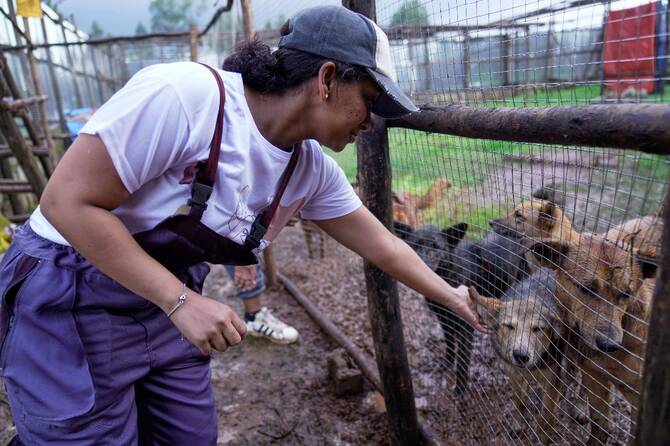
ADDIS ABABA: Among the whimpering of rescued dogs, a soft whistle cuts through. It’s Feven Melese, a young woman hoping to support thousands of abandoned dogs on the streets of the Ethiopian capital, Addis Ababa.
The 29-year-old music degree graduate has put up a rare shelter on the outskirts of the city, where she provides food and a place to stay for 40 dogs, while feeding about 700 others every week on the streets.
Melese said she has found new homes for more than 300 dogs in the past two years. Together with fellow young animal rights activists, they are on a mission to change the widespread perception in Ethiopia that dogs are protectors working for humans, not pets to be cared for.
As skyscrapers rise in Addis Ababa, the estimated 200,000 unclaimed dogs roaming the streets have fewer places to hide. Many dog owners have abandoned them as they move into new residential apartments whose landlords enforce a no-pet policy.
Authorities have expressed concern about the spread of diseases like rabies, and in recent months they have faced criticism after poisoning thousands of stray dogs ahead of major events, following an incident in which a resident was bitten.
Melese said many in Ethiopia do not treat dogs with care and abandon them when they become inconvenient.
“In Ethiopia, the society does not understand. They say, are they (dogs) hungry? Do they have feelings? They don’t care if they eat or not. If they are sick, they don’t care,” she said.
Melese’s shelter, though small and makeshift, is also a haven for dogs that survived road accidents. One of them, Konjit — whose name means “beautiful” in Amharic — wears a neck brace to help support healing, and wags her tail as Melese cuddles her.
Melese said that as a child in Addis Ababa, she cared for stray dogs and ended up with five that came to her home and stayed.
“My mother got angry and tried to take them back to the streets, but they kept coming back and I would still take them in,” she said.
Some residents in Addis Ababa say they are worried about the dangers posed by stray dogs and that the animals should be taken to a shelter.
“They (dogs) do not allow people to pass on the road and can be aggressive, even biting. They are very dangerous for the community, as their owners are unknown. No one can safely pass this way at night,” said Yonas Bezabih.
The Addis Ababa city administration official, Melese Anshebo, told The Associated Press that the government was planning to begin a dog registration and vaccination exercise to ensure that dog owners are fully responsible.
“To those who seem to have no owners, we will aim to find them shelters and some of the stray dogs who show symptoms of viruses, we will be forced to eliminate them,” he said.
A veterinarian, Dr. Alazar Ayele, said rabies remains a serious public health concern in Addis Ababa and expressed concern that resources for vaccination, sterilization and sheltering are still very limited.
“What we need are coordinated, humane approaches, more vaccines, trained veterinarians and community education to protect both people and animals,” he said.
Luna Solomon, a friend of Melese’s, volunteers several times a week at the shelter to help feed the dogs and check on those that may need a vet.
Solomon said many owners abandon female dogs because they are likely to reproduce.
“People don’t usually pick female dogs because it takes a lot of responsibility to raise a female dog. There’s a lot that comes with it. Also, they don’t want to deal with her having puppies,” she said.
Biruk Dejene met Melese on social media when he was looking for a home for his dog that was being mistreated by his housemates.
He now gets to see his dog, Zuse, when he visits the shelter every week to volunteer.
While many see dogs as their guardians, there is often a lack of reciprocity by the owners, Dejene said.
“There’s no attachment. They just want them for their benefits and so on, so we’re doing a little bit of awareness of that,” he said.
Melese and her friends will continue advocating for dogs both on social media and in the streets of Addis Ababa, she said. They hope the government will consider mass vaccinations, neutering programs, and incentivized adoption to help give stray dogs a second chance at a home.


![]()

Abandoned dogs in Ethiopia’s capital get little care. A woman wants to change that
Short Url
https://arab.news/bark5
Abandoned dogs in Ethiopia’s capital get little care. A woman wants to change that
- The 29 year old music degree graduate has put up a rare shelter on the outskirts of the city, where she provides food and a place to stay for 40 dogs, while feeding about 700 others every week on the streets


Latest updates





© 2026 SAUDI RESEARCH & PUBLISHING COMPANY, All Rights Reserved And subject to Terms of Use Agreement.