SHARM EL SHEIKH: The US and Egyptian presidents are chairing a gathering of world leaders dubbed “the Summit for Peace” to support ending the two-year war in Gaza after a breakthrough ceasefire deal.
Israel and Hamas have no direct contacts and are not expected to attend Monday’s summit. Israel has rejected any role in Gaza for the internationally backed Palestinian Authority, whose leader is coming.
Leaders from Turkiye, Jordan, Britain, Germany, France, Italy, the United Nations and European Union also have all said they will attend.
The summit in the Egyptian Red Sea resort town of Sharm el-Sheikh comes on the same day that Hamas is to release its 20 remaining living Israeli hostages and Israel is to free hundreds of Palestinians from its prisons, crucial steps after a ceasefire began on Friday.
But major questions remain unanswered over what happens next, raising the risk of slide back into war.
So why are the world leaders meeting?
A new page
The two sides came under pressure from the United States, Arab countries and Turkiye to agree on the ceasefire’s first phase.
Israel and Hamas need international and regional technical and financial support to get through many complex issues.
Egyptian President Abdel Fattah El-Sisi’s office said the summit aims to “end the war” in Gaza and “usher in a new page of peace and regional stability” in line with US President Donald Trump’s vision.
In March, Egypt proposed a postwar plan for Gaza that would allow its 2.3 million people to remain. At the time, that was a counterproposal to a Trump plan to depopulate the territory.
The two leaders co-chairing the international summit signals that they are working together on a path forward.
Directly tackling the remaining issues in depth is unlikely at the gathering, expected to last about two hours. El-Sisi and Trump are expected to issue a joint statement after it ends.
Under the first phase, Israeli troops pulled back from some parts of Gaza, allowing hundreds of thousands of Palestinians in Gaza to return home from areas they were forced to evacuate. Aid groups are preparing to bring in large quantities of aid kept out of the territory for months.
Hostage and prisoner exchange: Logistical challenge
The negotiations will have to tackle the issues of disarming Hamas, creating a post-war government for Gaza and the extent of Israel’s withdrawal from the territory. Trump’s plan also stipulates that regional and international partners will work to develop the core of a new Palestinian security force.
Another major issue is raising funds for rebuilding Gaza. The World Bank, and Egypt’s postwar plan, estimate reconstruction and recovery needs in Gaza at $53 billion. Egypt plans to host a future reconstruction conference.
Who is missing?
Israel and Hamas.
The two primary parties to the conflict — staunch enemies who have little trust in each other and a number of failed negotiations behind them — are not attending.
Negotiations in Doha and in previous rounds were indirect, with Egypt and Qatar as meditators.
Iran, a main backer of Hamas, is not attending either.
Iran finds itself at one of its weakest moments since its 1979 Islamic Revolution. Iranian officials portrayed the ceasefire deal as a victory for Hamas but it underlined Iran’s waning influence in the region and revived concerns over possible renewed conflict with Israel as it still struggles to recover from the 12-day war in June.
A state function
The conference is likely to see world leaders praise Trump’s push for the ceasefire. For his part, El-Sisi is almost certainly relieved that Egypt has warded off plans to depopulate the Gaza Strip.
Turkish President Recep Tayyip Erdogan is expected to attend. Turkiye, which hosted Hamas political leaders for years, played a key role in bringing about the ceasefire agreement. Qatar, Saudi Arabia and the United Arab Emirates are also expected.
King Abdullah of Jordan is among the expected attendees. His country, alongside Egypt, will train the new Palestinian security force.
Germany, one of Israel’s strongest international backers and top suppliers of military equipment, plans to be represented by Chancellor Friedrich Merz. He has expressed concern over Israel’s conduct of the war and its plan for a military takeover of Gaza. He plans on co-hosting the reconstruction of Gaza conference with Egypt.
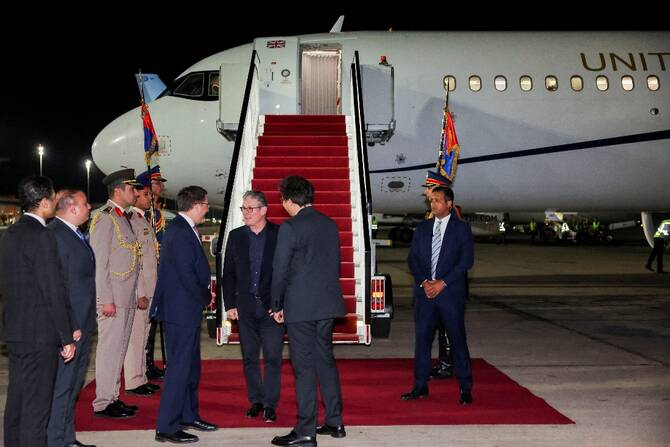
Britain’s Prime Minister is Keir Starmer is among the leaders who plans to attend. He has said will pledge 20 million British pounds (27 million dollars) to help provide water and sanitation for Gaza and said Britain will host a three-day conference to coordinate plans for Gaza’s reconstruction and recovery.
UN Secretary-General António Guterres, European Union President António Costa and Italian Prime Minister Giorgia Meloni have also said they will be attending.
The venue
Sharm el-Sheikh, the Red Sea resort at the tip of the Sinai Peninsula, has been host to many peace negotiations in the past decades.
Sharm el-Sheikh was briefly occupied by Israel for a year in 1956. After Israel withdrew, a United Nations peacekeeping force was stationed there until 1967, when Egypt’s President Gamal Abdel Nasser ordered the peacekeepers to leave, a move that precipitated the Six-Day War that year.
Sharm el-Sheikh and the rest of the Sinai Peninsula were returned to Egypt in 1982, following a 1979 peace treaty with Israel.
The town — now known for a luxury beach resort, dive sites and desert tours — also hosted many peace summits and rounds of negotiations between Israel and the Palestinians under President Hosni Mubarak, ousted in 2011. Under El-Sisi, the city has also been hosted many international conferences Monday’s is it’s first peace summit under him.


![]()
World leaders throw their weight behind the Gaza ceasefire deal

Short Url
https://arab.news/4wv2s
World leaders throw their weight behind the Gaza ceasefire deal
- The summit in Sharm el Sheikh comes on the same day that Hamas is to release its 20 remaining living Israeli hostages and Israel is to free hundreds of Palestinians from its prisons, crucial steps after a ceasefire began on Friday
- Leaders from Turkiye, Jordan, Britain, Germany, France, Italy, the United Nations and European Union also have all said they will attend


Latest updates


© 2026 SAUDI RESEARCH & PUBLISHING COMPANY, All Rights Reserved And subject to Terms of Use Agreement.