

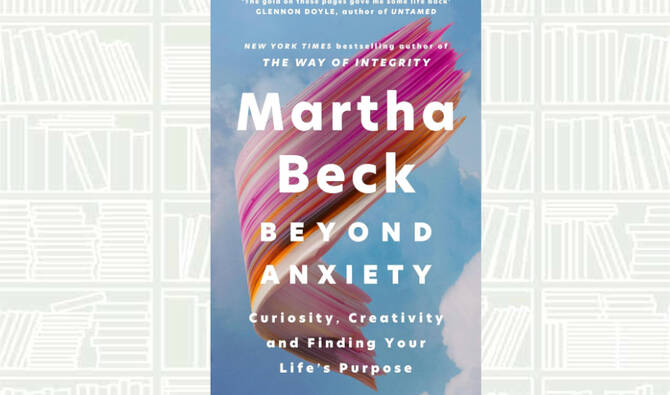

Martha Beck’s “Beyond Anxiety: Curiosity, Creativity and Finding Your Life’s Purpose” examines why modern life leaves so many people on edge and proposes a clear, practical route out of chronic worry.
Rather than treating anxiety as a defect to eliminate, Beck reframes it as a misdirected guidance system. She contrasts the “anxiety spiral,” a loop that keeps the body in threat mode, with a “creativity spiral” that restores flexibility, connection and purposeful action.
The book’s strength lies in its accessibility. The author distills neuroscience into plain language and focuses on short practices that fit into daily routines.
It invites readers to interrupt worry loops through curiosity, sensory grounding and playful problem-solving. These micro-exercises shift attention from scanning for danger to exploring options, gradually teaching the nervous system how to settle.
A social perspective complements the individual guidance. Drawing on ideas akin to Max Weber’s “iron cage,” Beck argues that systems built on speed, metrics, and profit amplify vigilance and crowd out meaning.
The book suggests that personal regulation and social well-being are intertwined: Cultivating creativity and connection at the individual level contributes to healthier communities and more humane institutions.
I appreciate how practical it is — offering prompts for five-minute experiments, reflections that encourage noticing small changes and gentle checkpoints that prevent perfectionism from derailing progress.
Newcomers will find plain language and doable routines; experienced readers may recognize familiar ideas but will appreciate the renewed emphasis on creativity as a regulatory tool.
Those well versed in mindfulness, somatic work or habit change may still welcome the way Beck links curiosity to nervous-system flexibility, giving an immediate lever to pull when worry spikes.
The message is ultimately hopeful. “Beyond Anxiety” does not promise a life without fear; instead it shows how to transform anxious energy into fuel for discovery, relationships and purpose.
Readers who want steps they can try today — without jargon or heavy time commitments — will find the approach inviting. As a field guide for overwhelmed beginners, it is clear, humane and designed for real life.


