

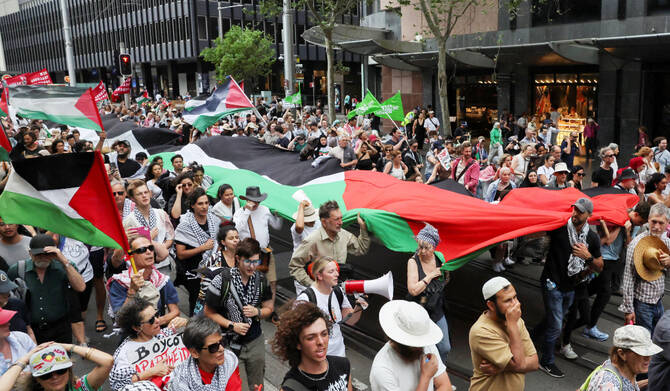
Tens of thousands participate in pro-Palestinian rally in Sydney

The rallies took place against the backdrop of Israeli troops pulling back under the first phase of a US-brokered deal to end the war in Gaza, which has killed tens of thousands of people. (Reuters)
Short Url
Updated 12 October 2025
Follow

Tens of thousands participate in pro-Palestinian rally in Sydney

  • Amid ceasefire, Israeli troops still conducting military occupation of Gaza, say organizers

SYDENY: Tens of thousands of people joined a pro-Palestinian rally in the business district of Australia’s most populous city, Sydney, on Sunday, organizers said, after a court this week blocked a move to hold the protest at the Sydney Opera House.

Around 27 protests took place across Australia on Sunday, including in Melbourne and Sydney, said the organizer. The organizers estimated a crowd of 30,000 at the Sydney rally. 
The rallies took place against the backdrop of Israeli troops pulling back under the first phase of a US-brokered agreement to end the war in Gaza, which has killed tens of thousands of people and left much of the enclave in ruins.
Amal Naser, an organizer of the Sydney rally, said “even if the ceasefire holds, Israel is still conducting a military occupation of Gaza and the West Bank.”

HIGHLIGHTS

• Pro-Palestinian protests have been common in Australia, especially in Sydney and Melbourne, since war in Gaza erupted on Oct. 7, 2023.

• Gaza authorities say more than 67,000 people have been killed and much of the enclave flattened since Israel began its military response to the Hamas attack.

“The occupation as well as systemic discrimination against Palestinians living in Israel constitute an Apartheid system,” she said in a statement.
Australian Broadcasting Corp. footage showed protesters, many carrying Palestinian flags and wearing keffiyeh scarves, marching on closed city streets. Police said no arrests were made.
Pro-Palestinian protests have been common in Australia, especially in Sydney and Melbourne, since war in Gaza erupted on Oct. 7, 2023.
Gaza authorities say more than 67,000 people have been killed and much of the enclave flattened since Israel began its military response to the Hamas attack. 
Meanwhile, preparations were underway on Sunday to ramp up aid entering Gaza.
Egypt said it was sending 400 aid trucks into Gaza on Sunday. They will be inspected by Israeli forces before being allowed in.
Dozens of trucks crossed the Egyptian side of the Rafah border crossing with the coastal strip. The Egyptian Red Crescent said they carried medical supplies, tents, blankets, food and fuel. The trucks will head to the inspection area in the Kerem Shalom crossing for screening by Israeli troops.
Expanding Israeli offensives and restrictions on humanitarian aid have triggered a hunger crisis, including famine in parts of the territory.
The UN has said it has about 170,000 metric tonnes of food, medicine and other humanitarian aid ready to enter once Israel gives the green light.
Abeer Etifa, a spokeswoman for the World Food Programme, said workers were clearing and repairing roads inside Gaza on Sunday to facilitate delivery.
The fate of the Gaza Humanitarian Foundation, an Israeli- and US-backed contractor that replaced the UN aid operation in May as the primary food supplier in Gaza, remains unclear.
Food distribution sites operated by the group in the southernmost city of Rafah and central Gaza were dismantled following the ceasefire deal, several Palestinians said on Sunday.
The foundation had been touted by Israel and the US as an alternative system to prevent Hamas from taking over aid. However, its operations were mired in chaos and hundreds of Palestinians were killed by Israeli gunfire while heading to its four sites.


The UN aid coordination agency cuts its funding appeal after Western support plunges

Updated 09 December 2025
Follow

The UN aid coordination agency cuts its funding appeal after Western support plunges

  • The UN aid coordinator sought $47 billion for this year and aimed to help 190 million people worldwide. Because of the lower support, it and humanitarian partners reached 25 million fewer people this year than in 2024

GENEVA: The UN’s humanitarian aid coordination office is downsizing its appeal for annual funding in 2026 after support this year, mostly from Westerngovernments, plunged to the lowest level in a decade.
The United Nations Office for the Coordination of Humanitarian Affairs said Monday it was seeking $33 billion to help some 135 million people cope with fallout from wars, climate disasters, earthquakes, epidemics and food shortages. This year, it took in $15 billion, the lowest level in a decade.
The office says next year it wants more than $4.1 billion to reach 3 million people in Palestinian areas, another $2.9 billion for Sudan — home to the world’s largest displacement crisis — and $2.8 billion for a regional plan around Syria.
“In 2025, hunger surged. Food budgets were slashed — even as famines hit parts of Sudan and Gaza. Health systems broke apart,” said OCHA chief Tom Fletcher. “Disease outbreaks spiked. Millions went without essential food, health care and protection. Programs to protect women and girls were slashed, hundreds of aid organizations shut.”
The UN aid coordinator sought $47 billion for this year and aimed to help 190 million people worldwide. Because of the lower support, it and humanitarian partners reached 25 million fewer people this year than in 2024.
The donor fatigue comes as many wealthy European countries face security threats from an increasingly assertive Russia on their eastern flank and have experienced lackluster economic growth in recent years, putting new strains on government budgets and the consumers who pay taxes to sustain them.
“I know budgets are tight right now. Families everywhere are under strain,” Fletcher said. “But the world spent $2.7 trillion on defense last year – on guns and arms. And I’m asking for just over 1 percent of that.”
The UN system this year has slashed thousands of jobs, notably at its migration and refugee agencies, and Secretary-General António Guterres’ office has launched a review of UN operations — which may or may not produce firm results.
Fletcher, who answers to Guterres, has called for “radical transformation” of aid by reducing bureaucracy, boosting efficiency and giving more power to local groups. Fletcher cited “very practical, constructive conversations” almost daily with the Trump administration.
“Do I want to shame the world into responding? Absolutely,” Fletcher said. “But I also want to channel this sense of determination and anger that we have as humanitarians, that we will carry on delivering with what we get.”