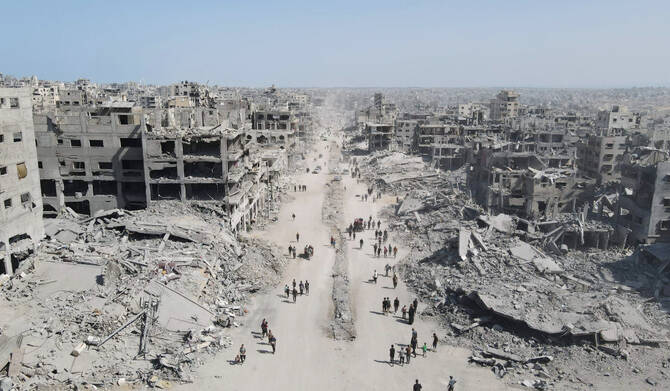

GAZA CITY, Palestinian Territories: Hundreds of thousands of Palestinians returned to a devastated Gaza City on Saturday, as Hamas warned the next stage in US President Donald Trump’s peace plan would be more difficult than the first.
Trump’s Middle East envoy promised Israeli hostage families their loved ones would be returned to them by Monday, and the region’s top US general visited Gaza one day after the guns fell silent.
“Your courage has moved the world,” US peace envoy Witkoff told the families and huge crowd in Tel Aviv. “To the hostages themselves: you are coming home,” he declared, as Israelis chanted “Thank you Trump.”
Israel and Hamas are now expected to release hostages and prisoners, two years after the Palestinian militant group’s October 7, 2023 attack triggered a counteroffensive that killed more than 67,000 Palestinians.
But mediators still have to secure a longer-term political solution that will see Hamas hand in its weapons and step aside from governing Gaza.
In an interview with AFP in Qatar, Hossam Badran, a member of Hamas’s political bureau, warned: “The second phase of the Trump plan, as it is clear from the points themselves, contains many complexities and difficulties.”
Hamas, he said, would not attend the formal signing of the Gaza peace deal in Egypt, where international leaders are due to gather Monday to discuss implementing the first phase of the ceasefire.
Hamas is resisting calls to disarm. An official from the group, speaking on condition of anonymity, told AFP that it was “out of the question.”
Hamas ally Iran also warned it did not trust Israel to respect the ceasefire.
“There is absolutely no trust in the Zionist regime,” Foreign Minister Abbas Araghchi, said, accusing Israel of violating previous ceasefires, such as in Lebanon.
- Multinational force -
Under the Trump plan, as Israel conducts a phased withdrawal from Gaza’a cities, it will be replaced by a multinational force from Egypt, Qatar, Turkiye and the United Arab Emirates, coordinated by a US-led command center in Israel.
On Saturday, US Central Command (CENTCOM) chief Admiral Brad Cooper, special envoy Steve Witkoff and Trump’s son-on-law Jared Kushner visited Gaza.
Witkoff, Kushner and Trump’s daughter Ivanka then went on to Tel Aviv to attend a gathering with the families of the remaining Israeli hostages held in Gaza.
Einav Zangauker, whose son Matan is one of about 20 hostages believed to still be alive, said: “We will continue to shout and fight until everyone is home.”
“We finally feel hope, but we cannot and will not stop now,” added Zairo Shachar Mohr Munder, whose uncle Abraham was abducted during the Hamas attack and his body recovered in August.
Hamas has until noon on Monday to hand over 47 remaining Israeli hostages — living and dead — from the 251 abducted two years ago. The remains of one more hostage, held in Gaza since 2014, are also expected to be returned.
In exchange, Israel will release 250 prisoners, including some of those serving life sentences for deadly anti-Israeli attacks, and 1,700 Gazans detained by the military since the war broke out.
The Israeli prison service said Saturday it had moved the 250 national security detainees to two prisons ahead of the handover.
- ‘Stood and cried’ -
According to Gaza’s civil defense agency, a rescue service operating under Hamas authority, more than 500,000 Palestinians had returned to Gaza City by Saturday evening.
“We walked for hours, and every step was filled with fear and anxiety for my home,” Raja Salmi, 52, told AFP.
When she reached the Al-Rimal neighborhood, she found her house utterly destroyed.
“I stood before it and cried. All those memories are now just dust,” she said.
Drone footage shot by AFP showed whole city blocks reduced to a twisted mess of concrete and steel reinforcing wire.
The walls and windows of five-story apartment blocks had been torn off and now lay choking the roadsides as disconsolate residents poked through the rubble.
The United Nations humanitarian office says Israel has allowed agencies to start transporting 170,000 tons of aid into Gaza if the ceasefire holds.
- ‘Ghost town’ -
Men, women and children navigated streets filled with rubble, searching for homes amid collapsed concrete slabs, destroyed vehicles and debris.
While some returned in vehicles, most walked, carrying belongings in bags strapped to their shoulders.
Sami Musa, 28, returned alone to check on his family’s house.
“Thank God... I found that our home is still standing,” Musa told AFP.
“It felt like a ghost town, not Gaza,” Musa said. “The smell of death still lingers in the air.”
Israel’s campaign in Gaza has killed at least 67,682 people, according to the health ministry in the Hamas-run territory, figures the United Nations considers credible.
The data does not distinguish between civilians and combatants but indicates that more than half of the dead are women and children.
The war was sparked by Hamas’s October 7, 2023 attack on Israel, which resulted in the deaths of 1,219 people, mostly civilians, according to an AFP tally based on official Israeli figures.