

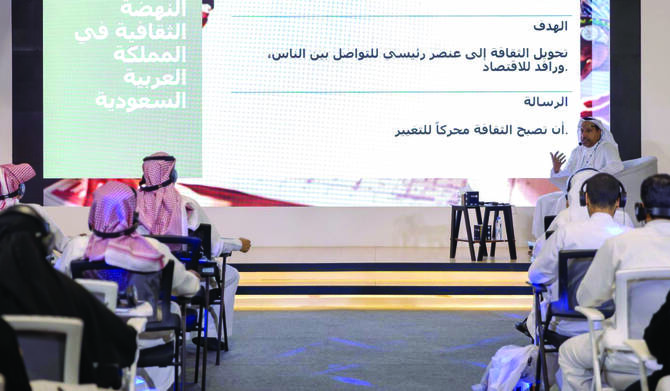

RIYADH: As part of the Riyadh International Book Fair, supervised by the Literature, Publishing and Translation Commission, Mirza Al-Khuwaildi presented a workshop titled “Cultural Journalism and Critical Reporting,” the Saudi Press Agency reported on Saturday.
The workshop “explored the concept of cultural writing and the foundations of a structured journalistic approach capable of producing high-quality written, visual, or audio content that conveys information, ideas, entertainment, or targeted marketing to specific audiences,” according to the SPA.

The library’s pavilion at the fair showcased the latest methods for restoring and treating valuable books and manuscripts, displaying restoration tools and materials. (SPA)
Al-Khuwaildi said that cultural media plays an important role in “connection, context, and cultural communication,” adding that successful cultural media “relies on three pillars — the idea, the platform, and the audience.” He reviewed the pros and cons of various content types, from educational and cultural to artistic, analytical, tourism, and entertainment.
The book fair — which organizers claim is the Kingdom’s largest annual cultural celebration — concluded on Saturday after 10 days of events, seminars, and artistic performances.
HIGHLIGHT
Some artisans demonstrated the traditional Sadu craft, weaving decorative patterns inspired by the desert landscape. Wicker crafts were also on display, with palm leaves woven into household items, reflecting the richness of the Saudi environment.
The King Fahd National Library’s pavilion at the fair showcased the latest methods for restoring and treating valuable books and manuscripts, displaying restoration tools and materials including ink fixative, magnesium for de-acidification, glycerin for paper moisturizing, caustic soda, and a paper scale. It also featured natural Japanese paper imported specifically for manuscript repair. Restoration technicians provided explanations of the step-by-step processes used to return damaged manuscripts to their original condition.
The library follows “a precise multi-stage process for handling documents and manuscripts from both government agencies and individuals. This includes sterilization, treatment, restoration, microfilming, digital imaging, and binding,” the SPA reported.
Meanwhile, the crafts pavilion provided a rich display of traditional arts and handmade products featuring the work of several Saudi craftswomen, highlighting local artistry and cultural identity.
Some artisans demonstrated the traditional Sadu craft, weaving decorative patterns inspired by the desert landscape. Wicker crafts were also on display, with palm leaves woven into household items, “reflecting the richness of the Saudi environment,” according to the SPA.
“This participation strongly supports the Ministry of Culture’s initiative designating 2025 as the Year of Handicrafts, which aims to empower artisans, document the nation’s craftsmanship heritage, and encourage new generations to sustain these skills,” the SPA concluded.


