

Pakistan PM forms committee to promote artificial intelligence for economic growth

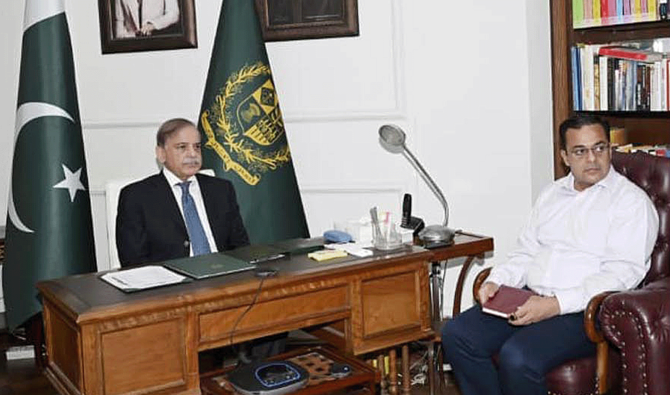
Prime Minister of Pakistan, Shehbaz Sharif (left), chairing an online meeting in Lahore, Pakistan, on October 11, 2025. (Government of Pakistan)
Short Url
Updated 11 October 2025
Follow

Pakistan PM forms committee to promote artificial intelligence for economic growth

  • Government says AI will make digital economy implementation more effective and transparent
  • A steering committee and expert panel will guide responsible use and data protection framework

ISLAMABAD: Prime Minister Shehbaz Sharif said on Saturday the government wants to promote the use of artificial intelligence (AI) to drive economic growth, as he constituted a high-level steering committee to oversee its adoption across sectors.

Pakistan has already launched an AI-based Customs Clearance and Risk Management System (RMS) to improve tax collection, cut human intervention and make customs operations more transparent and efficient.

It has also announced digital upgrades at the southern ports to integrate AI for managing congestion, accelerating cargo processing and boosting exports.

“The government is working on a priority basis to promote information technology and artificial intelligence,” Sharif said, according to an official statement released after he presided over a meeting. “We want to use artificial intelligence for the development of the national economy.”

The statement said the national policy on AI would be implemented effectively and that responsible use of the technology and data protection would be ensured.

The prime minister directed the formation of an AI Steering Committee to promote and implement the technology nationwide.

Officials briefing the meeting said a panel of experts would also be established to advise on AI deployment and regulatory safeguards.

“The implementation of the digital economy will be made more effective through artificial intelligence,” Sharif siad during the meeting.


Pakistan, global crypto exchange discuss modernizing digital payments, creating job prospects 

Updated 05 December 2025
Follow

Pakistan, global crypto exchange discuss modernizing digital payments, creating job prospects 

  • Pakistani officials, Binance team discuss coordination between Islamabad, local banks and global exchanges
  • Pakistan has attempted to tap into growing crypto market to curb illicit transactions, improve oversight

ISLAMABAD: Pakistan’s finance officials and the team of a global cryptocurrency exchange on Friday held discussions aimed at modernizing the country’s digital payments system and building local talent pipelines to meet rising demand for blockchain and Web3 skills, the finance ministry said.

The development took place during a high-level meeting between Finance Minister Muhammad Aurangzeb, Pakistan Virtual Assets Regulatory Authority (PVARA) Chairman Bilal bin Saqib, domestic bank presidents and a Binance team led by Global CEO Richard Teng. The meeting was held to advance work on Pakistan’s National Digital Asset Framework, a regulatory setup to govern Pakistan’s digital assets.

Pakistan has been moving to regulate its fast-growing crypto and digital assets market by bringing virtual asset service providers (VASPs) under a formal licensing regime. Officials say the push is aimed at curbing illicit transactions, improving oversight, and encouraging innovation in blockchain-based financial services.

“Participants reviewed opportunities to modernize Pakistan’s digital payments landscape, noting that blockchain-based systems could significantly reduce costs from the country’s $38 billion annual remittance flows,” the finance ministry said in a statement. 

“Discussions also emphasized building local talent pipelines to meet rising global demand for blockchain and Web3 skills, creating high-value employment prospects for Pakistani youth.”

Blockchain is a type of digital database that is shared, transparent and tamper-resistant. Instead of being stored on one computer, the data is kept on a distributed network of computers, making it very hard to alter or hack.

Web3 refers to the next generation of the Internet built using blockchain, focusing on giving users more control over their data, identity and digital assets rather than big tech companies controlling it.

Participants of the meeting also discussed sovereign debt tokenization, which is the process of converting a country’s debt such as government bonds, into digital tokens on a blockchain, the ministry said. 

Aurangzeb called for close coordination between the government, domestic banks and global exchanges to modernize Pakistan’s payment landscape.

Participants of the meeting also discussed considering a “time-bound amnesty” to encourage users to move assets onto regulated platforms, stressing the need for stronger verifications and a risk-mitigation system.

Pakistan has attempted in recent months to tap into the country’s growing crypto market, crack down on money laundering and terror financing, and promote responsible innovation — a move analysts say could bring an estimated $25 billion in virtual assets into the tax net.

In September, Islamabad invited international crypto exchanges and other VASPs to apply for licenses to operate in the country, a step aimed at formalizing and regulating its fast-growing digital market.