KYIV: Power was restored to over 800,000 residents in Kyiv on Saturday, a day after Russia launched major attacks on the Ukrainian power grid that caused blackouts across much of the country, and European leaders agreed to proceed toward using hundreds of billions of frozen Russian assets to support Ukraine’s war effort.
Ukraine’s largest private energy company, DTEK, said “the main work to restore the power supply” had been completed, but that some localized outages were still affecting the Ukrainian capital following Friday’s “massive” Russian attacks.
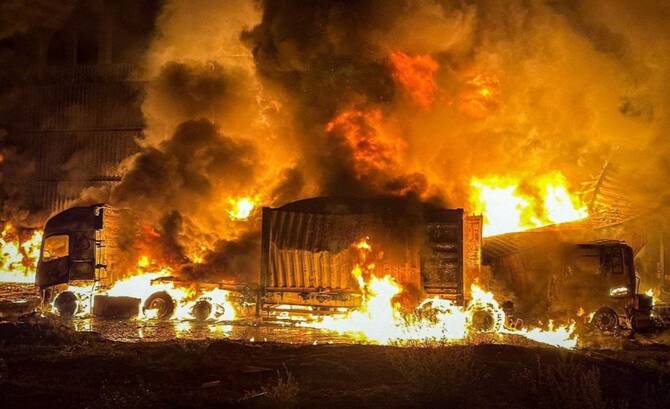
Russian drone and missile strikes wounded at least 20 people in Kyiv, damaged residential buildings and triggered blackouts across swaths of Ukraine early Friday.
Prime Minister Yulia Svyrydenko described the attack as “one of the largest concentrated strikes” against Ukraine’s energy infrastructure.
Russia’s Defense Ministry on Friday said the strikes had targeted energy facilities supplying Ukraine’s military. It did not give details of those facilities, but said Russian forces used Kinzhal hypersonic missiles and strike drones against them.
Ukraine’s air force said Saturday that its air defenses intercepted or jammed 54 of 78 Russian drones launched against Ukraine overnight, while Russia’s defense ministry said it had shot down 42 Ukrainian drones over Russian territory.
At least two people were killed and five wounded in airstrikes on Kostiantynivka, a city in Ukraine’s Donetsk region Saturday, regional Gov. Vadim Filashkin said.
Ukrainian President Volodymyr Zelensky said Saturday that he had a “very positive and productive” phone call with US President Donald Trump.
In a post on X, Zelensky said he told Trump about Russian attacks on Ukraine’s energy system, and that the two discussed opportunities to strengthen Ukraine’s air defense. “There needs to be readiness on the Russian side to engage in real diplomacy — this can be achieved through strength,” Zelensky wrote.
Ukraine’s energy sector has been a key battleground since Russia launched its all-out invasion more than three years ago.
Each year, Russia has tried to cripple the Ukrainian power grid before the bitter winter season, apparently hoping to erode public morale. Winter temperatures run from late October through March, with January and February the coldest months.
Zelensky said in his nightly address Friday that Russia was taking advantage of the world being “almost entirely focused on the prospect of establishing peace in the Middle East,” and called for strengthening Ukraine’s air defense systems and tighter sanctions on Russia.
“Russian assets must be fully used to strengthen our defense and ensure recovery,” he said in the video, posted to X.
Meanwhile, British Prime Minister Keir Starmer, French President Emmanuel Macron and German Chancellor Friedrich Merz said in a joint statement on Friday they were ready to move toward using “in a coordinated way, the value of the immobilized Russian sovereign assets to support Ukraine’s armed forces and thus bring Russia to the negotiation table.”
The statement added they aimed to do this “in close cooperation with the United States.”
Ukraine’s budget and military needs for 2026 and 2027 are estimated to total around 130 billion euros ($153 billion). The European Union has already poured in 174 billion euros (about $202 billion) since the war started in February 2022.
The biggest pot of ready funds available is through frozen Russian assets, most of which is held in Belgium — around 194 billion euros ($225 billion) as of June – and outside the EU in Japan, with around $50 billion, and the US, the United Kingdom and Canada with lesser amounts.


![]()

Power restored to 800,000 in Kyiv after major Russian strikes on Ukraine’s energy grid
Short Url
https://arab.news/by2hn
Power restored to 800,000 in Kyiv after major Russian strikes on Ukraine’s energy grid
- DTEK, said “the main work to restore the power supply” had been completed
- Svyrydenko described the attack as “one of the largest concentrated strikes” against Ukraine’s energy infrastructure


Latest updates




© 2026 SAUDI RESEARCH & PUBLISHING COMPANY, All Rights Reserved And subject to Terms of Use Agreement.