


BEIRUT: President Joseph Aoun on Saturday condemned Israeli strikes on civilian sites in southern Lebanon, which reportedly killed at least one person.
“The seriousness of the latest attack stems from the fact that it comes after the ceasefire agreement in Gaza,” he added, questioning whether Israel now sought to expand its attacks on Lebanon.
The Health Ministry said the raids killed a Syrian national and injured seven people, including two Syrian women, on the outskirts of Msaileh Al-Najjarieh, Saida.
The victim, who lived in Ain Qenia in the Hasbaya district, was identified as Hazem Kabul, a truck driver delivering vegetables from the south to other regions.
The attack also injured his sister, who was traveling with him in the truck.
In a statement, the Lebanese Foreign Ministry said that the attack “constitutes a blatant violation of UN Resolution 1701 and the ceasefire agreement, which Israel continues to disregard.”
The ministry warned that “the ongoing hostilities could hinder the Lebanese army’s national efforts to implement its plan aimed at confining weapons to the hands of the legitimate forces, and preserving security and stability in southern Lebanon.”
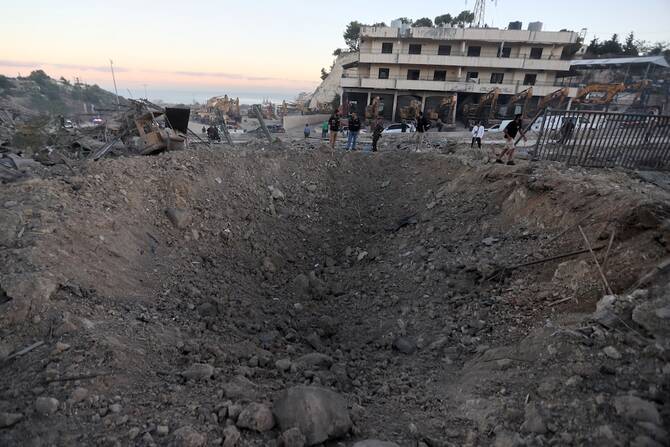
Israeli warplanes carried out 10 raids that shook neighboring towns, targeting the outskirts of the Msaileh highway leading to Al-Najjarieh and the adjacent valley, causing significant damage.

Above, heavy machinery destroyed by Israeli airstrikes in the southern village of Msayleh, Lebanon on Oct. 11, 2025. (AP)
The town is home to the residence of Parliament Speaker Nabih Berri, who negotiates on behalf of Hezbollah with foreign parties.
Al-Najjarieh’s mayor, Abbas Hallal, told Arab News that “the location of the raids is only 200 meters from Nabih Berri’s residence,” adding that he “visits the property now and then.”
Zafer Nasser, secretary-general of the Progressive Socialist Party, told Arab News that “an attack of such magnitude surely carries several messages to many recipients, one of whom might be Nabih Berri and others.”
He added: “The attacks send a clear message that nowhere in Lebanon is safe. By targeting Msaileh, they carry a direct message to Nabih Berri.”
Nasser believes that “the countries backing the ceasefire deal must stop Israel’s ongoing attacks, as it hasn’t abided by the agreement and has shown no commitment to it since the day it came into force.”
An official source told Arab News that the Foreign Ministry’s statement was clear in asserting that the attack “aims to undermine the state monopoly on arms that Lebanon is upholding and the Lebanese army is enforcing.”
But the source added at the same time that “the strike may also be a message to Parliament Speaker Berri to pressure Hezbollah into agreeing to hand over its weapons.”
The airstrikes destroyed more than 300 vehicles, including bulldozers and excavators. The showrooms that were destroyed and damaged are among the largest and most prominent heavy machinery showrooms in Lebanon.
They also caused severe damage to the power grid, shattered the windows of dozens of homes, shops, and commercial establishments hundreds of meters away from the strike site.
The targeted area is known for being a mixed region, home to people of different religious sects.
Hallal told Arab News: “The cost of the damage is estimated at around $50 million. This area is well known in Lebanon as a center for selling bulldozers and excavators, attracting buyers from all over the country.”
He confirmed that the area had “never been targeted by Israel during the recent war, nor had any warnings been issued to evacuate it.”
An unexploded missile remains at the site. The Engineering Regiment of the Lebanese Army said in a statement that “it will wait for 72 hours as the missile’s batteries are still active, after which it will be transferred to a safe location for controlled detonation.”
Public Works and Transport Minister Fayez Rasamny visited the attack site and assessed the damage on behalf of the president and the prime minister.
Interior Minister Ahmed Al-Hajjar and Labor Minister Mohammed Haidar also visited the area and toured nearby homes that sustained damage.
Rasamny described the event as a “massacre and a crime. We will confront it through our unity.”
Since the ceasefire agreement between Israel and Lebanon came into effect on Nov. 27, 2025, through US-French mediation, Israel has launched near-daily airstrikes on border areas and deep into the south, reaching as far as the Lebanese-Syrian border.
These strikes resulted in the killing of more than 200 people, including Hezbollah members and civilians, including children.
Speaking about the attack, Berri said: “Be it in its form and substance, its timing and location, or in the objectives it targeted, it will not change our convictions, our principles, or those of our people, who once again, with their lives, their homes, and their livelihoods, are paying the price for their attachment to their land and their legitimate right to a dignified life.”
Berri stated that what happened “is not an aggression against Msayleh, its residents, and the owners of its industrial facilities, but rather an aggression against all of Lebanon that targeted both Christians and Muslims.”
The Israeli military, meanwhile, claimed that it “targeted and dismantled a Hezbollah infrastructure in southern Lebanon, where engineering machinery was being used to rebuild the terrorist infrastructure.”
It noted that “the presence of this machinery, along with Hezbollah’s activity in the area, constitutes a violation of the understandings between Israel and Lebanon.”
The Israeli military claimed Hezbollah “continues its efforts to rebuild terrorist infrastructure throughout Lebanon, using the Lebanese population as human shields.”
It vowed to “continue its operations to remove any threat to Israel.”


