7.6-magnitude earthquake off southern Philippines causes damage and tsunami evacuations

1 / 4
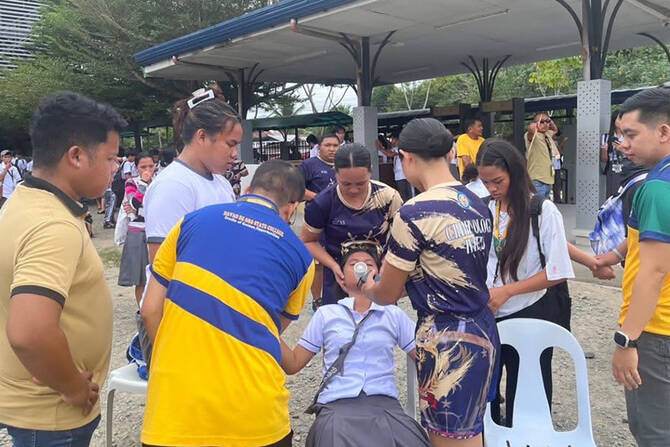
This handout photo from Golden Cornucopia - Davao de Oro State College taken and received on October 10, 2025, shows students helping a fellow student as they gather outside the school buildings after an earthquake in Davao de Oro, Mindanao. (Handout photo via AFP)
2 / 4
This handout photo from Golden Cornucopia - Davao de Oro State College taken and received on October 10, 2025, shows students helping a fellow student as they gather outside the school buildings after an earthquake in Davao de Oro, Mindanao. (Handout photo via AFP)
3 / 4
This handout photo from Golden Cornucopia - Davao de Oro State College taken and received on October 10, 2025, shows students helping a fellow student as they gather outside the school buildings after an earthquake in Davao de Oro, Mindanao. (Handout photo via AFP)
4 / 4
This handout photo from Golden Cornucopia - Davao de Oro State College taken and received on October 10, 2025, shows students helping a fellow student as they gather outside the school buildings after an earthquake in Davao de Oro, Mindanao. (Handout photo via AFP)
Short Url
Updated 10 October 2025
Follow

7.6-magnitude earthquake off southern Philippines causes damage and tsunami evacuations

  • Tsunami warnings for Philippines, Indonesia
  • Philippine provincial governor says some reports of damage

MANILA, Philippines: An offshore earthquake with a preliminary magnitude of 7.6 hit off a southern Philippine province Friday morning, sending people out of houses and buildings in panic, knocking out power and prompting officials to order villagers to evacuate from the coastlines of nearby provinces due to a possible tsunami.
President Ferdinand Marcos Jr. said the potential damage was being assessed and rescue teams and relief operations were being prepared and would be deployed when it was safe to do so.
The Philippine Institute of Volcanology and Seismology said it was expecting damage and aftershocks from the earthquake, which was centered at sea about 62 kilometers (38 miles) southeast of Manay town in Davao Oriental province and was caused by movement in a fault at a shallow depth of 10 kilometers (6 miles).


US Geological Survey illustration map

“I was driving my car when it suddenly swayed and I saw powerlines swaying wildly. People darted out of houses and buildings as the ground shook and electricity came off,” Jun Saavedra, a disaster-mitigation officer of Gov. Generoso town in Davao Oriental, told The Associated Press by cellphone.
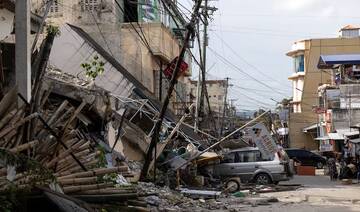
“We’ve had earthquakes in the past, but this was the strongest,” Saavedra said, adding that the intense ground swaying caused cracks in several buildings, including schools.
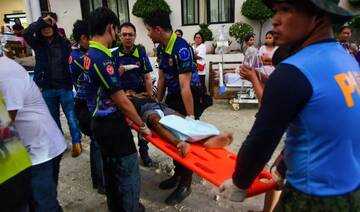
At least 50 students from a high school in his town were brought to a hospital by ambulance after either fainting or becoming dizzy due to the earthquake, Saavedra said.
Gov. Generoso is a town about 100 kilometers (62 miles) south of Manay, where classes in all levels were also suspended.
Children evacuated schools in Davao city, which has about 5.4 million people and is the biggest city near the epicenter, about 250 kilometers (155 miles) west of Davao Oriental province.
The Pacific Tsunami Warning Center in Honolulu said hazardous waves were possible within 300 kilometers (186 miles) of the epicenter. It said waves up to 3 meters (10 feet) above normal tides were possible on some Philippine coasts, and smaller waves were possible in Indonesia and Palau.


Google map showing Davao region nin Mindanao where the earthquake struck at 9:43 a.m., Philippine time. 

Office of Civil Defense deputy administrator Bernardo Rafaelito Alejandro IV warned that tsunami waves could hit six nearby coastal provinces from Davao Oriental up to two hours after the earthquake struck at 9:43 a.m. He asked people to immediately move to higher ground or further inland away from coastal areas.
“We urge these coastal communities to be on alert and immediately evacuate to higher grounds until further notice,” Alejandro said in a video news briefing.
“Owners of boats in harbors and those in the coastal areas...should secure their boats and move away from the waterfronts,” he said.
Indonesia’s Meteorology, Climatology, and Geophysics Agency said small tsunami waves were detected in North Sulawesi province with heights ranging from 3.5 to 17 centimeters (1.3 to 6.7 inches) in Melonguane, Beo, Essang and Ganalo in Talaud Islands districts. People were warned to stay away from beaches and riverbanks.
The Philippines is still recovering from a Sept. 30 earthquake with a magnitude of 6.9 that left at least 74 people dead and displaced thousands of people in the central province of Cebu, particularly Bogo city and outlying towns.
One of the world’s most disaster-prone countries, the Philippines is often hit by earthquakes and volcanic eruptions because of its location on the Pacific “Ring of Fire,” an arc of seismic faults around the ocean.
The archipelago also is lashed by about 20 typhoons and storms each year, making disaster response a major task of the government and volunteer groups.
Federal agents must limit tear gas for now at protests outside Portland ICE building, judge says

Updated 04 February 2026
Follow

Federal agents must limit tear gas for now at protests outside Portland ICE building, judge says

  • The ruling came in response to a lawsuit filed by the ACLU of Oregon on behalf of protesters and freelance journalists covering demonstrations at the flashpoint US Immigration and Customs Enforcement building

PORTLAND, Oregon: A judge in Oregon on Tuesday temporarily restricted federal officers from using tear gas at protests at the US Immigration and Customs Enforcement building in Portland, just days after agents launched gas at a crowd of demonstrators including young children that local officials described as peaceful.
US District Judge Michael Simon ordered federal officers not to use chemical or projectile munitions on people who pose no imminent threat of physical harm, or who are merely trespassing or refusing to disperse. Simon also limited federal officers from firing munitions at the head, neck or torso “unless the officer is legally justified in using deadly force against that person.”
Simon, whose temporary restraining order is in effect for 14 days, wrote that the nation “is now at a crossroads.”
“In a well-functioning constitutional democratic republic, free speech, courageous newsgathering, and nonviolent protest are all permitted, respected, and even celebrated,” he wrote. “In helping our nation find its constitutional compass, an impartial and independent judiciary operating under the rule of law has a responsibility that it may not shirk.”
Ruling follows a lawsuit filed by the ACLU of Oregon
The ruling came in response to a lawsuit filed by the ACLU of Oregon on behalf of protesters and freelance journalists covering demonstrations at the flashpoint US Immigration and Customs Enforcement building.
The suit names as defendants the Department of Homeland Security and its head Kristi Noem, as well as President Donald Trump. It argues that federal officers’ use of chemical munitions and excessive force is a retaliation against protesters that chills their First Amendment rights.
The Department of Homeland Security said federal officers have “followed their training and used the minimum amount of force necessary to protect themselves, the public, and federal property.”
“DHS is taking appropriate and constitutional measures to uphold the rule of law and protect our officers and the public from dangerous rioters,” spokesperson Tricia McLaughlin said.
Courts consider question of tear gas use
Cities across the country have seen demonstrations against the administration’s immigration enforcement surge.
Last month, a federal appeals court suspended a decision that prohibited federal officers from using tear gas or pepper spray against peaceful protesters in Minnesota who aren’t obstructing law enforcement. An appeals court also halted a ruling from a federal judge in Chicago that restricted federal agents from using certain riot control weapons, such as tear gas and pepper balls, unless necessary to prevent an immediate threat. A similar lawsuit brought by the state is now before the same judge.
The Oregon complaint describes instances in which the plaintiffs — including a protester known for wearing a chicken costume, a married couple in their 80s and two freelance journalists — had chemical or “less-lethal” munitions used against them.
In October, 83-year-old Vietnam War veteran Richard Eckman and his 84-year-old wife Laurie Eckman joined a peaceful march to the ICE building. Federal officers then launched chemical munitions at the crowd, hitting Laurie Eckman in the head with a pepper ball and causing her to bleed, according to the complaint. With bloody clothes and hair, she sought treatment at a hospital, which gave her instructions for caring for a concussion. A munition also hit her husband’s walker, the complaint says.
Jack Dickinson, who frequently attends protests at the ICE building in a chicken suit, has had munitions aimed at him while posing no threat, according to the complaint. Federal officers have shot munitions at his face respirator and at his back, and launched a tear-gas canister that sparked next to his leg and burned a hole in his costume, the complaint says.
Freelance journalists Hugo Rios and Mason Lake have similarly been hit with pepper balls and tear gassed while marked as press, the complaint says.
“Defendants must be enjoined from gassing, shooting, hitting and arresting peaceful Portlanders and journalists willing to document federal abuses as if they are enemy combatants,” the complaint states.
The owner and residents of the affordable housing complex across the street from the ICE building has filed a separate lawsuit, similarly seeking to restrict federal officers’ use of tear gas because its residents have been repeatedly exposed over the past year.
Local officials have also spoken out against use of chemical munitions. Portland Mayor Keith Wilson demanded ICE leave the city after federal officers used such munitions Saturday at what he described as a “peaceful daytime protest where the vast majority of those present violated no laws, made no threat, and posed no danger to federal forces.”
“To those who continue to work for ICE: Resign. To those who control this facility: Leave,” Wilson wrote in a statement Saturday night.
The protest was one of many similar demonstrations nationwide against the immigration crackdown in cities like Minneapolis, where in recent weeks federal agents killed two people, Alex Pretti and Renee Good.